Welcome to a weekend with FinSoar! Today I’m looking at a $900 billion valuation for Elon Musk’s SpaceX stakes, climbing bond yields as AI’s borrowing binge and Washington’s deficit struggle to compete, and China’s successful car sales abroad fall short at home:
The Bond Market Raises Rates While the Fed Sits Still
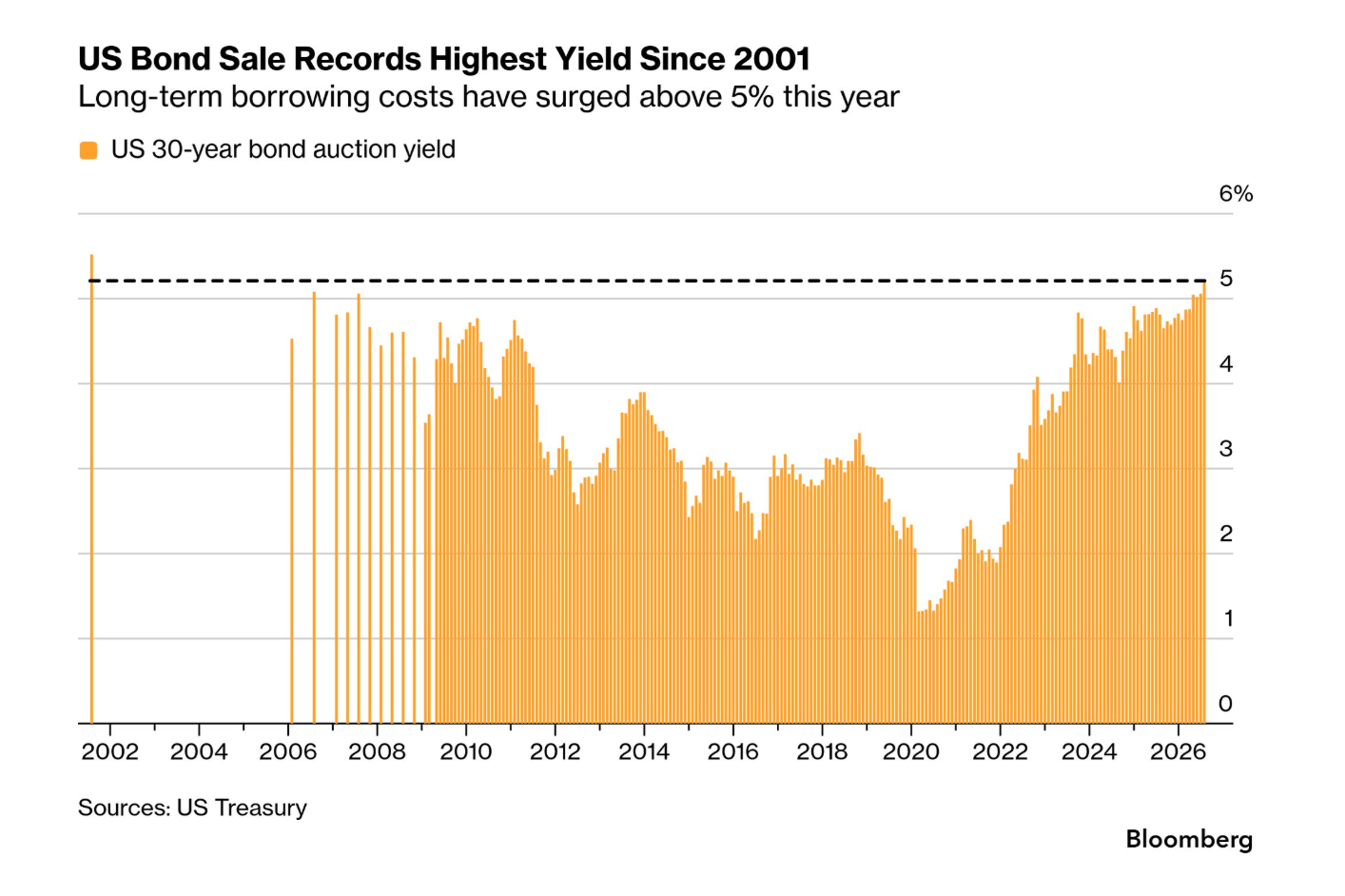
The US Treasury sold 30-year bonds on Thursday at 5.216%, the highest borrowing cost since 2001. A day earlier, 10-year notes drew the steepest yield since 2007. The Fed left rates alone last month. Bond traders did not. Several forces are pushing in the same direction. US 30-year real yields, which strip out inflation, sit near 18-year highs around 3%, with British and German real yields at decade highs. The war in Iran keeps energy prices elevated, the deficit is running near 6% of GDP, and the Fed is no longer buying bonds to hold yields down. The newest force is AI. Alphabet, Amazon, and Meta have issued almost $220 billion of bonds this year, already more than double all of 2025, to fund the data-centre buildout, competing for the same pool of long-term investors as Treasury auctions. It is a competition for capital that is relatively unprecedented. Yet the market has mostly shrugged: stocks keep hitting records on strong earnings, and one prominent bull says 4% to 5% yields are simply normal. JPMorgan lifted its S&P 500 forecast, and European profits are growing at their fastest pace since 2022. Analysts expect real yields to keep rising until they choke off the borrowing driving them. Neuberger's Ashok Bhatia says yields are not yet at the 3% to 4% zone where growth suffers, but today's level is a warning, with higher rates already meaning a 6.69% average 30-year mortgage. This week's tame inflation data helped, with CPI landing in line and July producer prices flat, trimming September hike odds. But that pressure is far from gone, because real yields are higher and likely to stay there. The AI trade is built on borrowed money, and the cost keeps climbing. |
China's Cars Are Winning Everywhere Except China
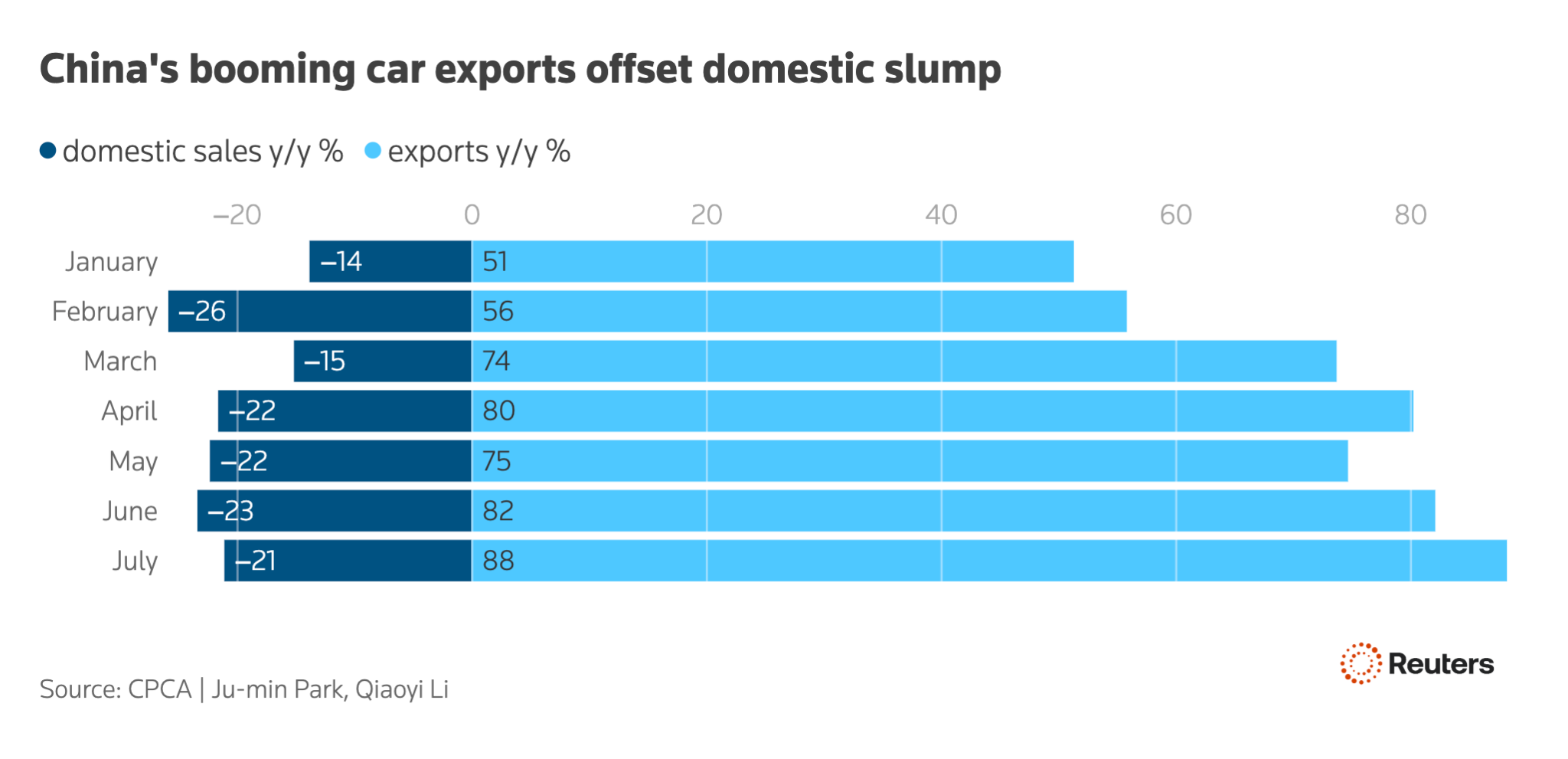
Chinese car sales fell for a 10th straight month in July, dropping 21% at home to 1.47 million vehicles. Over the same month, exports surged 88% to 923,000. The world's biggest auto market is contracting while its factories run hot for everyone else. The scale of the home slump is hard to overstate. In the first half, domestic sales fell by 2.3 million vehicles, a 20% drop equal to Japan's entire new-car market over the same period, while exports rose 71%. Two forces are draining demand at home: Beijing cut its trade-in subsidy earlier this year, shifting from a flat 15,000 yuan to 10% of price, and analysts call the result a "payback" effect that pulled future sales forward and could depress demand for up to two years. The Iran war also pushed petrol prices up over 25%, hurting gasoline-car demand, and buyers are delaying purchases, betting another price war brings cheaper deals. So the overseas push is now strategic necessity. BYD offset a 35% home slump with overseas sales up 79%, with Brazil and Britain now its biggest single markets outside China, and EV and hybrid exports alone jumped 148%. Europe is where the pressure lands hardest. Chinese brands expanded from 3% to 16% of the passenger market since early 2022, while Japanese share held flat near 12%. In EVs the gap is starker, with Chinese brands taking nearly a quarter of Europe's EV shipments to Japan's under 5%, and one forecast sees Chinese brands reaching 29% of Europe's EV market by 2030. Tariffs are the obvious defence, but carmakers are routing around them by building locally, often in underused plants owned by legacy rivals. Geely will build EVs at a Ford plant in Spain. The factories are Western; the wheel is not. |
Musk's SpaceX Stake Is Worth $900 Billion, Give or Take VestingA regulatory filing on Thursday showed Elon Musk held a 48.4% stake in SpaceX as of June 30, worth more than $900 billion at current prices. Musk quickly pushed back on the number, and the caveats matter. Musk owns 6.42 billion shares with sole voting power, split across Class A and B shares in trusts, restricted stock and options. Even below 50% economic ownership, he commands over 82% of the votes. On the valuation, he noted on X that a chunk of the shares has not vested, some only on "extremely crazy good outcomes," so the fully vested figure is lower. The backdrop is a wild first two months as a public company. SpaceX's June 12 IPO raised $85.7 billion and briefly pushed its market cap past $2 trillion, the largest listing ever. Then enthusiasm drained: shares hit a low of $105.11 earlier this month, more than half off their June peak of $225.64 and roughly 20% under the IPO price. The dip had two triggers: the first earnings report showed capital spending more than double revenue, though revenue of $7.8 billion beat forecasts, and then a lockup expired, freeing up to 911.5 million insider shares to sell for the first time. Since then, the stock has jumped 30% in August, closing Thursday at $141.29, though Musk's own shares stay locked until June 2027. The filing season also revealed who else is in. Norway's sovereign wealth fund disclosed a 0.05% stake worth about $1.2 billion, while Canada's PSP Investments holds 100,000 shares, and Ontario Teachers' held a far larger $8.7 billion position at the end of June. So the paper number is enormous and genuinely uncertain. A $900 billion stake resting on a stock that has halved, recovered, and still trades below its IPO price is a fortune measured in a currency that moves several times a day. |
That’s all for today!/
