Welcome to FinSoar! We’re looking at stagnant wage growth amid rising inflation, suspended Beef Tariffs, and a Trump-Xi summit this week:
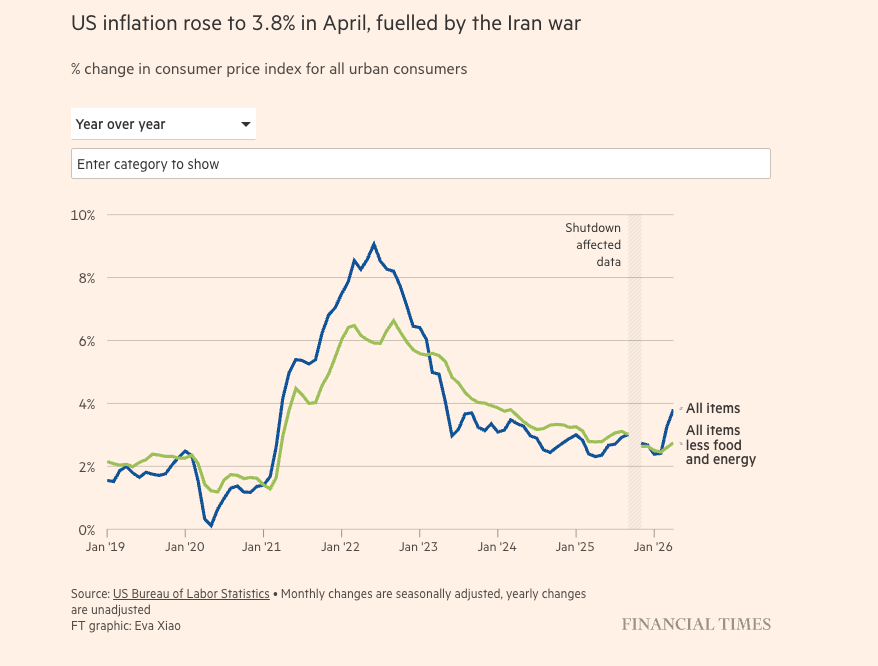
Inflation Rebreaks Above Wage Growth as Iran War Bleeds Through
US inflation accelerated to 3.8% in April, the fastest annual pace since May 2023, with Bureau of Labor Statistics data showing prices rising 0.6% on the month. Energy was the dominant driver, accounting for roughly 40% of the monthly increase. Gas prices alone surged 28.4% year over year, with the national average hitting $4.50 a gallon Tuesday per AAA, the highest since July 2022. Airfares jumped 20.7% annually as airlines passed jet fuel costs directly to passengers. Grocery prices rose 0.7% month-over-month, the largest jump in nearly four years. Beef prices climbed 14.8% over the year. Stock futures and Treasuries fell on the release, with the S&P 500 opening down 0.6%. The April CPI release marked the first time in three years that inflation outstripped wage growth. Real average hourly earnings fell 0.3% year over year, according to a separate Labor Department report, the first such decline since 2023. As Axios noted, the cushion that insulated consumers from the pandemic-era price surge has now been removed, and the job-hopping leverage workers had in 2022-23 is gone in this cycle's tepid hiring environment. Core CPI rose 2.8% annually and 0.4% monthly, with shelter up 0.6% in part due to a statistical catch-up from last fall's government shutdown. The Strait of Hormuz remains effectively closed, and Brent crude climbed 3.7% Tuesday to $108 after Trump called Iran's latest proposal "totally unacceptable" and warned the ceasefire was on "life support." KPMG's Diane Swonk told the Financial Times the war is "more than an energy shock. It is a supply chain shock that echoes the disruptions we saw during the pandemic." Diesel has hit $5.64 a gallon, near all-time highs, with second-round effects through trucking and food distribution still building. University of California economist Yuriy Gorodnichenko warned the Washington Post the moment risks repeating the 1970s. "The longer they sit on their hands now, the bigger this problem is going to be," he said of the Fed. Markets had already priced out rate cuts for 2026 heading into the report, and Bankrate analyst Stephen Kates told CNBC any cuts this year are now "highly unlikely." Kevin Warsh is expected to be confirmed as Fed chair on Wednesday, taking over from Jerome Powell on Friday. The White House has pushed publicly for cuts. Warsh will need to convince 11 other voting members of a board that hasn't shown appetite to ease. The energy shock is dictating policy direction now. |
Trump Heads to Beijing With Diminished Leverage
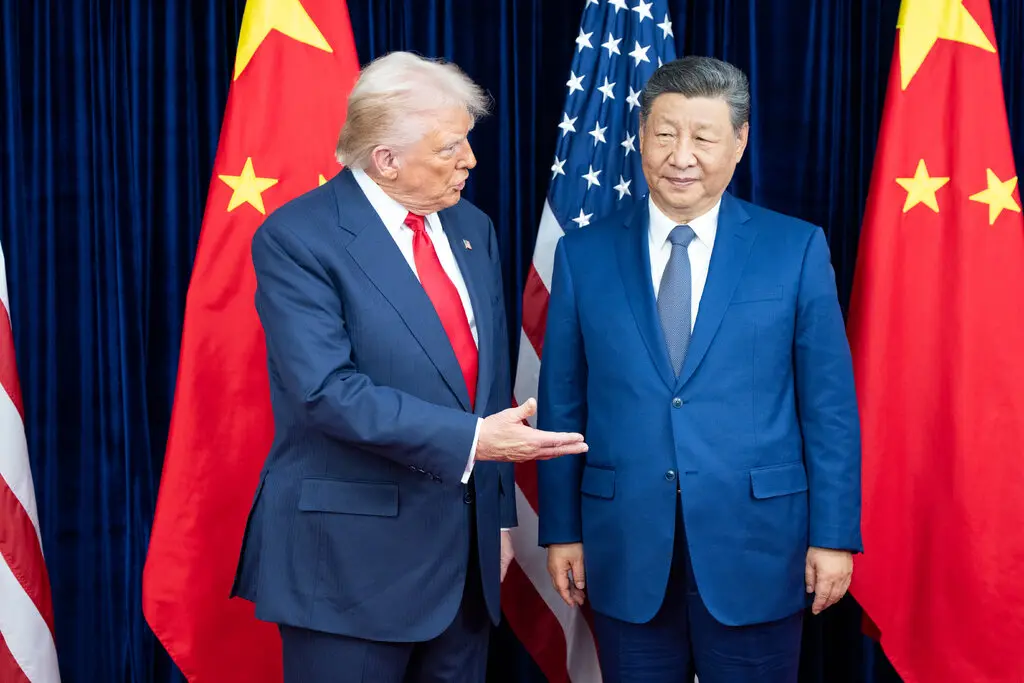
President Trump arrives in Beijing on Wednesday for his first state visit to China since 2017 and his seventh face-to-face meeting with Xi Jinping. The summit will include a Great Hall of the People ceremony, a Temple of Heaven tour, and a state banquet. The economic deliverables look modest. Reuters reported Trump's ambitions have narrowed to "a few deals on beans, beef and Boeing jets" and enlisting Chinese help to end the Iran war. Trump will be joined by Tesla's Elon Musk, Apple's Tim Cook, and Boeing's Kelly Ortberg. Notably, Nvidia CEO Jensen Huang is not on the list. The leverage picture has shifted materially since their last meeting. According to the New York Times, China is "locked and loaded" with new economic tools. Beijing has invoked a 2021 blocking measure to order five Chinese refineries to defy US sanctions tied to Iranian oil purchases. In April, China enacted rules giving regulators power to investigate corporate records, interrogate employees, and bar executives from leaving the country if found to be helping shift supply chains out of China. Control Risks' Andrew Gilholm told the Times that "we are on the brink of a much more frequent or widespread use of Chinese countermeasures against US sanctions." Iran will dominate the agenda. Nomura's Ting Lu told CNBC that "the most pressing agenda item is the Iran-Hormuz crisis." Trump needs China's leverage with Tehran. More than 60% of Americans disapprove of the Iran war, and energy-driven inflation just hit 3.8%. Beijing wants something in return. Top of Xi's list is Taiwan. The US recently announced an $11 billion arms deal with Taiwan, and Rubio confirmed Taiwan arms sales would be discussed. Fudan University professor Wu Xinbo, who advises China's foreign ministry, told Reuters that Trump should clarify the US "won't support independence or take actions that encourage a separatist political agenda." The trade picture remains complicated. China is pushing for the US to drop a recently announced Section 301 probe into unfair business practices and roll back chip export controls. The US wants more Chinese purchases of soybeans, beef, and Boeing aircraft. The Economist Intelligence Unit told CNBC those purchases will likely increase but won't recover to historical highs. Scott Kennedy of CSIS told Reuters the most probable outcome is "a superficial ceasefire that is largely to China's advantage." University of Hong Kong's Alejandro Reyes summed up the dynamic: Trump "kind of needs China more than China needs him." For markets pricing in stable supply chains and an eventual Iran resolution, a stable bilateral relationship may be enough. The harder stuff — on AI controls, rare earths, and Taiwan — is being staged for the next round. |
Beef Tariff Reversal Stalls as Ranchers Push Back
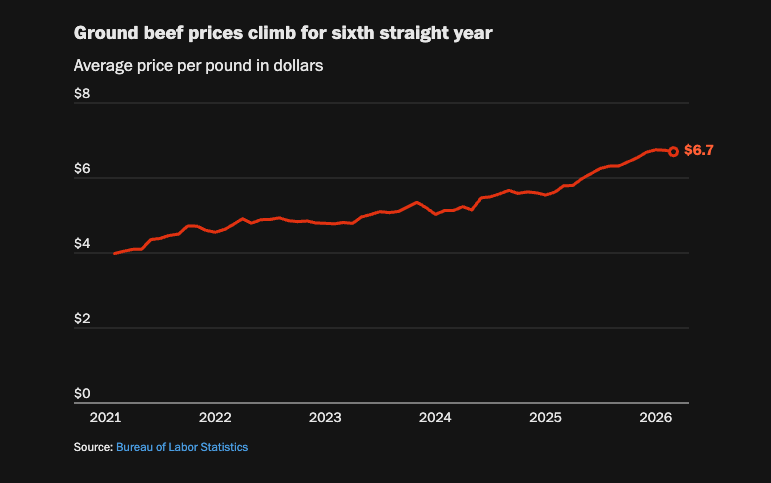
The Trump administration delayed a planned executive order on Monday that would have suspended tariff-rate quotas on imported beef, after pushback from cattle ranchers and Republican senators in cattle-heavy states. The White House had been expected to sign a pair of orders that would have lowered the 26% tariff Brazilian beef faces above quota levels, alongside measures expanding Small Business Administration loans to ranchers, rolling back Endangered Species Act protections for gray and Mexican wolves, and removing electronic ear tag requirements. A White House official said the actions had been delayed as the administration finalizes details, without specifying timing. Ground beef averaged $6.75 per pound in January, the highest on record, with prices up nearly 16% in the past year. Bloomberg reported that April broke the $7 per pound threshold for ground beef and pushed steak past $13 per pound. The US cattle herd has fallen to its lowest level since 1951 after drought across Texas, Oklahoma, and the Great Plains forced ranchers to cull breeding stock. Brazil's first-quarter beef and veal exports to the US hit nearly 400 million pounds, up from just 50 million in the same quarter of 2021, according to USDA data. The country is projected to import a record 5.8 billion pounds this year, up 25% from 2024. Ranchers are a core Trump constituency in states the party needs to hold in November. The Ranchers-Cattlemen Legal Action Fund warned that cheap imports would discourage herd rebuilding unless quotas are revisited in two to three years. Senator Cynthia Lummis told the Wall Street Journal the issue is a "challenging tightrope" and that ranchers would "lose a lot of money" if prices fall during selling season. Trump's earlier moves — authorizing expanded Argentine beef imports and removing a 40% punitive tariff on Brazilian beef — did little to bend prices, with beef up 12.1% year-over-year in April and more than 16% since Trump took office in January 2025. The downstream pressure is visible in restaurant earnings. Shake Shack shares dropped 30% last Thursday after weak Q1 earnings, with the company citing beef inflation. Chipotle flagged rising beef prices weighing on margins on its April 29 call. Restaurant Brands International, parent of Burger King, told analysts last week that "all-time high beef costs" are expected to keep pressuring the system "until at least 2027." McDonald's has been more resilient by leaning into chicken. The structural supply problem won't unwind on a midterm timeline. Even at record import levels, Texas A&M economist David Anderson told Reuters it would be "tough to have this be a huge influx of supply." The political price of inflation now collides with the political price of cheap imports. November is the deadline both sides are pricing in. |
That’s all for today!/
