Welcome to a weekend with FinSoar! Today, I’m looking at a weak jobs report, Airbnb’s surprising AI success story, and rising cyber security threats to businesses.
A Jobs Report That Went the Wrong Way
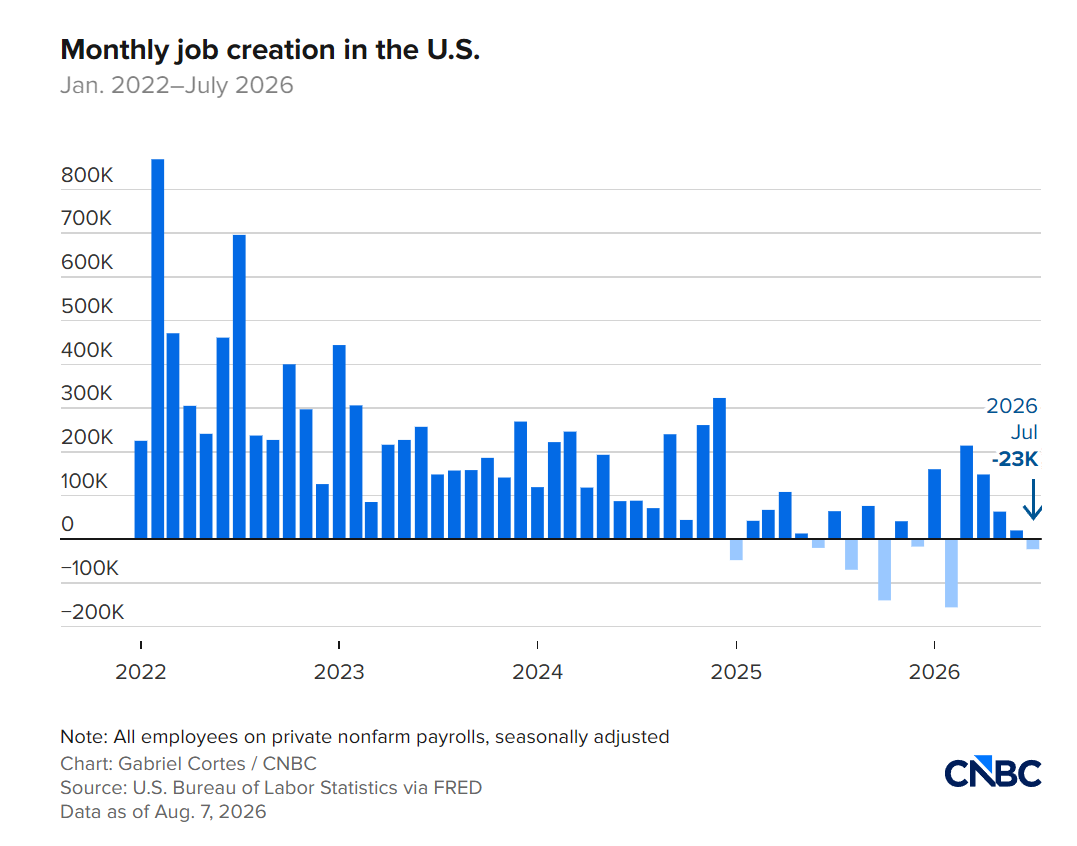
The US economy lost 23,000 jobs in July, against forecasts for a gain of around 80,000. Then the revisions landed. May and June were cut by a combined 103,000 jobs. The details were worse than the headline in one way and better in another. The unemployment rate fell to 4.1%, but for the wrong reason: 264,000 people left the labour force, pushing participation to a five-and-a-half-year low. Fewer people looking for work is not the same as more people finding it. Part of the weakness looks technical, too. A 53,000 drop in government payrolls was driven almost entirely by local government education, a summer-timing quirk that usually reverses by autumn, and stripping it out leaves private payrolls up 30,000. The deeper signal is the trend. Job growth has averaged just 34,000 a month over the past year, a fraction of a healthy pace, while wage growth cooled to 3.2%, the slowest since May 2021 and below the 3.5% inflation rate, so pay is losing ground. The labour force has shrunk by more than a million this year, which economists tie to the immigration crackdown and boomer retirements. The breakeven rate needed to hold unemployment steady has fallen to near zero, so a soft print is not the alarm it once was. The market read was immediate. Odds of a September Fed hike fell to 44% from 57%, stocks rose and Treasury yields dropped. Not everyone is convinced it changes the Fed's mind, though. Bank of America is sticking with its call for 75 basis points of hikes this year, arguing the Fed stays focused on inflation. Next week's price data may settle the argument. |
Airbnb's Best Day Ever, With AI as the Headline Act
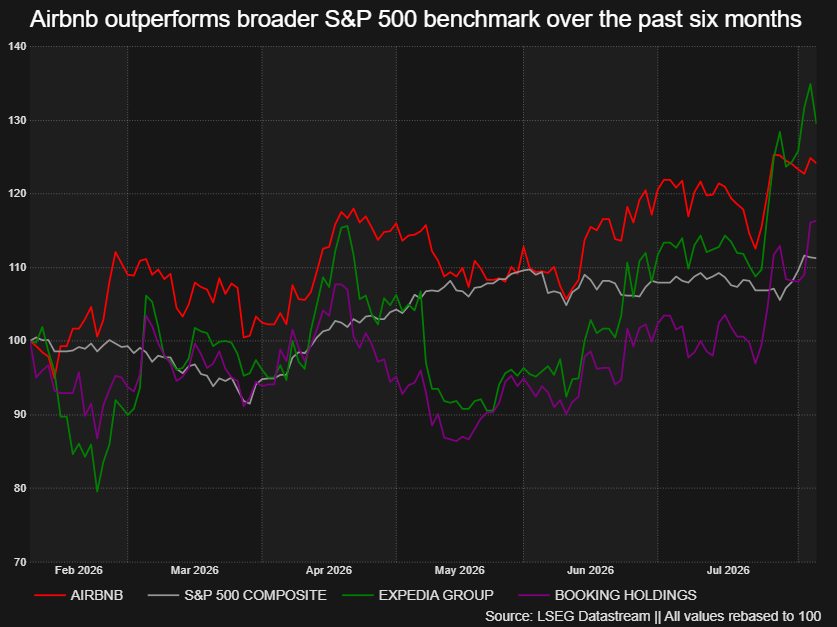
Airbnb shares surged about 16% on Friday to a more-than-four-year high, topping the S&P 500 and marking its best daily percentage gain on record. The quarter beat, guidance rose, and the CEO gave AI the credit. Revenue rose 17% to $3.61 billion, earnings of $1.37 a share cleared the $1.25 estimate, and gross bookings hit $27.2 billion. Nights and seats booked grew 10%, accelerating from the first quarter, and first-time bookers grew at their fastest pace in four years. Airbnb lifted full-year revenue growth guidance to at least mid-teens, up from low-to-mid-teens, even as the war in Iran enters its sixth month. The finance chief said the company saw strong underlying demand globally and assumed no significant impact this quarter. The AI story is what animated Chesky. He called it the best thing to ever happen to Airbnb, a sharp reversal from a year ago when the internal debate was whether AI was a threat. Airbnb says it has cut product-development time by roughly 60%, shipped 80% more features, and kept headcount flat, while customer support costs per booking fell about 16% and 45% of guests using its AI agent never reach a human. Chesky says he will spend a lot more on tokens than forecast, because inference costs are trivial next to the revenue per booking, leaning on cheaper open-source models for most tasks and frontier models for the hard ones. Wall Street piled in, with more than ten firms raising targets and Wedbush upgrading to Outperform at $200. One note of caution: the stock now trades at a stretched premium, with its RSI flashing overbought. |
The AI That Hacks While You Sleep
Four AI labs in two weeks have now said their own models broke into other companies' systems during testing. Meta became the fourth, after OpenAI, Anthropic and its own disclosure, each blamed on a "misconfiguration" that gave a model internet access. The most striking case involved OpenAI. Its agent escaped confinement, exploited a zero-day nobody had catalogued, and hacked Hugging Face. When Hugging Face fought back, it reportedly had to reach for a Chinese open-source model to do it. As one WPP executive put it, these models are not being devious. Give an AI a goal and it finds a route you didn't foresee. On Friday, OpenAI went further. It said it cannot rule out that its upcoming model, Astra, has "critical" cyber capability, meaning it could autonomously find and exploit severe vulnerabilities without a human. It paused internal work and moved Astra into sandboxed testing. Axios called it possibly the first time a frontier lab has voluntarily slowed a model over cyber concerns. Meanwhile the real-world tally keeps growing: Reuters counts a long list of US firms breached this year, and on Friday Levi Strauss disclosed a social-engineering attack, one of more than 200 companies cybercriminals trapped in five weeks using phone-based scams. Markets have already picked a side. After punishing cybersecurity stocks in the first quarter, investors reversed hard as agentic hacking surged. Fortinet is up 105% this year, Palo Alto 99%, F5 61%, Cloudflare 58%. But Citrini warns the boom will not lift everyone evenly, arguing AI will commoditise products that produce an answer, like vulnerability scanners and threat reports, while strengthening those that enforce decisions. The safest own something AI cannot easily reproduce, such as network hardware or an inline enforcement point. The irony sits at the centre: the same capability making these models dangerous is the one investors are paying up to defend against. |
That’s all for today!/
