Hi there!
Welcome to FinSoar. This week, I’m wondering how much funding it will take to see ROI from data centers, the direction for mortgages in 2026, and what TikTok’s new American ownership could mean for its creators:
Wall Street Blinks at AI's $500 Billion Bet
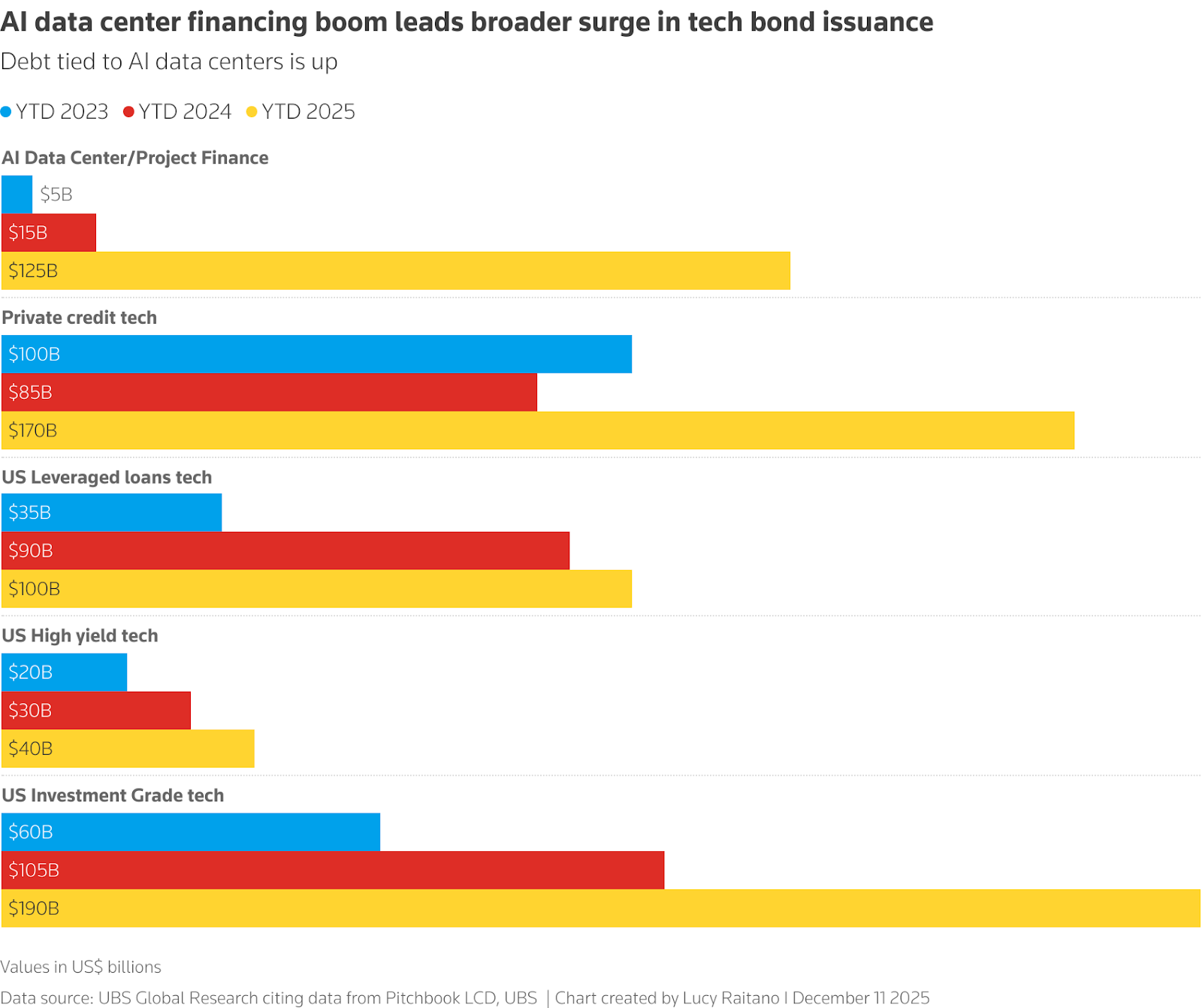
JPMorgan Chase is struggling to sell portions of $38 billion in loans it arranged for two Stargate data centers in Texas and Wisconsin. The project, a joint venture between Oracle and OpenAI, aims to build facilities worth $500 billion by the end of the decade. Interest from other banks and institutional investors has slowed. Oracle sits at the center of growing unease. The company's credit rating stands at BBB, below peers like Microsoft and Google. In November, credit default swaps on Oracle's debt hit their highest level since 2009. S&P Global affirmed the BBB rating in September but flagged a potential downgrade due to massive AI spending. A cut below BBB minus would push Oracle into junk territory. The financing challenge extends beyond one company. AI data center debt issuance surged to $125 billion in 2024 from $15 billion the prior year, according to UBS. Morgan Stanley and JPMorgan estimate the buildout could require $1.5 trillion in additional borrowing. Meta raised $30 billion in bonds this fall. Alphabet tapped markets for $25 billion. Oracle pulled off an $18 billion bond sale. Banks are approaching exposure limits. "We are hearing from market participants that in some cases, there may be banks that could be approaching the exposure levels they're comfortable with," Dhaval Shah at S&P Global told reporters. Senator Elizabeth Warren asked Treasury Secretary Scott Bessent to probe the "complex and opaque" debt markets funding AI infrastructure. Her January 22 letter cited risks to the financial system as tech companies shift from equity to debt financing. Oracle's troubles deepened when Blue Owl Capital pulled out of a $10 billion Michigan data center project. Blue Owl had backed Oracle's largest US facilities. Lenders pushed for stricter terms amid concerns about Oracle's debt levels and project delays. The breakdown leaves financing for the Michigan site uncertain. The slowdown raises questions about whether Stargate will meet its targets. OpenAI generates revenue that's a fraction of what's needed to justify the infrastructure costs. "Oracle has become a proxy for OpenAI's ability to raise significant amounts of capital," analyst Gil Luria noted. |
TikTok's New American Owners
Image Credits: Reuters TikTok closed a deal Thursday establishing a separate US entity to avoid a federal ban. The arrangement ends a five-year saga that began when Donald Trump first threatened to ban the app during his initial presidency. The structure splits ownership but not operations cleanly. Non-Chinese investors hold 80.1% of the new TikTok USDS Joint Venture. ByteDance retains 19.9%, the maximum allowed under 2024 legislation that demanded divestiture or a ban. Three investors each control 15% of the venture: Oracle, private equity firm Silver Lake, and UAE-backed MGX. Oracle will secure US user data and oversee the algorithm, which will be retrained using only American data. The company already housed TikTok's US data under a 2022 arrangement called Project Texas. Other stakeholders include Dell Family Office, run by tech billionaire Michael Dell, and Vastmere Strategic Investments, an affiliate of Susquehanna International Group. Susquehanna co-founder Jeff Yass held roughly 7% of ByteDance as of last year. Both Dell and Yass are Trump allies. The division of responsibilities matters. ByteDance maintains control of revenue-generating operations including e-commerce, advertising, and marketing. The joint venture handles backend operations, data security, and content moderation. ByteDance receives most economic benefits while the US entity provides technology and data services for a portion of revenue. Adam Presser, TikTok's former head of operations and trust & safety, will lead the venture as CEO. A seven-member, majority-American board includes executives from Oracle, Silver Lake, MGX, and TikTok CEO Shou Zi Chew. Trump thanked Chinese President Xi Jinping for approving the deal. "He could have gone the other way, but didn't," Trump wrote on social media. A White House official confirmed both governments signed off on the arrangement. The agreement drew immediate criticism. "The law requires a clean break from ByteDance. This structure doesn't meet that standard," former Treasury official Jim Secreto told NPR. "It looks more like a franchise deal that leaves TikTok's core technology in China than a true divestment." Whether US users notice changes remains unclear. The algorithm retrained on American data could affect recommendations. Experts suggest personalisation might weaken. TikTok says US creators will remain discoverable globally, and the app will maintain compatibility with other regions. |
The Mortgage Lock-In Effect Is Breaking
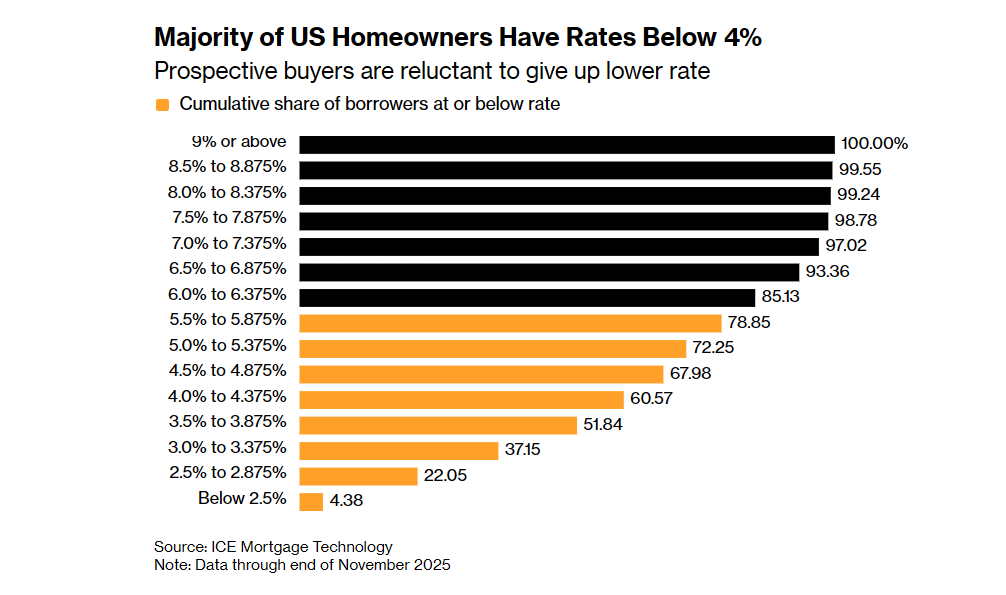
More American homeowners now have mortgage rates above 6% than below 3%, ending the lock-in effect that froze housing inventory for three years. The shift could finally bring sellers back to market. Pandemic-era borrowers with sub-3% rates peaked at 25% of all outstanding mortgages in 2021. That share has fallen steadily as new buyers take loans at current rates. Meanwhile, borrowers with rates of 6% or higher jumped from 7% in 2022 to roughly 20% by late 2025, according to analysis of Fannie Mae data by real estate investor Nick Gerli. The change matters because homeowners with rates closer to market levels have less financial incentive to stay put. "Since more existing owners have a higher rate, that means more have a payment and rate closer to market, which means there will be more incentive to sell," Gerli wrote. Each year, about 5 million to 6 million Americans take out new mortgages at current rates, gradually diluting the pool of ultra-low-rate holders. Inventory remains the central problem. Pending home sales plunged 9.3% in December to a five-month low, erasing gains since late summer. The National Association of Realtors counted 1.18 million previously owned homes on the market in December, matching the lowest level of 2025. Trump's $200 billion mortgage bond buying program has done little to change the equation. The 30-year fixed rate briefly dropped to 6.06% in January, the lowest since September 2022, before edging back up. Economists doubt the purchases will have a lasting impact. "The affordability issue when it comes to housing isn't a demand problem," David Wagner at Aptus Capital Advisors told Reuters. "There's plenty of demand there. It's a supply problem." Federal Reserve officials agree. "The biggest barrier for the housing market is supply," Minneapolis Fed President Neel Kashkari said. Atlanta Fed President Raphael Bostic noted affordability challenges are "about more than just financing." The purchases appear designed to offset the Fed's mortgage bond runoff, which totals roughly $15 billion monthly. But most analysts say the modest pace of Fed runoff creates no measurable upward pressure on borrowing costs, raising questions about why offsetting it matters. "It's mostly an exercise in burning cash," RSM chief economist Joseph Brusuelas told Reuters. "The US does not have a demand or financing problem within the housing complex. It has a supply problem." |
That’s all for today!
