Hi there!
Welcome to FinSoar. Today I’m taking a look at what softening capital rules mean, the US-Israel rift during the Iran war and gas and oil prices, and gold and silver continue to fall despite soft rebound:
Banks Win $175 Billion Giveaway as Capital Rules Soften
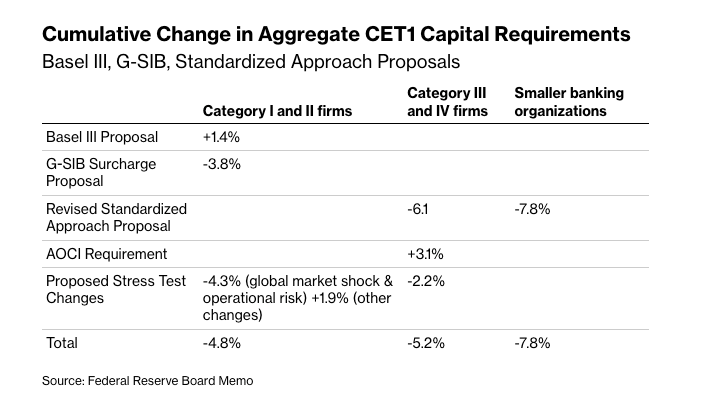
US regulators approved sweeping changes to bank capital rules Thursday that will cut requirements by 4.8% for Wall Street's biggest banks, freeing up an estimated $175 billion for lending, dividends and share buybacks. The move marks a stunning reversal from 2023 proposals that would have increased capital requirements by as much as 20%. The Federal Reserve, FDIC and Office of the Comptroller of the Currency unveiled the softened Basel Endgame rules after years of intense lobbying by the banking industry. Regional banks below $100 billion in assets will see capital requirements drop 7.8%, while larger regionals face a 5.2% decline. Fed Vice Chair for Supervision Michelle Bowman, who led the overhaul, said bank capital would remain "robust" under the changes, which better calibrate requirements to actual risks. But her Democratic predecessor Michael Barr plans to dissent, calling the changes "unnecessary and unwise." The banking industry waged an unprecedented campaign to weaken rules introduced after the 2008 financial crisis. Banks argued the original proposals would stifle lending and economic growth. The effort won over many lawmakers and created divisions among regulators, dragging the process into the Trump administration, which sided with industry. Critics warn the rollback weakens financial system safeguards just as geopolitical and private credit risks surge. Senator Elizabeth Warren said in a statement that "big banks can now declare mission accomplished" and warned the changes could make the banking system "even more prone to devastating crashes and taxpayer bailouts." Morgan Stanley analysts estimate large banks currently hold around $175 billion in excess capital. The new rules could allow banks to quickly deploy that cash. JPMorgan Chase, Bank of America, Citigroup and other major lenders stand to benefit significantly. A Fed official said the reform package would cut the amount of capital US banks need by about $117 billion from the current total of $2 trillion. The proposals now enter a 90-day public comment period, kicking off another round of lobbying as banks gain clarity on how they fare versus peers. Regulators will also propose tweaks to the "GSIB surcharge" levied on global systemically important banks by updating economic inputs and adjusting how short-term funding risk is calculated. The softened US approach diverges from stricter standards being considered in Europe, potentially giving American banks a competitive edge. European banking lobbies immediately responded by calling for the EU to water down its version of Basel standards to preserve competitiveness. |
Energy War Escalates as Israel Strikes Iran's Crown Jewel
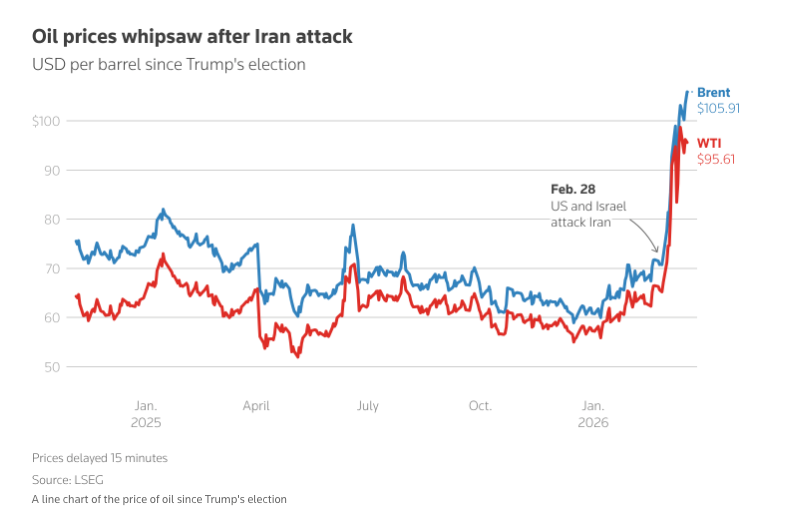
Israel's strike on Iran's South Pars gas field Wednesday marked a dangerous escalation in the three-week war, triggering retaliatory attacks across the Gulf that sent gas prices surging over 30% and raised fresh questions about coordination between Washington and Tel Aviv. The attack targeted part of the world's largest natural gas reserve, which Iran shares with Qatar. South Pars accounts for 70-75% of Iran's gas production and 90% of its domestic energy use. The field contains enough gas to supply the world for 13 years, according to Reuters. Iran retaliated swiftly, striking Qatar's Ras Laffan Industrial City with ballistic missiles. The damage reduced Qatar's LNG export capacity by 17% and will cost $20 billion annually in lost revenue, with repairs taking three to five years. Ras Laffan normally processes about a fifth of global LNG supplies. Trump claimed he "knew nothing" about the Israeli attack and told Netanyahu "don't do that" afterward. But three Israeli officials told Reuters the strike was coordinated with the US in advance. The contradiction exposes growing tensions between allies as the war's economic fallout mounts. Trump threatened to "massively blow up the entirety" of South Pars if Iran attacks Qatar's LNG facilities again, with or without Israeli consent. Netanyahu later confirmed at a press conference that Israel "acted alone" and that Trump requested no further attacks on energy targets. Iran's foreign minister Abbas Araghchi warned Tehran would show "ZERO restraint" if its infrastructure is struck again. Iran also attacked energy facilities in Saudi Arabia and the UAE, forcing Abu Dhabi to shut down its Habshan gas facility. Oil prices settled above $107 per barrel while European gas prices jumped over 10%. UK benchmark gas briefly peaked at 183p per therm before easing to 154.8p, an 11.3% increase. The strikes represent the first significant attacks on energy production facilities since the war began February 28. Qatar's prime minister warned the attacks would have "significant repercussions for global energy supplies" and called it a "very dangerous escalation." The US is now weighing lifting sanctions on some Iranian oil already at sea to ease pressure on rising prices. Treasury Secretary Scott Bessent told Fox Business the administration could remove sanctions on millions of barrels to help stabilize markets. |
Gold Crashes as Safe Haven Status Collapses
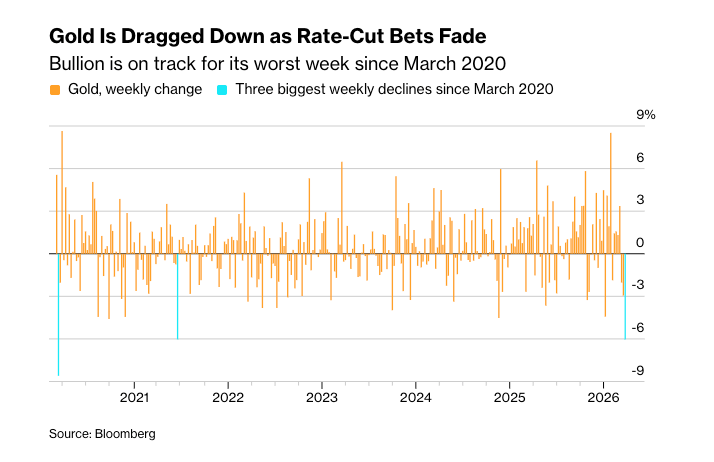
Gold and silver plunged Thursday in their steepest selloff in years, with gold falling 5.9% and silver dropping 8.2% as inflation fears from the Iran war crushed hopes for interest rate cuts. The metals are headed for their worst week since March 2020, down more than 7% for gold and 11% for silver. The collapse defies conventional wisdom that precious metals rally during conflicts. Instead, soaring oil prices have triggered stagflation concerns, with central banks signaling rates will stay higher for longer. Gold thrives when rates are low and the opportunity cost of holding the metal is minimal. Higher rates push investors toward bonds and other income-generating assets. Markets had expected two Fed cuts before the war. Now traders price zero cuts in 2026. Fed Chair Jerome Powell emphasized Wednesday that officials need to see progress on inflation before resuming rate cuts. The 10-year Treasury yield crossed 4.30% Thursday as inflation expectations surged. Individual investors are bailing. They've sold $10.5 million of SPDR Gold Shares over six straight days through midday Thursday. Gold-backed ETFs posted three weeks of outflows, with holdings falling more than 60 tons. Professional investors are cutting positions too. Trend-following hedge funds that use algorithms to spot price patterns have been "reducing positions significantly" according to Société Générale. Some investors are liquidating gains to cover losses elsewhere, including margin calls from slumping stocks. The stronger dollar compounds pressure. Gold becomes more expensive for buyers using other currencies when the dollar appreciates, further dampening demand. Industrial metals suffered similar fates. Copper fell 2% and palladium dropped 5.5%, signaling recession fears. Copper's decline typically indicates slowing economic growth, as the metal is used in electronics, wiring and plumbing. The selloff echoes 2022, when Russia's Ukraine invasion caused an energy shock. Gold fell for seven straight months through October that year, the longest losing streak on record. Despite the crash, gold remains about 8% higher in 2026 after touching a record just below $5,600 in late January. Silver peaked above $120 before the rally ended. Some analysts see opportunity. "If the war grinds on, market focus would likely shift from inflation concerns to recession risks," said JPMorgan's Yuxuan Tang. In that environment, "gold's safe-haven properties could once again come to the fore." |
That’s all for today!/
Unlock The $4 Trillion Rent Roll: Compound Your Wealth Like the 1%

Institutional giants use the $4 trillion rental market to compound millions. Now you can too. mogul offers fractional ownership in elite rental properties with 18.8% average IRR and zero property management required. Secure your share of the wealth Wall Street once kept for itself.
Past performance isn't predictive; illustrative only. Investing risks principal; no securities offer. See important Disclaimers
