Welcome to another week with FinSoar! This week, a SpaceX competitor emerges, gold might be replacing the dollar, and oil prices are set to fall as the Strait of Hormuz reopens:
Central Banks Are Pulling Back From the Dollar for the First Time
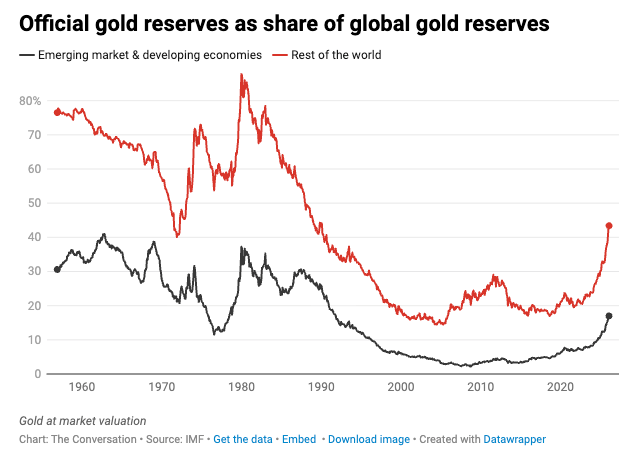
For the first time, more of the world's central banks plan to cut their dollar holdings than increase them over the coming decade, according to a new OMFIF survey of public investors. The London-based think tank found the shift among 90 central banks, pension funds, and sovereign funds overseeing about $10 trillion in assets. It is the first time the survey has recorded such a move away from the dollar. The findings feed a broader debate about the dollar's role as the primary reserve currency, stoked by US policy uncertainty and heightened geopolitical tensions. Some 79% of central banks said the global monetary system is moving toward a "multipolar" world. The dollar is not collapsing, though. There is no clear alternative, and it has rallied 3% this year on higher US interest rates and safe-haven demand from the US-Iran war. Smaller currencies like the Norwegian crown, New Zealand dollar, and sterling are gradually gaining ground. Gold is the clear winner. A historic rally has pushed bullion to 27% of global central bank reserves at the end of 2025, up from 20% a year earlier, overtaking US Treasuries, which fell to 22% from 25%. Dollar assets as a whole still lead at 42%. The buying has been sustained, with central banks purchasing an average of 1,000 tonnes a year over four years, double the prior decade's pace, lifting official holdings above 36,000 tonnes, the most since 1975. The motive goes beyond returns. Research ties the accelerated buying to the rising use of financial sanctions. After Russia's reserves were frozen in 2022, China, Turkey, and India ramped up purchases of an asset with no national ties. Around 37% of emerging-market central banks cited sanctions concerns directly. Still, foreign investors hold $33.7 trillion in long-term US securities, with US stocks the largest share. Even Turkey, a major gold buyer, sold or loaned 130 tonnes after the Iran war began, showing bullion can be drawn down in a crunch. |
Rocket Lab Becomes a SpaceX Competitor: Buys Iridium for $8 Billion
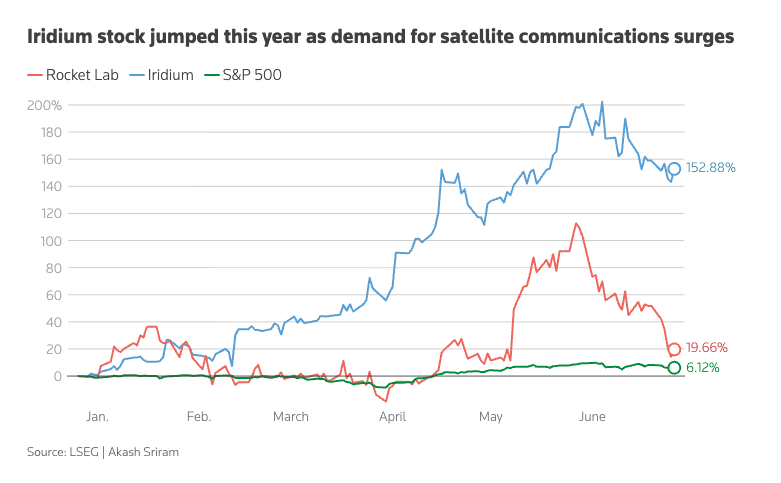
Rocket Lab agreed to acquire satellite communications provider Iridium in a cash-and-stock deal worth about $8 billion, one of the biggest consolidation moves the commercial space industry has seen. Iridium shareholders will receive $27 in cash plus Rocket Lab shares, a combined $54 per share and a 24.1% premium to the prior close. The deal is expected to close in mid-2027. The market loved it. Rocket Lab shares jumped nearly 16% to close at $97.95, while Iridium soared more than 25% to $54.59, slightly above the deal price. Other satellite operators rallied too, with Viasat up almost 24% and AST SpaceMobile up 21%. This purchase is in line with SpaceX's growth strategy. The acquisition combines Rocket Lab's launch vehicles and satellite manufacturing with Iridium's global L-band network, licensed spectrum, and more than 2.5 million subscribers across government, defense, aviation, and maritime markets. CEO Peter Beck thinks it's a time-saver. Buying Iridium lets Rocket Lab sidestep three big hurdles to building a comms business: securing spectrum, the long lead time to deploy infrastructure, and the years needed to build a customer base. "We've found a shortcut," the company said in an investor presentation. Spectrum is the prize, but not the only one. William Blair's Louie DiPalma noted Iridium also brings navigation technology, flight tracking, and Defense Department contracts. The existing business already generates cash, with Iridium posting $114 million in net income last year on $872 million in revenue. Rocket Lab secured a $3.6 billion bridge loan from Deutsche Bank and Wells Fargo for the cash portion, plus cash on hand and additional debt and equity. The deal fits a broader wave. Globalstar agreed to an Amazon takeover in April, SES absorbed Intelsat, and SpaceX itself bought spectrum from EchoStar. As Iridium CEO Matt Desch told the WSJ, "the real winners are going to be those who are vertically integrated." Investor appetite has surged since SpaceX's $86 billion IPO this month. At a $55 billion market value, Rocket Lab is still a fraction of SpaceX's $2 trillion. But the Iridium deal buys it a profitable network, coveted spectrum, and a customer base in one move. |
Oil Heads for Its Worst Quarter Since 2020
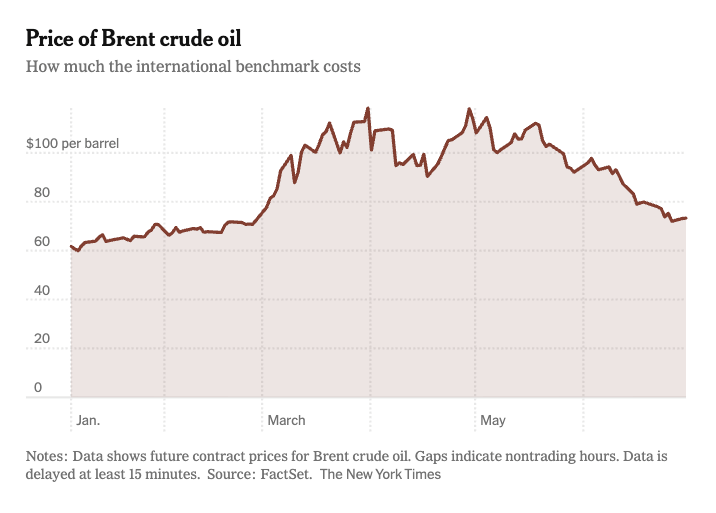
Oil prices are set for their steepest quarterly drop since the pandemic, as traders weigh fragile US-Iran talks against a fast-recovering supply picture. Brent crude was down about 38% for the quarter and roughly 20% in June alone, with WTI off about 30% over the quarter, both near where they traded just before the war began. The June slide alone was steep. Brent ended the month roughly $19 lower, a 20% fall from the May close, while WTI dropped about $16, or 19%. The diplomacy is murky. Trump said Monday that talks would happen in Qatar Tuesday, claiming Tehran "requested a meeting" after weekend strikes. Iran's Foreign Ministry denied any talks were scheduled. US envoys Jared Kushner and Steve Witkoff arrived in Doha but were set to meet mediators, not Iranians directly. A Qatari official confirmed the gap. Top US envoys would not hold a high-level meeting with Iran, with only technical talks on regional security planned. The sell-off has surprised analysts. ING strategists said the market is treating the temporary ceasefire as a permanent deal, which it is not, warning the situation can change very quickly. Reaching a permanent deal on the nuclear issue within 60 days, they added, looks optimistic. Supply is the bigger driver. Shipping through the Strait of Hormuz has rebounded, with 40 ships transiting Monday, up from 24 a day earlier. The recovery is gaining pace. Goldman Sachs estimates flows have reached nearly 80% of prewar levels, and could fully normalize to 23 million barrels per day by late July, leading to a "modest surplus" a month later. Morgan Stanley models a 4.8 million barrel-per-day global surplus in 2027. Pump relief is lagging but real. US gas averaged $3.86 a gallon Monday, down from a mid-May peak of $4.48 but still above the $2.98 seen February 28. Analysts caution that with the Strategic Petroleum Reserve at its lowest since the Reagan era, prices may not hit prewar levels until 2027. |
That’s all for today!/
