Hi there!
Welcome to FinSoar. Today, we await the Fed’s final meeting for 2025, the President’s Farmer bailout — not the first of its kind — and the shocking developments in China and U.S. chip wars:
The Fed's Final 2025 Act: A Rate Cut Nobody Trusts
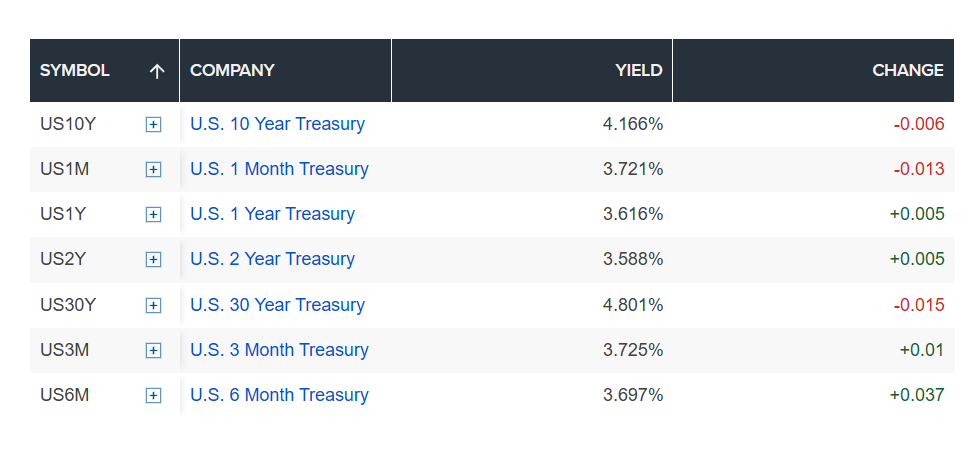
Source: CNBC The Federal Reserve concludes its final meeting of 2025 on Wednesday with markets pricing in a 90% chance of a quarter-point rate cut. That would bring the federal funds rate to 3.50% to 3.75% and mark the third consecutive cut. But nobody knows what happens next. The Fed is flying blind. The record-long government shutdown wiped out critical data: October's consumer price index, October's unemployment rate, and November's jobs report won't be released in time for the meeting. The Fed will lean on last-minute reports like JOLTS and the employment cost index, both dropping just before the decision. The FOMC is sharply divided. Roughly half the committee sees a labor market weakening enough to justify more cuts. The other half worries about stoking inflation and inflating stock market bubbles. Jefferies analysts expect "at least two hawkish dissents" and possibly dovish ones too. The FOMC hasn't had three or more dissents since 2019. Wall Street is watching for four specific words from Powell: "in a good place." If he uses that phrase, it signals no January cut. If he says rates are "modestly restrictive" or "somewhat above neutral," the door stays open for early 2026 cuts. The labor market tells a grim story. Employers announced 71,000 job cuts in November, up 24% from last year, citing AI and restructuring. Challenger, Gray & Christmas reported employers cut more than 1.1 million jobs through November, the most since 2020 and a 54% increase year over year. Goldman Sachs estimates job growth is now below the "breakeven" rate. Mortgage lenders may have already priced in this week's cut. The average mortgage rate fell to three-year lows in September and October hours before the Fed officially cut rates. The bigger question is 2026. Markets expect the Fed to hold rates steady at the January 27-28 meeting, with economists seeing a 62% probability of no change. Powell's term ends in May, and Trump will likely nominate a new chair in January who favors aggressive cuts. The dollar held steady ahead of the meeting, while 10-year Treasury yields ticked up to 4.168%.
|
Trump Sells China the Keys to the AI Kingdom (For a 25% Cut)
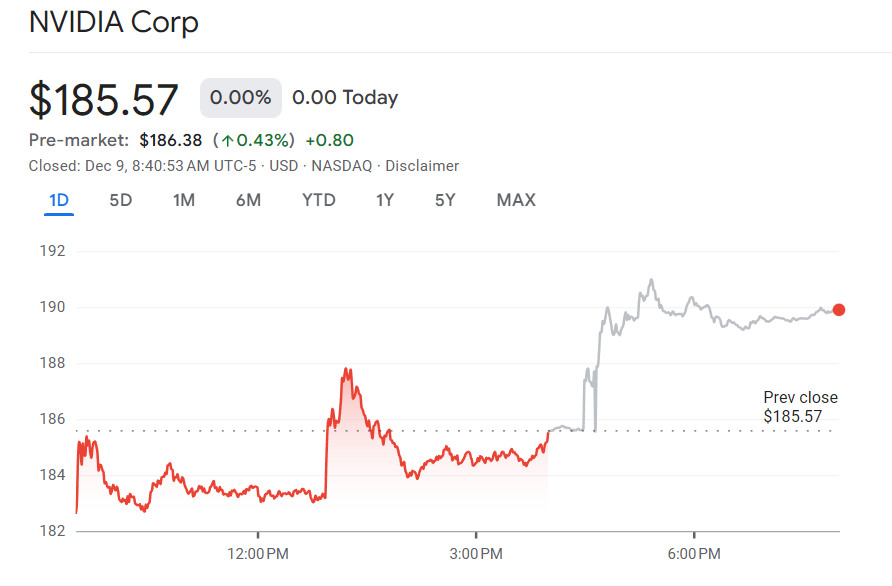
Source: Google Finance Trump announced Monday that Nvidia can ship H200 AI chips to "approved customers" in China under conditions where 25% of sales go to the U.S. government. The decision reverses years of Biden-era export controls designed to keep advanced semiconductor technology out of Chinese hands. Trump posted on Truth Social that President Xi "responded positively" to the deal. The timing was remarkable. Hours earlier, the Justice Department announced it had busted a China-linked smuggling network that trafficked or attempted to traffic more than $160 million in export-controlled Nvidia chips. Two Chinese men were detained, while a Houston company and its owner already pleaded guilty to routing Nvidia hardware through shell buyers. The operation exposed efforts to funnel H100 and H200 chips to China between October 2024 and May 2025. The backlash was swift. Democratic senators called it a "colossal economic and national security failure" and warned it would give Chinese companies an edge in AI. Former Biden NSC official Chris McGuire said it "negates the biggest U.S. advantage over China in AI" and called it "a significant strategic mistake." Georgetown's Rush Doshi warned: "By giving this up, we increase the odds the world runs on Chinese AI." The H200 represents a massive upgrade. While not Nvidia's most advanced chip, it's nearly 10 times more powerful than what China could legally access and at least two generations ahead of anything Chinese companies can produce. Huawei admits it can't build a chip better than the H200 for at least two years. But China may not play along. Beijing is discussing ways to limit access to the H200, requiring buyers to go through an approval process and explain why domestic chips won't work. The government may ban China's public sector from buying H200s. Beijing has pushed companies to use domestic chips and warned that Nvidia's products carry security risks. Nvidia CEO Jensen Huang lobbied Trump for months and attended the White House dinner for Saudi Crown Prince Mohammed bin Salman. Huang has pledged $500 billion in U.S. AI infrastructure investment over four years. Nvidia stock rose 1-2% after the announcement. |
Trump's $12 Billion Farm Bailout: Trading Markets for Handouts
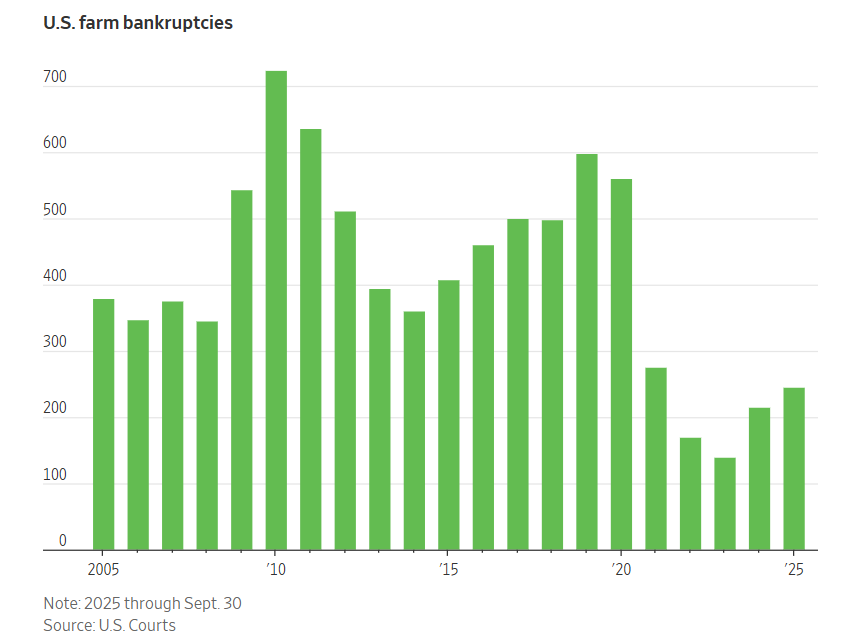
Source: WSJ Trump announced a $12 billion farm aid package on Monday, bailing out the same farmers crushed by his trade war with China. The money comes as American agriculture faces what some call the worst crisis since the 1980s. $11 billion goes to row crop farmers through one-time payments via the Farmer Bridge Assistance program, with another $1 billion reserved for specialty crops. Funds will be distributed by the end of February. Individual farmers can receive a maximum of $155,000 and must have an adjusted gross income below $900,000. The damage is extensive. Farm bankruptcies rose nearly 50% through the first nine months of 2025 compared to the same period in 2024. Soybean farmers expect their third consecutive year of losses. Crop prices remain depressed after harvesting the largest crop on record this fall, while costs for fertilizer and seeds have soared. China is the root cause. After Trump imposed tariffs, China stopped buying American soybeans for months, effectively cutting imports from their usual 29 million metric tons annually to zero until an October deal. China agreed to buy 12 million metric tons this year and 25 million metric tons annually for the next three years. But so far China has purchased only about 20% of what it promised, and Treasury Secretary Scott Bessent acknowledged China used farmers as "pawns" in trade negotiations. This isn't new. Trump gave about $23 billion in aid to farmers during his first term, also because of his trade policies. Farmers are set to receive near-record $40 billion in government payments this year. Democrats slammed the bailout. "The easiest way to give our farmers more certainty would be for the president to end his tariff taxes," said Senator Amy Klobuchar. Missouri farmer Bryant Kagay called it "crazy" that everyone is excited about a deal that merely gets farmers back to where they were before the trade war. Trump also threatened a 5% tariff on Mexico over violations of an 80-year-old water treaty, demanding 200,000 acre-feet of water for Texas farmers by December 31. |
That’s all for today!
