In partnership with

Hi there!
Welcome to FinSoar. You can now bet on political assassination, U.S. oil and gas prices are at an all-time high, and job losses are exposing the broken labor market for what it is:
$54 Million Bet on Khamenei Sparks Prediction Market Scandal
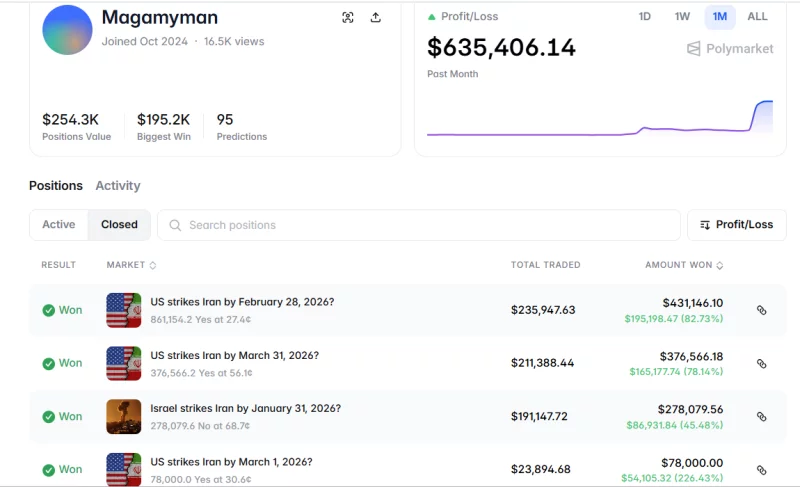
Prediction markets erupted in controversy after Iran's Supreme Leader Ayatollah Ali Khamenei was killed in US-Israeli strikes Saturday. Traders on Kalshi had wagered $54 million on whether Khamenei would be "out as Supreme Leader" by March or April. When he died, bettors assumed they'd won. Instead, Kalshi froze the market, citing rules banning transactions "directly tied to death." The platform paid users based on the last traded price one minute before bombs fell on Tehran. CEO Tarek Mansour said the "death carveout" had always existed, but acknowledged the user experience "could have been clearer." The company incurred a $2.2 million loss, reimbursing fees and net losses. Users exploded with anger. "I was booking my trip to Courchevel," one executive who'd bet $3,460 told The Washington Post, expecting $63,000 in payouts. "Then they changed the rules, and everybody got screwed." Traders flooded social media vowing to close accounts, with one saying, "You owe me $2,500+." Rival platform Polymarket, which operates offshore using cryptocurrency, took a different approach. It did not freeze its $61 million in trades on Khamenei being "out as Supreme Leader" by month's end. A user known as "Magamyman" made $553,000 betting on Iran and Khamenei just before the strikes. The trades triggered insider trading concerns. Analytics firm Bubblemaps identified six suspected insiders who made $1.2 million betting on a US strike by Feb. 28, the exact date of Operation Epic Fury. All accounts were created in February and bet exclusively on Iran timing. One account bet $26,000 and won over $200,000. Senator Chris Murphy called the trades "insane" and vowed to introduce legislation "ASAP to ban this." He said, "people around Trump are profiting off war and death." The White House denied anyone in Trump's orbit was behind the trades, though Donald Trump Jr. serves on Polymarket's advisory board and his venture firm invested millions. Senators Jeff Merkley and Amy Klobuchar introduced legislation on Thursday banning the president, vice president, and Congress members from trading event contracts. The bill imposes fines starting at $10,000 for violators but has no Republican co-sponsors. Six Democratic senators sent a letter in February urging the CFTC to prohibit contracts that "resolve upon or closely correlates to an individual's death." Amanda Fischer, former SEC chief of staff, said, "How is an 86-year-old theocratic leader supposed to lose his power other than through death?" Kalshi has over 67,591 words of rules across 180 pages. The company filed an update Monday proposing to standardize how it handles bets when a person dies, paying out at odds just before death was "reasonably anticipated by market participants." The rule takes effect on March 17. Bloomberg Opinion columnist Paul Davies wrote that "allowing these kinds of bets with the possibility of insiders is not just bad, it's dangerous." He argued platforms should "just cease making markets in military action and war." Combined weekly volumes on Kalshi and Polymarket exceeded $5 billion at February's end. |
Oil Hits $89 as Trump Scrambles to Contain Self-Inflicted Crisis
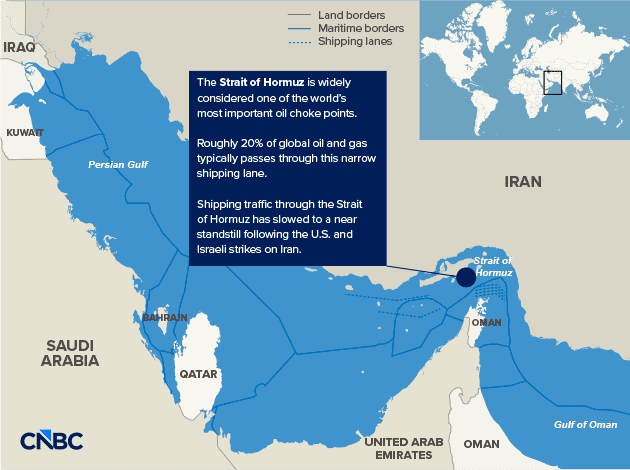
Oil surged toward $90 on Friday as the Iran war entered its seventh day, with Brent crude climbing 4.5% to $89.23 per barrel and WTI jumping 6.3% to $86.06. Prices are on track for their biggest weekly gain since Russia's invasion of Ukraine in early 2022, up more than 18% since strikes began Saturday. The Strait of Hormuz, which carries 20% of global oil and 20% of natural gas, remains effectively closed. Qatar's energy minister warned that Gulf producers could stop exports within days and oil could hit $150 per barrel if tankers can't pass through the strait. US gasoline prices jumped to $3.32 per gallon Friday, the highest since September 2024. Prices have surged 34 cents or 11% in one week. Diesel climbed even faster to $4.33 per gallon, the highest since November 2023. Rising transport costs threaten to cascade through supply chains, affecting everything from food to electronics. Trump faces a problem of his own making. The president said he had "no concern" about rising prices, saying "they'll drop very rapidly when this is over." But the administration is scrambling for solutions. Treasury Secretary Scott Bessent said the department would announce measures Thursday to combat rising energy prices, including potential action involving oil futures markets. Such intervention would be unprecedented for the world's largest oil producer. The administration says "everything is being considered", including tapping the Strategic Petroleum Reserve, waivers of fuel-blending requirements, and Treasury trading oil futures. Trump announced plans Tuesday to provide insurance guarantees and naval escorts for tankers through the Strait of Hormuz. The SPR problem complicates matters. The reserve contains 415 million barrels, about 20 days of total US consumption, well below its 714 million barrel capacity. Biden released 180 million barrels starting in 2021 as prices rose. Trump failed to refill it despite vowing in his inauguration speech to "refill our reserves right up to the top." Markets reflected stagflation fears. Treasury yields rose for the fifth consecutive day, with 10-year yields up 3 basis points Friday to 4.173%. Money market traders slashed Fed rate cut expectations to 30-35 basis points this year from roughly 55 basis points a week ago. European traders now expect the ECB to raise rates by year-end. |
US Economy Sheds 92,000 Jobs as Labor Market Cracks
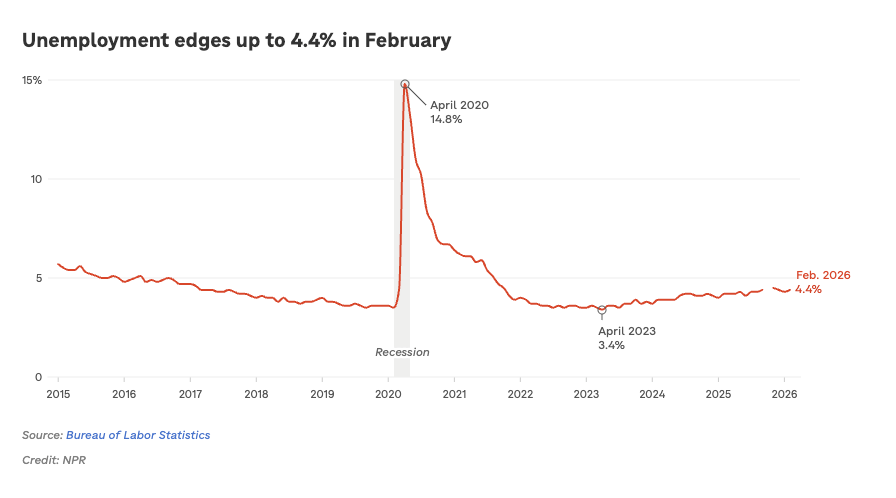
The US economy lost 92,000 jobs in February, defying expectations for 50,000 gains and marking the largest monthly decline since October. The unemployment rate ticked up to 4.4% from 4.3%. Job gains for December and January were revised sharply lower, with December now showing a loss of 17,000 positions. February marked the third time in five months that payrolls declined. With revisions, 2025 became the first year to record five months of labor market contractions since 2010, as the economy recovered from the financial crisis. Job losses hit nearly every sector. Healthcare, typically a growth driver, shed 28,000 positions due largely to a strike at Kaiser Permanente that sidelined more than 30,000 workers in Hawaii and California. The strike has since been resolved. Information services lost 11,000 jobs as AI-related cuts continued. Manufacturing dropped 12,000 despite tariffs aimed at reshoring production. Federal government employment fell 10,000 in February. Since peaking in October 2024, federal payrolls have dropped 330,000 or 11% of the total workforce as Trump's administration pares headcount. Transportation and warehousing shed 11,000 positions. Social assistance was one of the few sectors posting gains, up 9,000. Manufacturing has struggled throughout Trump's second term. The US lost 83,000 manufacturing jobs during his first year despite pledges to revive the sector through tariffs. Factory employment has fallen in all but one month since Trump returned to the White House. Wages rose despite weak hiring. Average hourly earnings increased 0.4% for the month and 3.8% year-over-year, both 0.1 percentage point above forecast. But the labor force participation rate fell to 62%, its lowest since December 2021. The report puts the Fed in a difficult position. San Francisco Fed President Mary Daly told CNBC, "I think it just tells us that the hopes that the labor market was steadying, maybe that was too much. We also have inflation printing above target and oil prices rising." Stocks fell sharply on Friday, with the Dow dropping more than 900 points at the open. Traders pulled forward expectations for the next rate cut to July. Morgan Stanley's Ellen Zentner said, "Today's numbers may have put the Fed between a rock and a hard place." Significant labor market weakening would support a rate cut, but higher oil prices risking another inflation surge may compel the Fed to stay on the sidelines. |
That’s all for today!
Become An AI Expert In Just 5 Minutes

If you’re a decision maker at your company, you need to be on the bleeding edge of, well, everything. But before you go signing up for seminars, conferences, lunch ‘n learns, and all that jazz, just know there’s a far better (and simpler) way: Subscribing to The Deep View.
This daily newsletter condenses everything you need to know about the latest and greatest AI developments into a 5-minute read. Squeeze it into your morning coffee break and before you know it, you’ll be an expert too.
Subscribe right here. It’s totally free, wildly informative, and trusted by 600,000+ readers at Google, Meta, Microsoft, and beyond.
