Hi there!
Welcome to FinSoar. The Strait of Hormuz remains closed for everyone other than a select few, as US allies reject Trump’s call for help, and markets speculate rate cuts and hikes ahead of the Fed meeting.
Allies Reject Trump's Hormuz Demands as Costs Explode
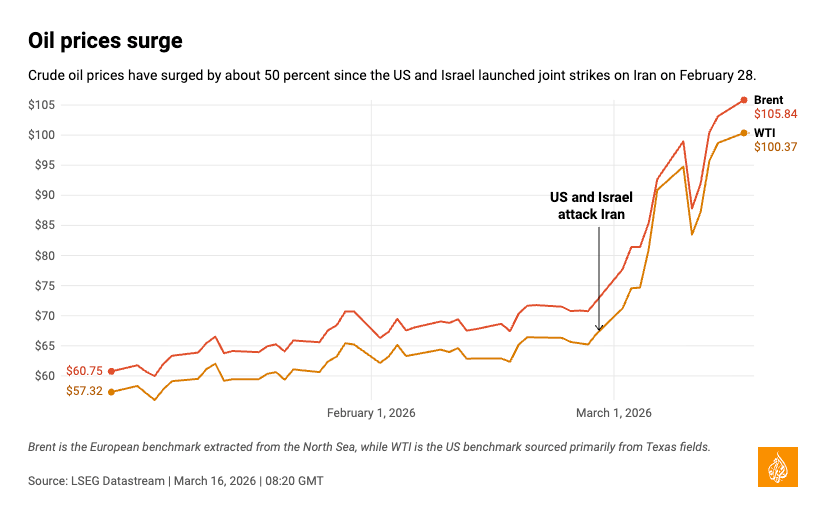
President Trump's demand for allies to send warships to the Strait of Hormuz met near-universal rejection Monday as insurance costs to cross the waterway hit unprecedented levels. Germany, the UK, France, Japan, and Australia all refused to participate in a naval coalition to reopen the vital shipping lane that carries 20% of global oil. "Some are very enthusiastic, and some are less than enthusiastic," Trump told reporters on Monday, declining to name which countries agreed to help. "I assume some will not do it. I think we have one or two that will not do it that we've been protecting for about 40 years." UK Prime Minister Keir Starmer said reopening the strait "will not be easy" and insisted Britain would "not be drawn into the wider war." German Chancellor Friedrich Merz said Berlin would not participate "as long as the war continues," noting the US and Israel did not consult Germany before attacking Iran. Japan's Prime Minister Sanae Takaichi told the parliament that "no decision has been made" about sending escort vessels. France said it would only deploy ships once hostilities cease. Australia ruled out sending warships entirely. The rejections compound an economic nightmare. Insurance costs to cross Hormuz soared to 5% of a vessel's value, meaning a $100 million oil tanker now costs $5 million to insure, five times higher than early March. At least 20 ships have been involved in security incidents since March 1st. Bank of America and Standard Chartered raised 2026 oil forecasts on Monday, with BofA lifting Brent to $77.50 from $61 and Standard Chartered to $85.50 from $70. Nearly 200 million barrels of crude have been choked off from markets. Standard Chartered estimates 7.4-8.2 million barrels per day offline across Iraq, Saudi Arabia, UAE, Qatar, and Kuwait. Iran has allowed selective passage for certain nations. Pakistan, India, and Turkey have gotten ships through after negotiations. Iran's foreign minister said the strait is "open to all except the US and its allies." Tehran is using access as leverage, with some ships requiring permission from Iranian authorities. The global economic damage is mounting. At least 85 countries reported petrol price increases since February 28, with Cambodia up 68%, Vietnam 50%, and Nigeria 35%. Pakistan imposed a four-day workweek. Myanmar mandated alternate-day driving. Sri Lanka requires QR codes to purchase fuel. Global stocks have fallen 5.5% since the war began, with Tokyo's Nikkei down 11% and India's Nifty50 down 7%. Airlines face surging costs as jet fuel hit $150-200 per barrel from $85-90 before the war. Financial Times columnist Gideon Rachman wrote that even if Iran relaxes its grip short term, "it can tighten it again in the future." The regime has discovered "a powerful future deterrent that is quite independent of nuclear weapons." |
Fed Faces Worst Nightmare as Zero-Cut Year Looms
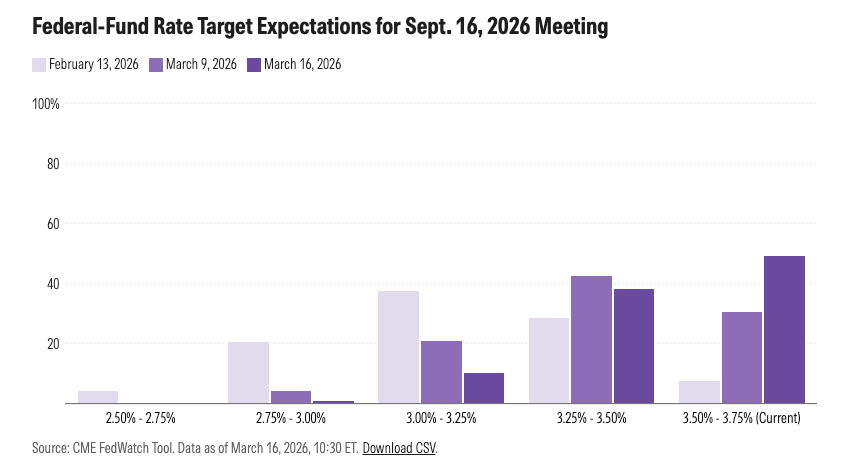
The Federal Reserve meets on Wednesday against a radically different backdrop than just three weeks ago, with the Iran war threatening to eliminate any rate cuts in 2026. Markets now price 99% odds that the Fed holds rates steady at 3.5-3.75% this week, with cuts pushed deep into the year or scrapped entirely. Just a month ago, traders expected two quarter-point cuts in 2026. Now they foresee just one, with 39% odds, in September. CME FedWatch shows 77% probability rates stay unchanged through June, up from 31% pre-war. Several economists now see no cuts at all this year. "It is entirely plausible that the Fed won't deliver any rate cuts in 2026," said EY-Parthenon chief economist Gregory Daco. Some analysts even predict rate hikes to counter inflation. "The Fed will not cut rates in 2026 and may even start talking about rate hikes later this year," said Carson Group's Sonu Varghese. The Fed faces what Wells Fargo economists called "the FOMC's worst nightmare": weakening jobs data coupled with rising inflation. February's loss of 92,000 jobs signals labor market fragility, while the Personal Consumption Expenditures index showed prices creeping higher in January, before the war's impact. Mortgage rates reflect the shifting outlook. The 30-year fixed rate had dropped below 6% in late February but jumped to 6.26% by March 16. "Higher inflation begets higher rates, all else equal," the Mortgage Bankers Association noted. Trump continues pressuring Chair Jerome Powell to "drop interest rates IMMEDIATELY," despite soaring oil prices. Powell has only two meetings left before his term ends in May, likely succeeded by Trump nominee Kevin Warsh. The oil shock creates competing pressures. Fed models typically advise looking through energy spikes since they're volatile. But this time differs. "Inflation expectations are not as anchored as they were before the pandemic," said former Cleveland Fed President Loretta Mester. "A shock like this could mean we might see more of a rise, and that's just going to make the Fed's job harder." Deutsche Bank expects "minor statement tweaks" on Wednesday, including smoothed language on conflicting jobs data and acknowledgment of geopolitical risks. Powell will likely stress events transmit through financial conditions, particularly oil prices, without signaling meaningful policy shifts. The bind intensifies as Powell's tenure ends. A Department of Justice investigation threatens to delay Warsh's confirmation despite a judge quashing subpoenas Friday. Former Boston Fed President Eric Rosengren captured the dilemma: "Both sides are going to be able to say that this makes the situation worse, and they're both going to be right. Reported inflation is likely to be higher, and reported labor market conditions are likely to be weaker." |
That’s all for today!/
AI Alone Can’t Run Revenue
Finance doesn’t run on “mostly right.” It runs on math.
In The Architecture Behind AI-Native Revenue Automation, Tabs’s CTO breaks down why LLMs alone aren’t enough—and what it actually takes to build audit-ready, AI-driven contract-to-cash systems for modern B2B teams.
