Welcome to another week with FinSoar! I’m looking at a lukewarm reaction to the new electric Ferrari, Eli Lilly investing in the infectious disease market, and Micron reaching a trillion dollar mark:
Ferrari Unveils Its First EV and Investors Don't Love It
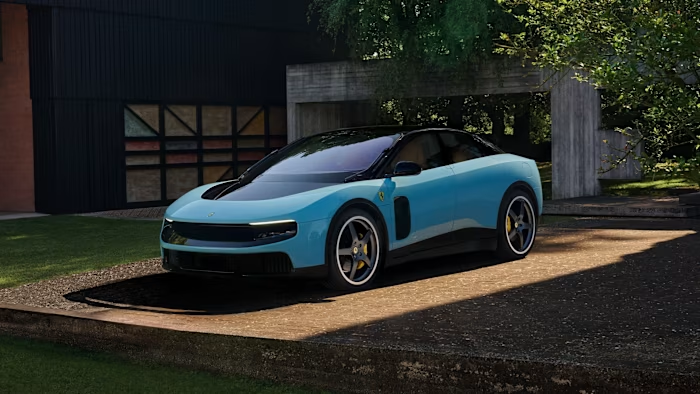
Ferrari unveiled the Luce on Monday in Rome, its first fully electric vehicle, after five years of development. Shares fell as much as 7.8% in Milan on Tuesday, the steepest drop since October, before moderating to roughly 6.5% by midday. US-listed shares fell 4.6% in morning trading. The Milan-listed stock is now down more than 32% over the last 12 months. The Luce is Ferrari's first five-seater, priced at €550,000 (roughly $640,000), with four electric motors generating over 1,050 horsepower combined. It accelerates 0-100 kph in 2.5 seconds, tops out above 310 kph, and offers more than 530 kilometers of range. Deliveries begin in Q4 2026. Some of the controversy can be attributed to design. Ferrari handed the exterior and interior to LoveFrom, the agency founded by former Apple design chief Jony Ive and industrial designer Marc Newson. The glass-clad shell-like form departs sharply from Ferrari's muscular sports car heritage. AIR Capital's Pierre-Olivier Essig wrote that the car resembled "a mix between a Honda Accord EV and Tesla 3". Oddo BHF analyst Anthony Dick called the reaction "by far the sharpest" ever seen for a car design. Chief marketing officer Enrico Galliera said the intent was to be "polarising", targeting buyers who already own an EV rather than the company's traditional combustion purists. Half of those invited to the launch were not Ferrari drivers, compared to the usual 10-20%. To replicate the engine roar, Ferrari engineered an accelerometer system that amplifies vibrations from the electric motors, likening the approach to an electric guitar pickup. Lamborghini pushed its first EV back to 2029, Bentley moved its all-electric deadline from 2030 to 2035, and Porsche has remapped its near-term future back to combustion. Mass-market carmakers including Ford and Stellantis have collectively taken roughly $70 billion in write-downs on EVs. Ferrari has already halved its own EV ambitions, with 20% of its 2030 lineup now expected to be all-electric, down from a 40% target set in 2022. Roughly $28 billion in market value has been wiped out since the October downshift. Vigna said the Luce will be profitable from launch and that the waiting list for Ferraris runs through late 2027. The Luce launch is now a referendum on whether Ferrari's brand equity transfers into the electric era. |
Eli Lilly Buys Three Vaccine Developers in $4 Billion Bet on Infectious Disease
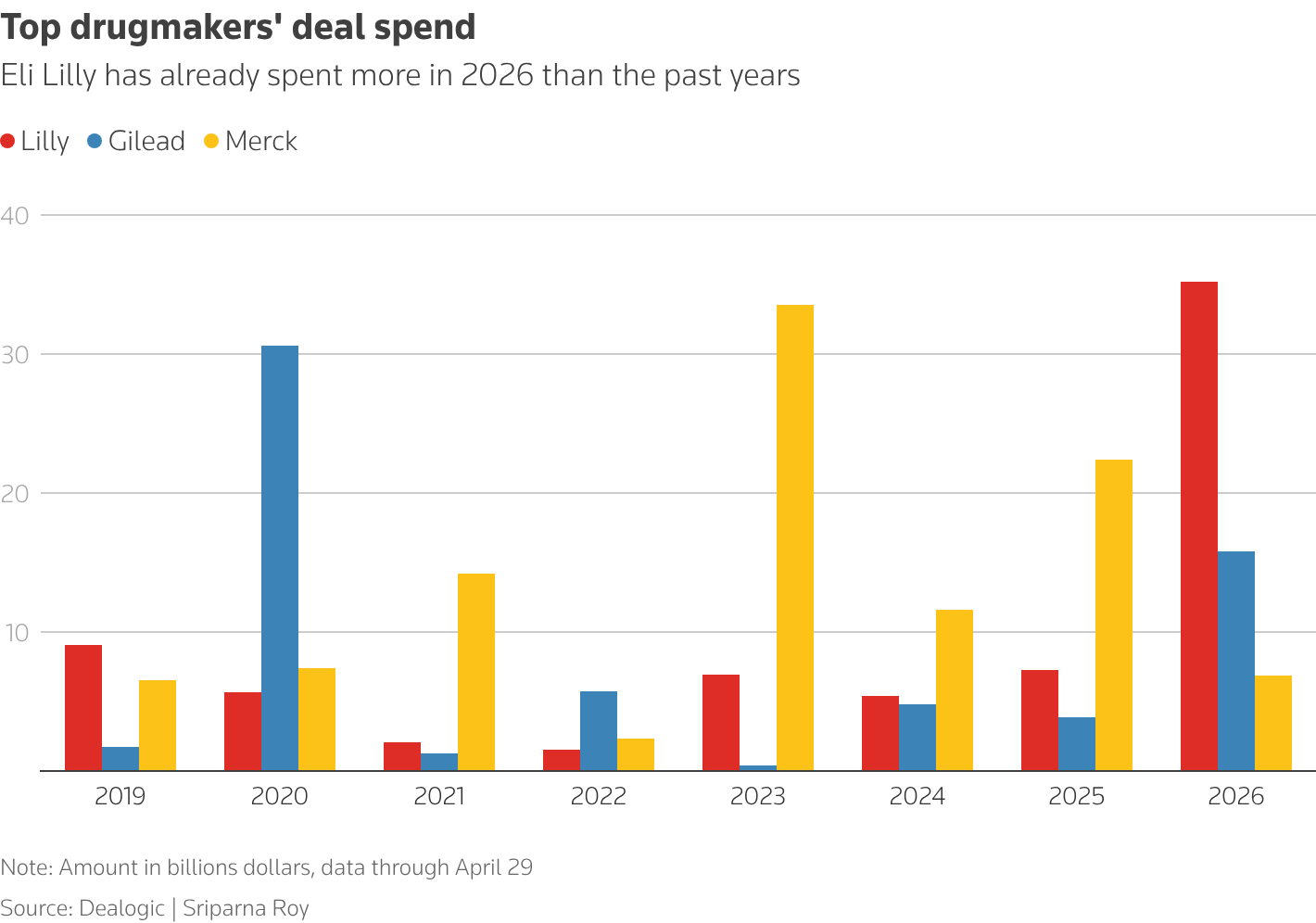
Eli Lilly announced on Tuesday that it will acquire three vaccine developers in deals worth up to $3.8 billion combined, marking a return to infectious disease research that the company had stepped away from in recent years. Shares edged 0.9% higher after the open. The three targets are Curevo for up to $1.5 billion, LimmaTech Biologics for up to $780 million, and Vaccine Company for up to $1.55 billion. Curevo is developing a shingles vaccine engineered with a synthetic adjuvant to reduce side effects. LimmaTech targets bacterial pathogens, including S. aureus, a major cause of surgical-site infections, alongside drug-resistant STIs like gonorrhea and chlamydia. The Vaccine Company is developing nanoparticle delivery technology targeting viral pathogens, including Epstein-Barr virus. The acquisitions arrive in a politically hostile environment for vaccine makers. Under Health Secretary Robert F. Kennedy Jr., vaccine sales have slumped, and smaller developers have struggled to raise capital. That dynamic has likely pushed valuations down. Carnegie Investment Counsel's Shams Afzal called the combined deal value a "bite-sized price tag." The financial firepower is coming from GLP-1 cash flow. Lilly became healthcare's first $1 trillion company last fall, with Q1 US revenue of $4.16 billion from Zepbound and $4.2 billion from Mounjaro. The company holds 60.1% of the US obesity drug market versus Novo Nordisk's 39.4%. Lilly's 2026 deal spending has already outpaced prior years, with recent acquisitions in cancer, narcolepsy, cell therapies, and inflammation. Last month, it agreed to buy Kelonia Therapeutics for $3.25 billion upfront. Lilly produced the polio vaccine in the 1950s, and antibiotic Ceclor was its top-selling product in the late 1980s. The GLP-1 cash is funding a return to a category that most large pharma companies had deprioritized as less profitable. With vaccine valuations depressed by political headwinds, Lilly is buying at the bottom of the cycle. |
Micron Hits $1 Trillion as Memory Chips Become the AI Bottleneck
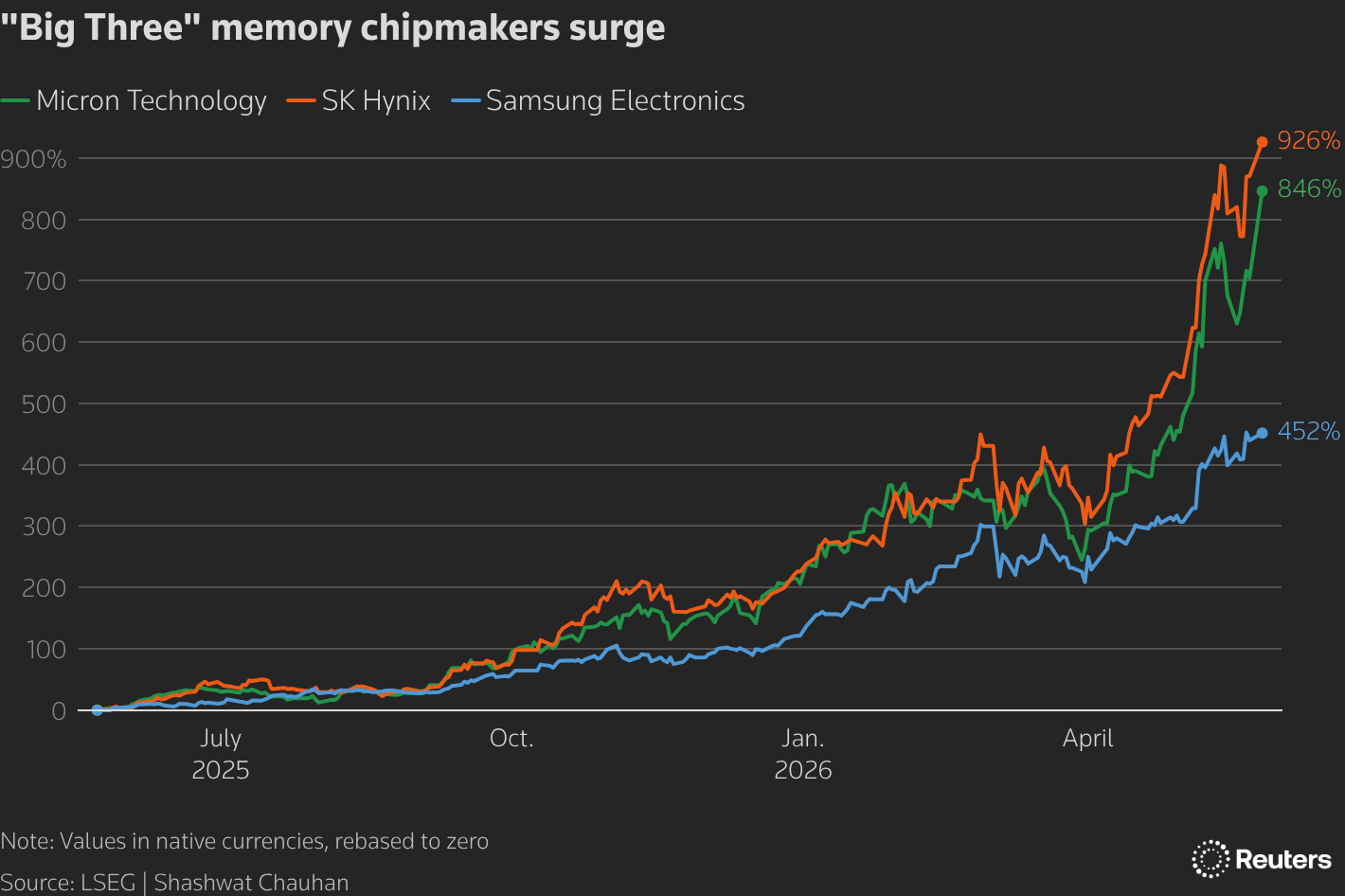
Micron Technology briefly topped $1 trillion in market value for the first time Tuesday after shares jumped as much as 19.3% during the session, settling 17.4% higher at $881.60. The catalyst was a UBS upgrade lifting the price target to $1,625 from $535, the highest among the 46 brokerages covering the stock. The new target implies a potential $1.8 trillion valuation over the next twelve months. While Nvidia makes the GPUs that train and run AI models, Micron produces the memory chips that store and move the data those models depend on. As hyperscaler capex pushes past $725 billion in 2026, the bottleneck has shifted from compute to memory. Micron has already sold out its entire 2026 high-bandwidth memory (HBM) chip supply, with next-generation HBM4 products now in production. The shortage has given Micron the kind of pricing power it has rarely held. Shares are up more than eightfold over the last 12 months, one of the largest rallies in the semiconductor industry's history. Memory chips have been an Asia-dominated category for years, with Samsung already past $1 trillion and SK Hynix approaching that mark. Micron's ascent gives the US a domestic contender in a category that touches every AI workload. Samsung's narrowly averted strike last week, which the consumer electronics union is now trying to block in court, shows how supply disruptions could push prices higher still. |
That’s all for today!/
