Welcome to another week of FinSoar! We’re looking at Beijing’s protective stance on Chinese AI, OpenAI hitting a wall with revenue and a new deal with Microsoft, and slipping gold prices in light of the Iran crisis.
Beijing Pulls the Plug on Meta's $2 Billion Manus Deal
China's National Development and Reform Commission ordered Meta on Monday to unwind its $2 billion acquisition of Manus, an AI agent startup with Chinese roots that had relocated to Singapore. The NDRC's foreign investment security review office said it would prohibit foreign investment in Manus and required the parties to withdraw the transaction. The order is unusual on its face. Manus is a Singapore-based company being acquired by a California-based company, with neither legally domiciled in China. The deal had already closed. Manus staff have moved into Meta's Singapore offices, and the Manus website now describes the company as "part of Meta." The two co-founders were summoned to Beijing in March and barred from leaving the country. According to the Financial Times, Beijing has told both companies the deal must be undone completely, including returning funds, re-registering ownership, and halting Meta's use of the Manus algorithm. If they fail, China may impose penalties, restrict Meta's China business, or pursue criminal charges. Meta said the transaction "complied fully with applicable law" and anticipates an appropriate resolution. This appears to be the first use of foreign investment security review measures Beijing introduced in late 2020. China is asserting jurisdiction over a transaction between two non-Chinese entities on the grounds that the technology, talent, and data originated in China. As Wilson Sonsini's Weiheng Chen told Reuters, Chinese national security clearance is becoming "a regular closing condition for cross-border tech deals." The implication for so-called Singapore washing — where Chinese startups redomicile to access foreign capital — is direct. Incorporation alone no longer insulates a deal from Beijing's reach. The White House called the move "undue foreign interference." Meta's social platforms are blocked in China, and Blueshirt Group's Gary Dvorchak told CNBC that "the practical reality is China has no leverage over Meta." About 11% of Meta's 2024 revenue came from China through ad resellers. The Manus business itself had crossed $100 million in annual recurring revenue by December, eight months from launch. As Fortune noted, it remains unclear how the deal can be unwound when Manus employees have already joined Meta's AI team and backers have already received their cut. The timing matters too, with a Trump-Xi summit planned in Beijing for mid-May. |

OpenAI Hits Air Pockets as Microsoft Renegotiates
OpenAI has missed internal targets for revenue and user growth in recent months, raising concern among company leaders about whether it can sustain its enormous data-center commitments. According to a Wall Street Journal report, CFO Sarah Friar has told other executives she is worried OpenAI might not be able to pay for future computing contracts if revenue growth disappoints. The board has examined recent data-center deals more closely and questioned Sam Altman's push to secure additional capacity. ChatGPT missed an internal goal of one billion weekly active users by year-end 2025, missed its annual revenue target as Google's Gemini ate into market share, and missed multiple monthly revenue targets this year after losing ground to Anthropic in coding and enterprise. Altman and Friar called any suggestion of a rift "ridiculous" in a joint statement. OpenAI is on the hook for roughly $600 billion in future spending commitments. The company's record $122 billion funding round will be burned through in three years assuming it hits ambitious revenue targets, and some of the funding is conditional. Friar has reportedly pushed back on Altman's preferred timeline for a year-end IPO, telling executives the company isn't ready for public-company reporting standards. A leadership vacuum has opened up after second-in-command Fidji Simo took unexpected medical leave, and Elon Musk's lawsuit seeking to unwind the for-profit conversion went to trial this week. The same day the revenue concerns surfaced, OpenAI and Microsoft announced a major restructuring of their partnership. OpenAI's revenue share payments to Microsoft will now be capped at an undisclosed ceiling, though they continue at the existing 20% rate through 2030. Microsoft will no longer pay a revenue share back to OpenAI on Azure-resold products. Microsoft's license to OpenAI intellectual property runs through 2032 but is no longer exclusive, freeing OpenAI to ship its products across Amazon, Google, and other clouds. Microsoft remains the primary cloud provider, with new products shipping first on Azure unless Microsoft declines. Since last October, OpenAI has signed a $50 billion Amazon investment and expanded its AWS deal by $100 billion, while Meta committed $48 billion to CoreWeave and Nebius. Microsoft had reportedly weighed legal action over the AWS arrangement, viewing it as a breach of its exclusivity rights. |
Gold Loses Its Safe-Haven Sheen as Oil Drives Inflation Bets
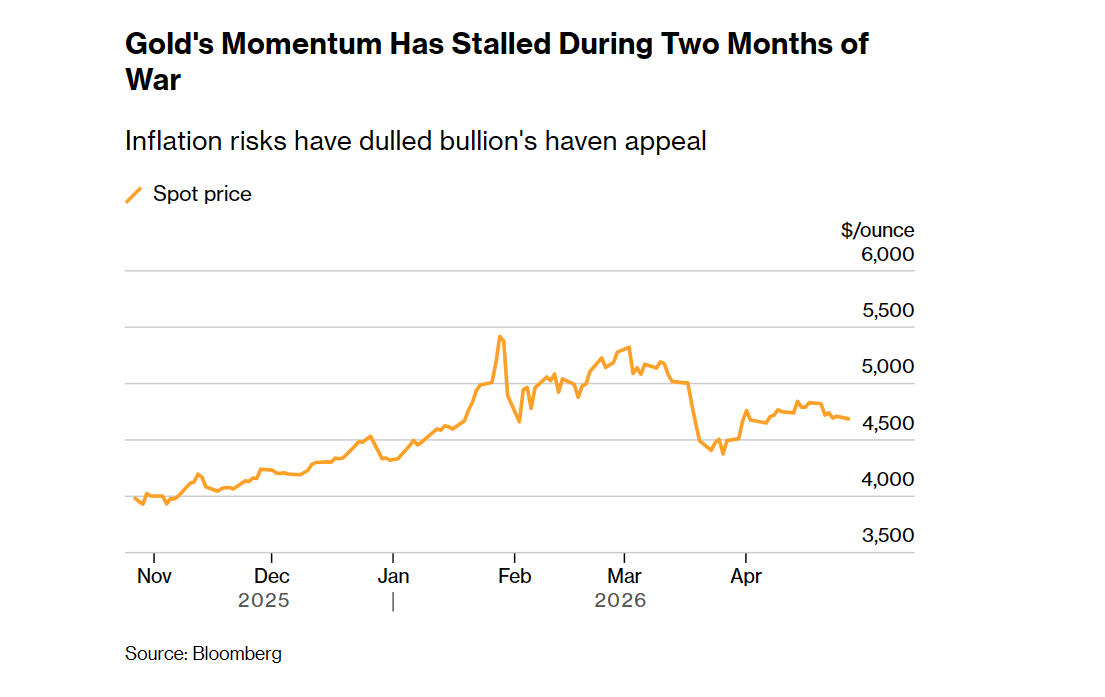
Gold prices slipped to a more than three-week low on Tuesday, with spot gold falling 1.6% to $4,605.18 per ounce, the lowest level since April 6. June futures dropped 1.6% to $4,619.10. The slide came as US-Iran peace talks stalled and Brent crude pushed above $110 a barrel, reinforcing expectations that major central banks will keep rates higher for longer. Bullion has lost roughly 11% since the conflict began at the end of February. The price action upends gold's traditional script. The metal is supposed to thrive on geopolitical chaos and inflation fear, but it is currently behaving more like a risk asset. President Trump and his national security team have expressed skepticism over Iran's latest proposal, which would lift the US blockade of Iranian ports and delay nuclear negotiations in exchange for halting attacks in the Strait of Hormuz. Iranian President Masoud Pezeshkian said his country will not enter "imposed negotiations under threats or blockade." Hormuz remains effectively closed. The mechanics are straightforward. Disrupted oil and gas flows feed inflation, which forces central banks to hold rates higher, which raises the opportunity cost of holding non-yielding gold. MUFG analyst Soojin Kim said the disruption has "intensified global inflation concerns" and is keeping the Fed and ECB cautious. Julius Baer's Carsten Menke told Reuters that "the gold market seems more concerned by the risk of tighter monetary policy due to the impact of the war than the risk of slowing global growth." The dollar gained on Tuesday and the 10-year Treasury yield hit a three-week high, both adding pressure on dollar-priced metals. The week's central bank calendar is heavy. The Bank of Japan kept rates steady but three of nine board members proposed hiking, a hawkish split pointing to a possible June move. The Fed is widely expected to hold on Wednesday, with the ECB, Bank of England, and Bank of Canada also scheduled to decide. Markets do not expect Warsh to deliver the aggressive cuts Trump has demanded. As Bloomberg noted, investors expect a measured, gradual approach. MKS PAMP's Nicky Shiels described gold as sitting in "technical no-man's-land," with thin conviction, sidelined large allocations, and "little appetite to chase it sub-$5,000." Other precious metals followed gold lower. Silver dropped 3.3% to $72.98, platinum lost 2.7%, and palladium fell 2.3%. The trade is binary: a genuine Iran ceasefire breaks oil and revives gold's haven bid, while continued stalemate keeps the rate path elevated and bullion bid down. |
That’s all for today!/
