Welcome to FinSoar! Today, I’m watching the Fed, the market correction coming for AI stocks, and CocaCola’s incredible run:
The Fed Meeting Where the Chairman Won't Show His Hand
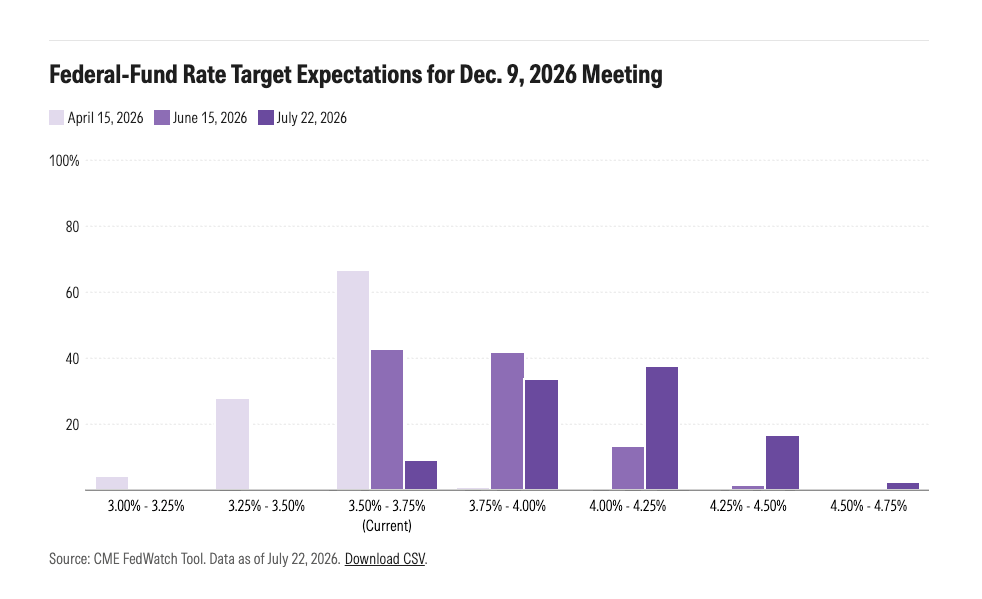
The Fed almost certainly will hold rates on Wednesday. What makes this meeting unusual is that "almost" now carries real weight, and the man running it wants it that way. Markets have talked themselves into a live meeting. Fed funds futures put the odds of a quarter-point hike near 38%, up from 16% a week earlier. Prediction markets moved the same direction, with Polymarket's hike contract jumping to 27% in a day. Oil might have triggered the jump. Brent topped $100 as the US-Iran ceasefire broke down, then partly reversed. The data cuts the other way. June inflation cooled to 3.5% from 4.2% in May, core CPI eased to 2.6%, and payrolls grew a soft 57,000. Warsh himself has been dismissive of the oil spike, telling the Senate that particular price shocks hit particular prices the Fed cannot control, and that a one-time change in prices is not necessarily inflationary. Here is the deeper reason to wait. The Fed rarely does one-and-done. Former St. Louis Fed chief James Bullard notes that hiking now would mean committing to a sequence of increases, and the committee is not ready to send that signal. The last isolated hike was 1997. So a "live" meeting is really a question about September, which markets have already fully priced. Warsh has his own reasons for patience. He has set up task forces on inflation, AI, and communication that report late in 2026. Voting to hike at his second meeting would concede those debates before they conclude. A hike over a president demanding cuts could also feed conspiracy theories about Jerome Powell as a shadow chair, complicating Warsh's hope for allies on the board. The wrinkle is that three or four of a dozen voters may dissent, and Warsh has ended forward guidance. He wants messier meetings whose outcomes are not settled in advance — but that buys nimbleness at the cost of looking skittish and reactive to a $10 move in crude. So the press conference matters more than the decision. |
The AI Trade Cracks, and the Cracks Start in Korea
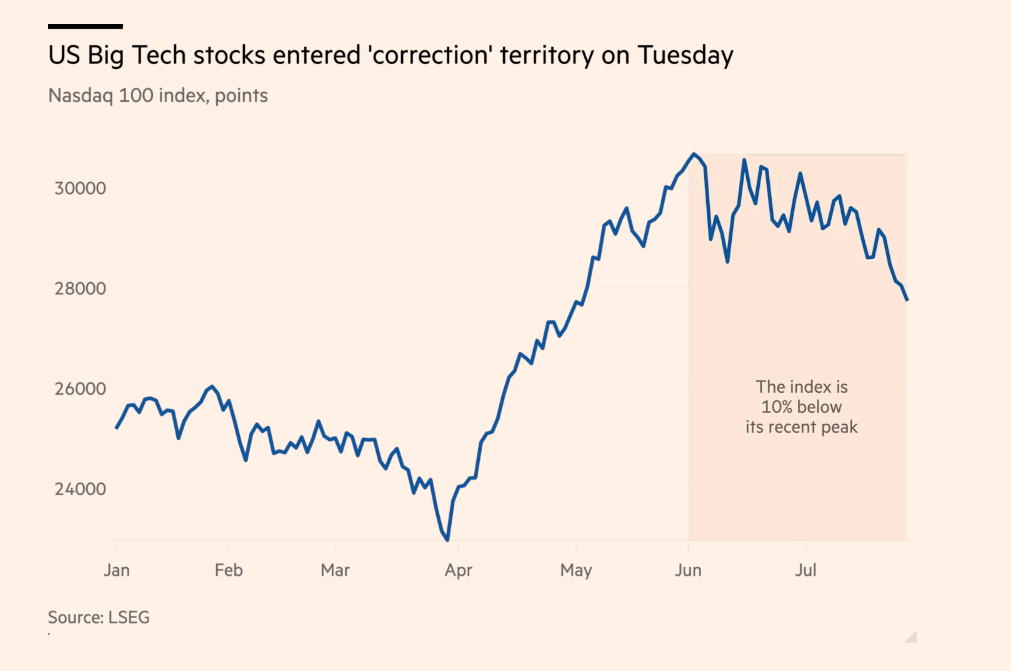
South Korea's Kospi fell more than 10% on Tuesday, triggering a circuit breaker and marking its largest monthly fall on record, worse than anything during the 1997 Asian financial crisis. The chip trade that carried global markets all year is unwinding fast. The epicentre is memory. SK Hynix and Samsung Electronics, the two biggest suppliers of the high-bandwidth memory that AI servers need, each shed more than 12%. The selling followed through everywhere. Micron fell about 11%, Intel 8.5%, AMD around 10%, and memory names Sandisk, Seagate, and Western Digital were routed. The Nasdaq 100 is now down more than 10% from its June high, in correction territory. Two China stories lit the fuse. The Information reported that a Chinese firm has begun mass-producing homegrown deep ultraviolet lithography machines, an area ASML dominates. That knocked ASML 8% on Monday. Separately, memory maker CXMT rose 466% on its Shanghai debut, China's push to build its own AI supply chain. Investors are also increasingly nervous about the circular financing threaded through the sector. The Wall Street Journal reported Nvidia is in talks to provide OpenAI with $250 billion for an Ohio data centre. Rather than reassure, the news knocked Nvidia 5% on Monday and pushed up the cost of insuring its debt. There is also a supply overhang — SK Hynix and Samsung plan two new plants apiece, part of a combined $548 billion push to double DRAM capacity over five years. Some brokers now flag a memory price peak in 2027. The real test comes this week: Microsoft, Meta, Amazon, and Apple all report. After Alphabet's 7% drop on cash-burn fears, the hyperscalers now have to prove the spending is worth it. |
Coke Turns a Hydration Break Into a Guidance Raise
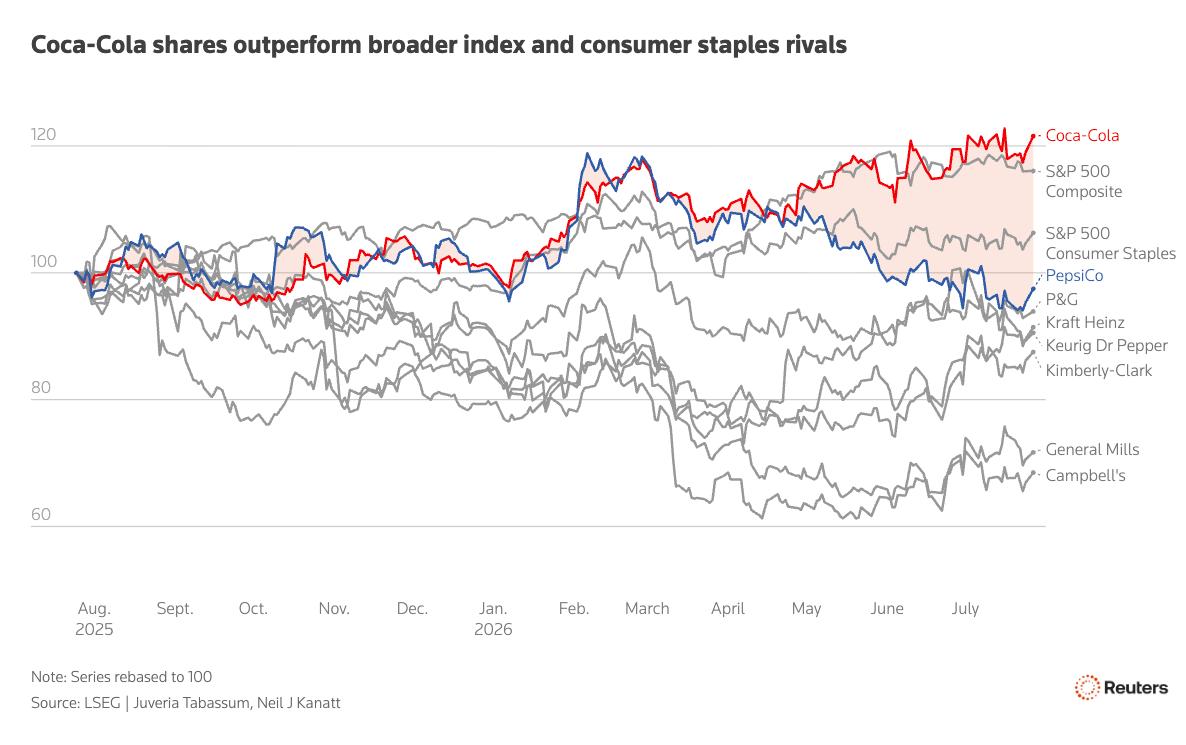
Coca-Cola beat on both lines and lifted its full-year outlook on Tuesday, sending shares up more than 6% to a record. Revenue rose 7% to $13.4 billion, against the $13.16 billion analysts expected, and adjusted earnings of 97 cents beat the 93-cent estimate. Global unit case volume grew 5%, and every reporting segment expanded. Coke credited its World Cup campaign, which lifted the namesake soda 5% and Powerade 8%. Trademark Coca-Cola's jump was its biggest quarterly gain in 17 years, pandemic aside. The Powerade lift came from a specific place. Coke sponsored the tournament's mid-game hydration breaks, which fans disliked for slowing play. The CFO said the company was not unhappy with them. New guidance: comparable EPS growth of 9% to 10%, up from 8% to 9%, and organic revenue of about 5%, at the top of the prior range. CEO Henrique Braun repeatedly called the consumer environment uneven, flagging pressure on low-income shoppers and customers in Latin America and China. Rival PepsiCo already reported weaker US snack and drink sales on tighter budgets. Coke's numbers do not show that strain — even North America's volume grew 3%. Part of the answer is packaging. Coke has leaned on mini-cans, a lower absolute price point that keeps the product affordable without broad price cuts, now sold individually in convenience stores. Pricing still did work too, up 4% in North America and 2% globally. There are costs on the horizon. Aluminium and PET rose more than Coke expected this year, and the CFO tied some of that to the war in Iran. Coke also collected more than 25 million data records via QR codes on packaging during the tournament, fuel for future campaigns. The stock is up about 20% this year, outpacing Pepsi. In a week when AI names are cracking, a soda maker selling more cans at higher prices looks almost novel. |
That’s all for today!/
