Welcome back to FinSoar! This weekend, I’m watching Microsoft jump in valuation over other tech companies, a slowing economy, and Fed Chairman Warsh’s determination to hold steady:
Microsoft Adds Half a Trillion Dollars in a Day
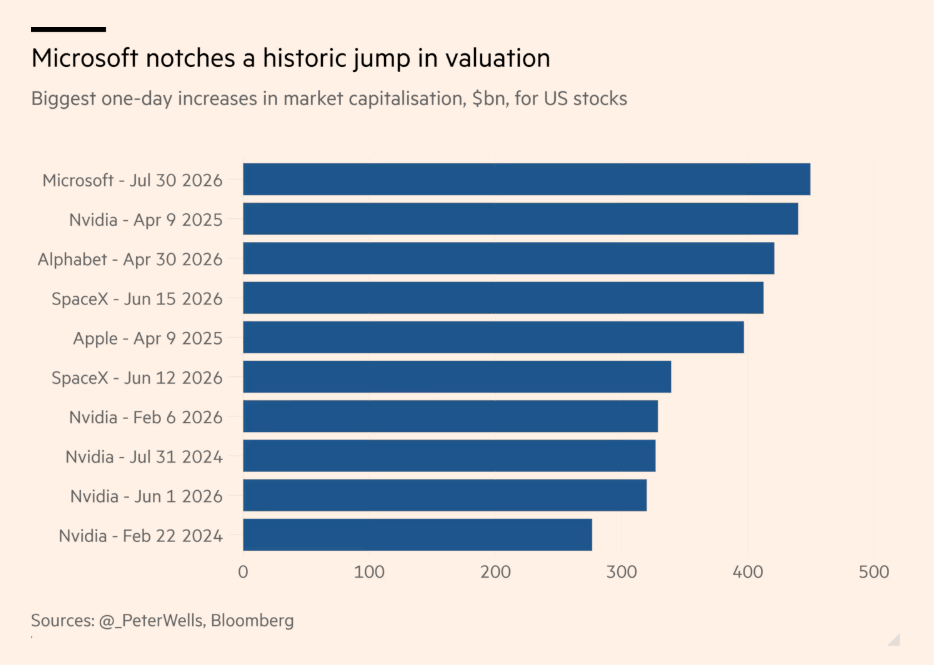
Microsoft added $450 billion in market value on Thursday, the largest single-day gain for any US company ever, edging past Nvidia's $440 billion leap in April 2025. The stock rose about 16%, its best day since 2008. One earnings report did that. The report answered the question hanging over the whole sector. Quarterly revenue hit $90 billion, up 18%, and Azure grew 43%, past its own guidance. Nadella disclosed Azure crossed $100 billion in annual revenue for the first time. Paid Microsoft 365 Copilot seats hit 30 million, up 10 million in a quarter. Crucially, Microsoft did not raise its 2026 capex forecast. Meta offered the mirror image. Same day, similar spending, opposite verdict. Meta's free cash flow plunged 91% to $784 million, it kept pushing capex higher, and its revenue guidance missed. The stock fell 8%, an 11th straight decline and its longest losing streak on record. The difference is structural. Meta is alone among the big spenders in using all its new AI servers internally, with no cloud unit to rent them out. Microsoft monetises the buildout directly. Microsoft's strategic blueprint was to show AI revenue, hold spending steady, and wait for investors to reward them. Microsoft even helped its own optics with an accounting change, extending the assumed life of its data centre buildings to 25 years from 15, which trims the headline capex figure to $175 billion from $190 billion. A day after Warsh spooked markets, the Nasdaq rose 2.8%, and battered chip names like Micron and Intel posted double-digit gains. Microsoft answered the cash-flow question. The rest of the sector still has to. |
Warsh Says Nothing, and the Bond Market Panics
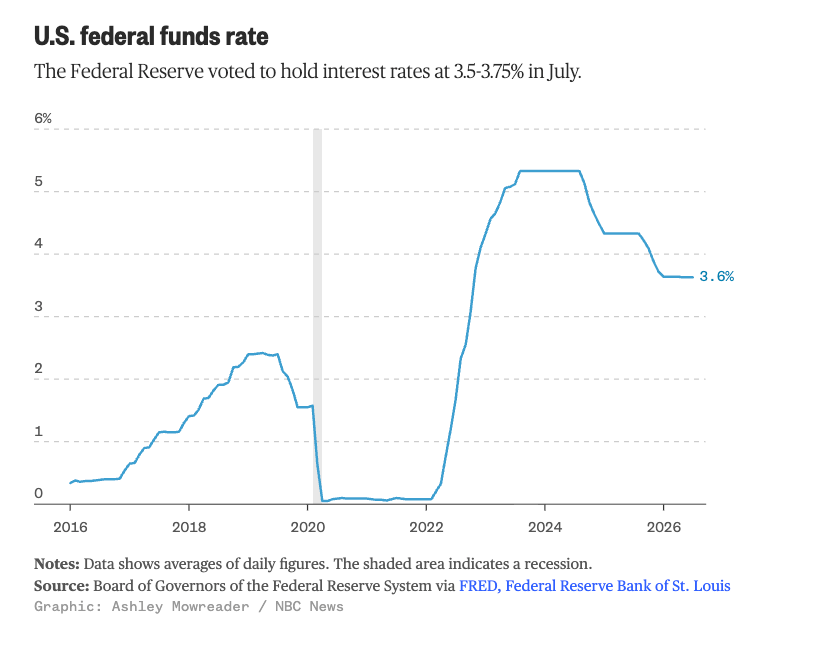
The Fed held rates at 3.5% to 3.75% on Wednesday, exactly as expected. Then Kevin Warsh spoke, and the 30-year Treasury yield climbed above 5.20% for the first time since 2007. A hold nobody disputed produced a sell-off almost nobody saw coming. Three of twelve FOMC members dissented in favour of a hike, the first time since 2016 that three officials broke the same way — laying bare a committee losing patience with inflation above target for more than five years. Warsh did not ease the tension. When asked whether higher rates are the cure for stubborn inflation, he would only say rates could be part of the solution but not in isolation. Asked which inflation gauge he targets, he named PCE, then wondered aloud what might change after January when his review task forces report. He has ended forward guidance and wants investors to, in his phrase, play the ball, not the referee. Showing willingness to raise short-term rates usually calms long-term yields. The Warsh Fed signalled the opposite, so long bonds priced in more risk while short-dated yields fell. The 30-year fixed mortgage rose to 6.66%, its highest in a year. Morgan Stanley, JPMorgan, and Bank of America all questioned Warsh's inflation-fighting credibility. JPMorgan's Michael Feroli called the press conference internally contradictory and flagged that even hinting PCE might be dropped undercuts the target itself. Bank of America titled a note "Doved and Confused." Thursday brought cooler data, with PCE inflation easing to 3.7% from 4.1%. Here is the irony. By refusing to promise action, Warsh may have made action likelier. Bank of America argues the need to rebuild credibility raises the odds of a September hike. A chairman who prizes credibility spent his second meeting watching the market question it. |
A 1.5% Economy That Is Stronger Than It Looks
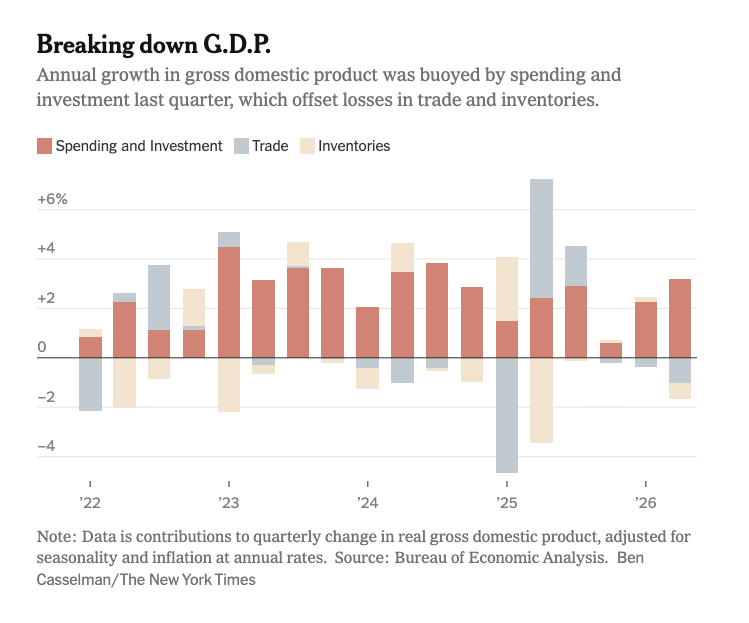
US GDP grew at just 1.5% in the second quarter, down from 2.1% and below the 1.8% economists expected. Read the headline, and the economy is slowing. Read the components and it is doing something stranger. The drag came from two places that tend not to persist. Rising imports subtracted 1.01 percentage points, the biggest hit since early 2025, and a continued inventory drawdown took off another 0.67. Falling federal spending trimmed more. The measure economists were watching, final sales to private domestic purchasers, rose 3.9%, the fastest since early 2023. Consumer spending surged 3.2% after a near-flat first quarter. Business investment in equipment grew 15.2%, a second straight double-digit quarter, driven by the AI buildout. The chips and servers behind the AI boom are largely imported, and imports subtract from GDP. So the same spending that powers domestic demand also mechanically lowers the headline number. AI capex adds to GDP, then gets offset by the imports feeding the data centres. The tax refunds from Trump's spending bill that padded spring spending are mostly gone. The saving rate fell to 2.7%, a four-year low, meaning consumers are dipping into savings to keep spending. Inflation offered a small reprieve. PCE, the Fed's preferred gauge, eased to 3.7% in June from 4.1%, with core at 3.3%, both roughly as forecast and both still well above the 2% target. On a quarterly basis, though, PCE ran at 5.1%, the hottest in four years. That combination keeps the Fed boxed in. Growth soft enough to worry about, inflation hot enough to demand action, and July energy prices already climbing back above $4 a gallon. Unless June's softness is the start of a real break, it is hard to see the Fed putting off rate hikes much longer. |
That’s all for today!/
