Hi there!
Welcome to FinSoar. It’s up, it’s down, it’s confounding world markets — and your dear author — as oil rises and falls, and Trump grows tired of the war in Iran. Markets fear stagflation, and the usual safe havens are not that safe anymore…
Oil Whiplash: Trump Signals Iran War End
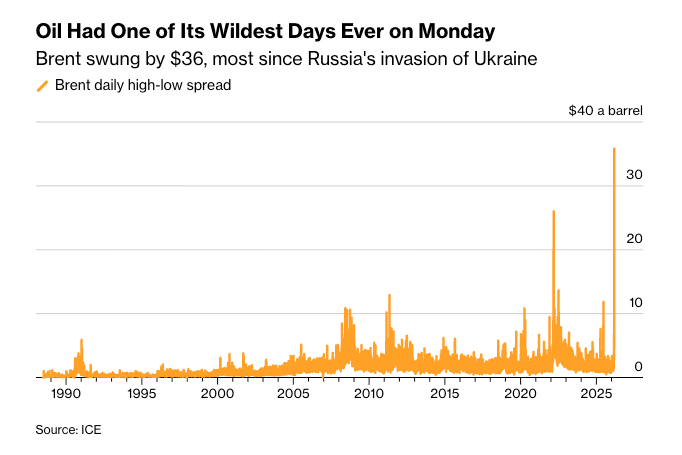
Oil prices plunged nearly 25% on Monday after spiking to four-year highs, the sharpest intraday reversal since the pandemic, as President Trump hinted the Iran war would end "very soon." Brent crude dropped to around $82 per barrel after touching $109 earlier in the session. WTI fell to $78 from a peak near $105. The wild swings began after Iranian drones struck Saudi oil facilities on Sunday, pushing prices above $100 for the first time since 2022. Benchmark crude surged 30% at one point. Then Trump spoke. "It will be over very soon," he told reporters on Monday from his Doral, Florida resort, adding Iran is "unable to counter" continued strikes. Markets seized on the comments despite mixed signals. Trump also claimed the Strait of Hormuz was "open for business," though shipping data shows traffic remains at a standstill. Iran continues launching counterstrikes. The war enters its eleventh day with no formal ceasefire. Gas prices jumped again on Monday. The nationwide average hit $3.46 per gallon, up 48 cents since strikes began February 28. That's the highest since September 2024 and threatens Trump ahead of November midterms, focused on affordability. The volatility fits a pattern. Barron's noted that Trump's crisis playbook has been "remarkably predictable." Major policy triggers market upheaval, White House waters down rhetoric, and the markets rebound. Monday's $40 swing in global crude followed that path. Other factors supported the decline. The G7 discussed releasing strategic reserves at meetings on Monday to contain prices. Reports emerged that alternative shipping routes through pipelines in Saudi Arabia and the UAE could absorb some capacity. Russia also signaled willingness to increase output. Oil steadied around $82-90 on Tuesday as markets assessed whether Trump's words would hold. The Guardian reported crude remained volatile, with traders skeptical of a quick resolution. Iran's Foreign Minister Abbas Araghchi said Tehran would continue defending itself. Analysts questioned the sustainability of lower prices. "Iran is still launching counterstrikes, Hormuz is still at a standstill, and oil remains within a few bad hours of $100 a barrel again," wrote Barron's. Bloomberg noted the Strait of Hormuz carries roughly 17 million barrels daily, about 17% of global supply. The whipsaw affected broader markets. The S&P 500 reversed a 100-point decline Monday to close slightly higher. Energy stocks tumbled on falling crude. Treasury yields dropped as recession fears eased. The dollar strengthened. Gasoline futures fell 10% Monday, suggesting pump prices could retreat if crude stays lower. But the damage lingers. Gas has jumped nearly 50 cents in 10 days, the fastest increase since Russia's invasion of Ukraine. |
Stagflation Fears Shatter Traditional Safe Havens
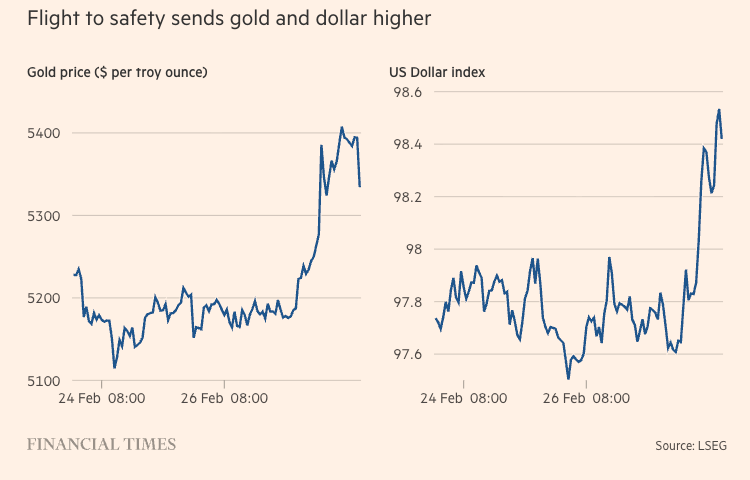
Investors fled to gold and dollars on Monday as the Iran war triggered fears of 1970s-style stagflation, upending traditional market playbooks. Gold jumped 2.6% to $5,400 per troy ounce near record highs. But government bonds, typically a haven during crises, sold off sharply as traders braced for inflation shocks. The stagflation scenario echoes the 1970s when energy disruptions sent inflation surging while battering growth. "The risk of a 1970s scenario is rising," said Kaspar Hense, portfolio manager at RBC BlueBay Asset Management. "If there is another extended war, with oil prices going up significantly further, then the safe-haven status of government bonds is at risk." Central banks face an impossible choice. Rate hikes to contain inflation would further damage growth. Chicago Fed President Austan Goolsbee told the Wall Street Journal a "stagflationary environment that's as uncomfortable as any" could be looming. Markets now see at least one ECB rate hike this year versus 40% odds of a cut before the war. Bettors on the popular "TACO trade" (Trump Always Chickens Out) face harsh lessons. The wager worked with tariffs but carries far higher risks with Iran, according to Jacob Manoukian, US head of investment strategy at J.P. Morgan Private Bank. "The risk scenario that Wall Street is trying to figure out is that global events have started, and we don't know where they're going," he told Fortune. Even bullish strategists sound cautious. Ed Yardeni raised the odds of a significant market drop by year-end to 35% from 20%. "The US economy and stock market are stuck between Iran and a hard place currently. So is the Fed," he wrote. Deal makers worry the war may postpone M&A transactions already facing headwinds from private credit jitters. CNBC's Jim Cramer warned investors not to jump on Monday's rally despite Trump's remarks. "Despite the extremely bullish close, it's possible we may not be out of the woods," he said. Four conditions must be met before markets normalize: both sides must stop attacking energy infrastructure, Iran must accept free passage through the Strait of Hormuz, the strait must reopen quickly to avoid production damage, and Trump needs an exit allowing him to declare victory. Startup valuations are also getting hammered. Investors now haircut founder projections by 30-40% versus the typical 20%, according to Claire Trachet, CEO of fundraising advisory firm Trachet. "They are trying to understand one thing: how resilient the business truly is if growth slows, and cash conversion becomes less predictable," she told Forbes. Working capital requirements jumped 25-30% to buffer against 60-day inventory delays. Companies without documented contingency plans see valuations drop more than 10% before term sheets arrive. Defense and energy sectors see premiums, but logistics and e-commerce startups relying on physical goods face severe scrutiny. |
That’s all for today!
