Hi there!
Welcome to FinSoar. Here’s a fresh update on where markets are headed despite US-Venezuelan geopolitical tensions — investors say everywhere, and nowhere, and don’t seem to particularly care…
Markets Unfazed by Venezuela Raid. History Says They're Right to Ignore It
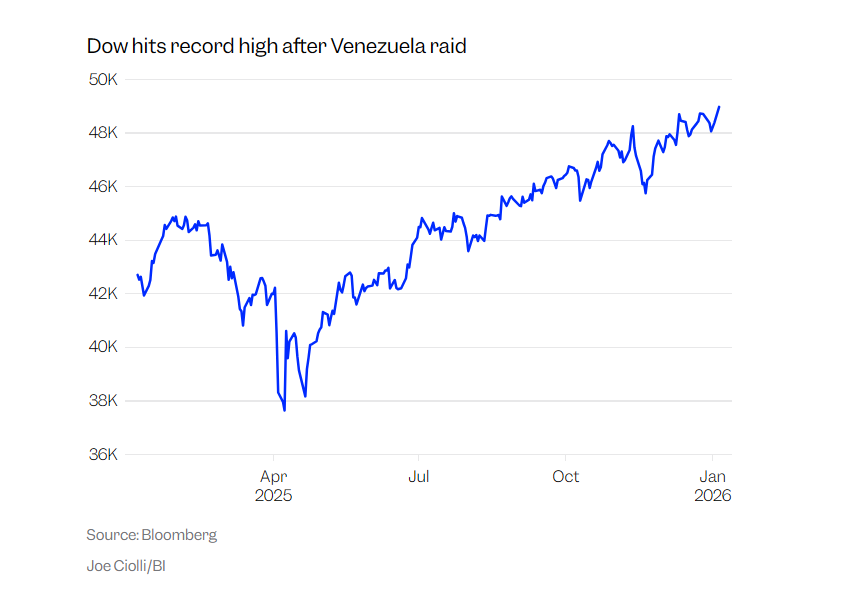
The Dow closed Monday at a record high, up 1.23%. The S&P 500 climbed 0.64%, the Nasdaq gained 0.69%. This came hours after US forces captured Venezuelan President Nicolás Maduro in a weekend raid that sent shockwaves through foreign policy circles. UBS reviewed the last 11 major geopolitical events and found the S&P 500 on average was just 0.3% lower one week after, and 7.7% higher 12 months later. "The old adage has long been to 'sell the rumor, buy the invasion,'" wrote Kent Fung at Fundstrat Research. The VIX tells the same story. Volatility currently stands at 14.5, well below stress levels and far from the 50+ spike seen during last year's tariff shocks. "That tells you markets are not paying up for protection despite elevated geopolitical headlines," said Billy Leung at Global X ETFs. Oil barely moved at first…Brent crude climbed just 1.1% to $61.46 a barrel. Venezuela produces roughly 1 million barrels per day, about 1% of global supply. The oil market remains in contango, not backwardation, meaning no supply panic. "The key here is whether the oil market supply tightens," said Leung. "As long as Brent trades around $60 and the forward curve remains in contango, the market is signalling ample supply and limited concern." Goldman Sachs and JPMorgan both hit record highs, rising more than 3%. The S&P 500 financials index jumped 2.2% as investors looked to upcoming quarterly reports. Gold provided the only significant safe-haven move, advancing over 2% to $4,419 per ounce. The dollar firmed slightly, up 0.2%, despite coming off its worst year since 2017. "While the headlines are unsettling, the market response so far has been notably restrained," said Jung In Yun at Fibonacci Asset Management. The movements reflect "modest hedging rather than flight-to-safety." Real yields remain elevated, credit spreads unchanged, and high yield spreads show no stress. "At this stage, the price action points to a temporary geopolitical risk premium rather than a structural shift," Jung added. Markets have seen this film before. They know how it ends. |
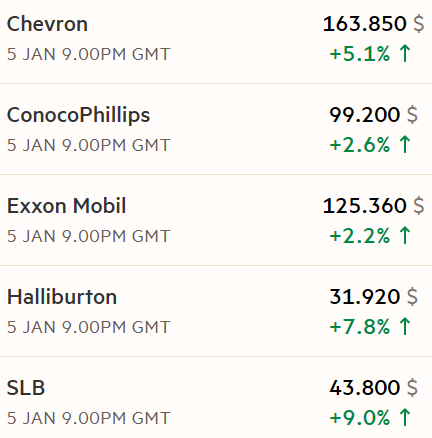
Big Oil Surges, US Shale Tanks: Venezuela Winners and LosersChevron surged nearly 7% Monday, while Exxon Mobil climbed more than 4%. The S&P 500 energy index rose 2.7% to its highest since March 2025. These are the biggest surges:
The reason? Trump said the US plans to meet with oil company executives this week to discuss boosting Venezuelan production. Chevron already operates in Venezuela under a license from the Trump administration. Trump told NBC News that oil companies will spend billions to upgrade Venezuela's energy infrastructure, and "they'll get reimbursed by us, or through revenue." "A tremendous amount of money will have to be spent, and the oil companies will spend it," he said. But US shale producers took the opposite trade. Diamondback Energy fell 3.7%, Coterra Energy dropped 4%, Occidental Petroleum declined 2%, and Devon Energy fell 3%. Access to Venezuela's vast reserves threatens domestic production economics. Defense contractors also won big.
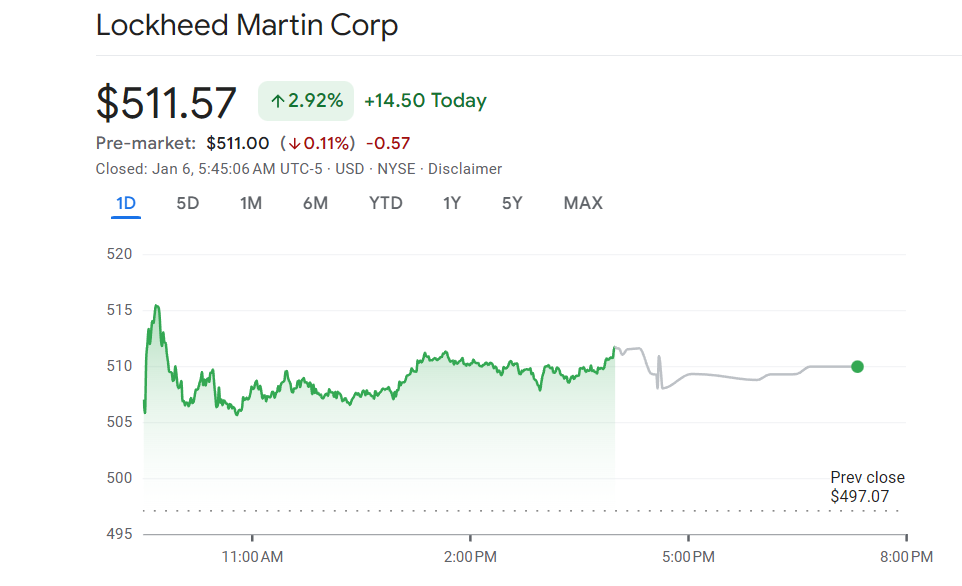
Lockheed Martin and General Dynamics climbed as the S&P 500 aerospace and defense index rose to a record high. Weapons manufacturers advanced after Washington's military action. Michael Burry of "Big Short" fame says US oil services companies like Halliburton, Schlumberger, and Baker Hughes "should benefit significantly" as US contractors fix and modernize Venezuela's pipelines and refineries. Venezuelan bonds surged almost 30% as the price of the country's sovereign debt extended its rally. Investors betting on economic recovery flooded in. Someone else cashed in spectacularly. A newly created Polymarket account bet $30,000 on Friday that Maduro would be out of office by January 31. After Maduro's capture Saturday, the user netted a $436,759 prize. Rep. Ritchie Torres plans to introduce legislation this week barring federal officials from trading on prediction markets when they have nonpublic information. Polymarket has no restrictions on insider trading. Kalshi does. "Energy stocks are really benefiting from the expectation that President Trump is intending to send them in to do more investment in Venezuela and ultimately make more money," said Rob Haworth at US Bank Wealth Management. The market picked its winners fast. |
From Michael Burry: Markets are missing the Venezuela paradigm shift
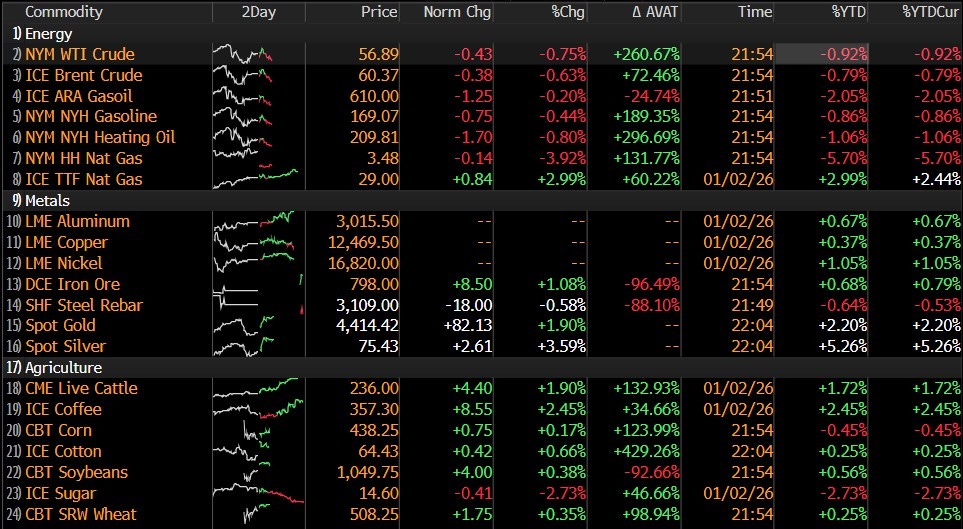
Burry posted this on his Substack, Cassandra Unchained: "Sunday night Bloomberg commodities futures are little changed. Oil is down less than 1%, a cool non-reaction." Michael Burry says markets aren't pricing in the longer-term impacts of the US raid on Venezuela. "This is a paradigm shift despite the markets yawning," the "Big Short" investor wrote Monday. Burry published a Substack post saying the "game just changed" in the mid to long term. "Markets are not pricing in all that may come of this weekend's events," he wrote. The seizure was a "shot across China's bow," Burry argued. China has made billions in loans to Venezuela under its Belt and Road Initiative, collateralized using future oil output "now in US hands." China may now have a "blueprint" for taking control of Taiwan, Burry wrote, but "must be in awe of Trumpian America's infuriating gall and decisive power." China stocks strike him as "somewhat riskier" now. Alibaba, Baidu, and other potential sanction targets "could be in for some volatility." Burry said "Putin's jaw has to be on the floor" after the US did in "practically seconds" what Russia has been trying to do in Ukraine for three years. Russian oil "just became less important" as tapping Venezuelan oil could reduce Russia's income and power. Canada and Mexico could "lose a good amount of leverage" in trade with the US if American refineries switch to Venezuelan oil. Burry forecast a "long-term tailwind" for the US economy as Venezuelan oil inflows could push down gas, diesel, and jet fuel prices. Lower prices benefit consumers, especially lower-income ones, and cut supply chain costs. Analysts at Mizuho agree on the energy advantage. Venezuela's heavy crude is well-suited to US refining capacity, and access to vast oil reserves gives the US a decisive edge in the AI race, particularly relative to China. "China's energy security is compromised at the margin whilst the US gains a significant energy dominance advantage," wrote Vishnu Varathan at Mizuho. Other investors disagree. "We're in a regime where geopolitics has become a persistent feature, not a surprise," said Charu Chanana at Saxo. "Unless it threatens the broader supply chain, investors tend to rotate back to rates, earnings, and positioning." Burry thinks they're making a mistake. Markets always do when paradigms shift. What do you think? |
That’s all for today!
