Hi there!
Welcome to FinSoar. Unilever has just struck a deal with McCormick, U.S. hiring rates are down low, low, low, and oil forecasts are reaching highs to match 2005.
Unilever Exits Food as $45 Billion McCormick Deal Creates Condiment Giant
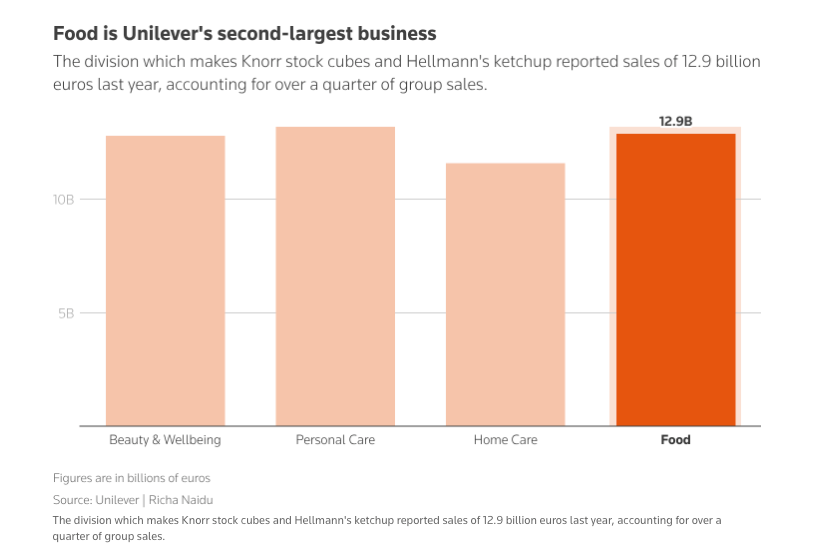
McCormick agreed to buy Unilever's food business for $45 billion in a deal that will create a global seasonings and sauces powerhouse while ending Unilever's century-long presence in food. The transaction values the spice maker at roughly $21 billion and gives Unilever shareholders 65% control of the combined entity. Under the structure, McCormick will pay $15.7 billion in cash plus $29.1 billion in stock for brands including Hellmann's mayonnaise, Knorr stock cubes and Marmite. Unilever will retain a 9.9% stake while its shareholders own 55.1% of the new company. McCormick CEO Brendan Foley will lead the combined business, which will generate about $20 billion in annual revenue. As a result, McCormick shares plunged 9% at the open while Unilever fell 4%, with the stock heading for its worst month since July 1975. The selloff reflects skepticism about McCormick's ability to integrate a business twice its size. "Why is Unilever disposing of a business dominated by two brands, of which it owned 100%, for a minimal control premium and leaving its shareholders with a 55% shareholding in a sprawling food business?" asked RBC analyst James Edwardes Jones. The deal is being structured as a Reverse Morris Trust, a tax-free transaction where Unilever spins off its food division before merging it with McCormick. The companies project $600 million in annual cost savings by year three and expect the deal to close by mid-2027, pending regulatory approval. For Unilever CEO Fernando Fernández, the move completes a dramatic reshaping of the Anglo-Dutch giant. The company spun off its ice cream business last year, creating Magnum Ice Cream Co. The remaining business will focus on beauty, personal care, and home products, competing directly against L'Oréal, Beiersdorf, and Estée Lauder. Food made up just over a quarter of Unilever's €50.5 billion in 2025 sales, with Knorr and Hellmann's accounting for 70% of the division's €12.9 billion revenue. But growth has lagged, as health-conscious consumers shifted away from packaged food and private-label brands gained market share. Big Food is abandoning the conglomerate model that powered growth for decades in favor of what consultants call "targeted scale." Companies are shedding lower-margin businesses to dominate specific categories rather than maintaining diverse portfolios. "The rules have changed, and many big consumer products companies are facing a relentless drift toward irrelevance," Ernst & Young wrote in its State of Consumer Products Report. For McCormick, adding Hellmann's and Knorr, which together serve 5 billion customers in over 90 countries, creates a flavor giant. But integrating a business twice its size during an uncertain economic period represents "clear and sizable execution risks," warned Deutsche Bank analyst Steve Powers. McCormick reported on Tuesday that first-quarter sales rose 17%, though organic sales increased just 1% as consumer demand slipped despite nearly 2% price increases. |
Oil Forecasts Jump 30% as Benchmark Prices Mask True Supply Crisis
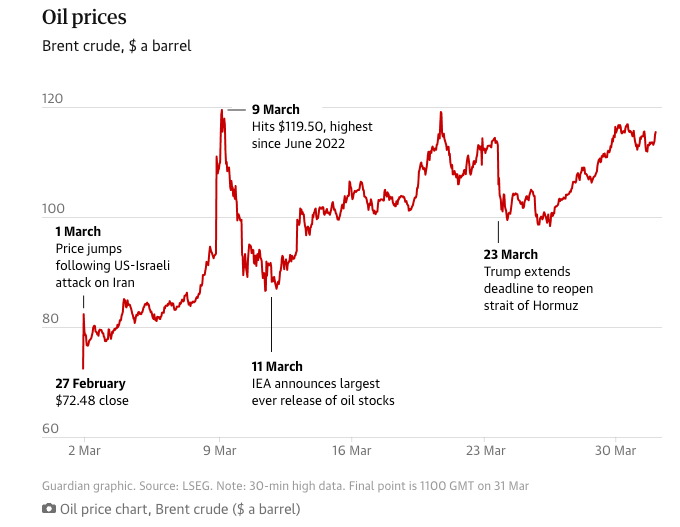
Analysts have raised 2026 oil price forecasts by the steepest margin on record, with Brent crude now expected to average $82.85 per barrel this year, up 30% from February's $63.85 projection made before the Iran war began. The $19 surge represents the largest annual forecast increase in Reuters poll data going back to 2005. Yet benchmark prices tell only part of the story. While Brent hovered around $118 Tuesday after Iran attacked a Kuwaiti tanker off Dubai, fuel prices have exploded far higher. Jet fuel in Europe has already hit all-time highs equivalent to more than $215 per barrel, while US gasoline topped $4 per gallon for the first time since 2022. "Crude oil prices don't reflect the global supply crisis," Bloomberg's Dan Murtaugh wrote. The disconnect stems from strict fuel specifications that limit market size and liquidity. Hundreds of gas stations in Australia have reported shortages as disruption ripples globally. Some analysts warn prices could test 2008's record of $147 per barrel if the Strait of Hormuz remains closed for another month. The month-long conflict has led to the effective closure of Hormuz, which typically carries 20% of global oil. Gulf producers have cut output by up to 11 million barrels per day in the second quarter as storage filled up. Supply is projected to remain below pre-crisis levels throughout 2026 even after recovery begins. The IEA's record release of 400 million barrels from strategic reserves hasn't calmed markets either. Trump's messaging has also lost credibility. The president told advisers he was willing to end US operations even if Hormuz remained shut, according to the Wall Street Journal. Yet he simultaneously threatened Monday to "completely obliterate" electricity plants, oil facilities, and "possibly" desalination infrastructure if Iran didn't reopen the strait. "Most advisers would say the president has to speak directly to the American people and fully acknowledge the economic pain that his policy has so directly caused," said Gene Sperling, a top economic adviser in Democratic administrations, in comments to Fortune. "Instead, you have a strategy of not recognizing or even dismissing people's economic pain." Consumer sentiment fell to 53.3 in March, its lowest since December, with higher-income households showing particularly large drops as they faced both escalating gas prices and volatile markets. Just 38% of US adults approve of Trump's economic handling, and only 35% support him on Iran, according to a March AP-NORC survey. White House press secretary Karoline Leavitt called the oil price increases a "short-term fluctuation." "The uncertainty is now soaring," Yale professor Jeffrey Sonnenfeld told Fortune. Some traders now refuse to hold positions into weekends when major strikes have occurred, afraid of being caught by Trump's volatile pronouncements. |
US Hiring Hits Six-Year Low as Job Market Stalls
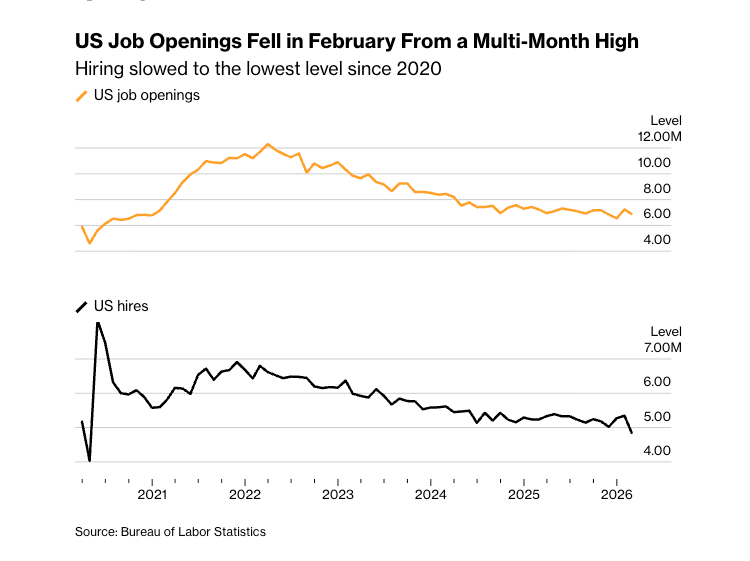
US job openings fell to 6.88 million in February from an upwardly revised 7.24 million in January, while hiring plunged to the lowest level since March 2020 at the start of the pandemic. The pullback shines a light on further weakness in a labor market that has sputtered for over a year. Hiring dropped by 498,000 positions to 4.85 million last month, pushing the hiring rate down to 3.1% from 3.4% in January. The decline was concentrated in construction, leisure and hospitality, and business services, potentially reflecting severe winter weather during February. The JOLTS report highlights what Fed Chair Jerome Powell called a "zero-employment growth equilibrium" that "has a feel of downside risk." Employers added fewer than 10,000 jobs per month in 2025, the weakest hiring outside a recession since 2002. This year started with 126,000 jobs added in January, before February saw 92,000 jobs lost. Despite sluggish hiring, unemployment has remained at 4.4%, creating what economists describe as a low-hire, low-fire environment where companies hesitate to add staff but don't want to let go of existing workers. Growing concerns center on AI taking over entry-level work and companies delaying hiring decisions until they understand how to deploy the technology. The quits rate, which measures workers voluntarily leaving jobs, dropped to 1.9%, matching the lowest level since 2020. This suggests workers have less confidence in finding better opportunities elsewhere. Meanwhile, layoffs edged up but remained low overall, even as major employers like Meta and Oracle announced sizable cuts to redirect resources toward AI investment. The ratio of vacancies per unemployed worker eased to 0.9 in February, down from a peak of 2 to 1 in 2022. This reinforces the Fed's view that the labor market isn't creating inflationary pressure. With the Iran war expected to push inflation higher this year, officials are now seen keeping rates elevated even as employment remains soft. Economists blame the stagnation on uncertainty from Trump's trade and immigration policies that have undercut both labor demand and supply. Private nonfarm payrolls grew by just 18,000 jobs per month on average in the three months through February. Friday's March jobs report is expected to show payrolls rebounded with 60,000 new positions added, though Indeed's job-posting index showed openings fell sharply in March as Iran war uncertainty mounted. Separate data Tuesday showed consumer confidence unexpectedly rose in March, though the share saying jobs are currently hard to get climbed to the highest since 2021. |
That’s all for today!/
AI Alone Can’t Run Revenue
Finance doesn’t run on “mostly right.” It runs on math.
In The Architecture Behind AI-Native Revenue Automation, Tabs’s CTO breaks down why LLMs alone aren’t enough—and what it actually takes to build audit-ready, AI-driven contract-to-cash systems for modern B2B teams.
