S&P 500 Wobbles as War Hits Business Activity
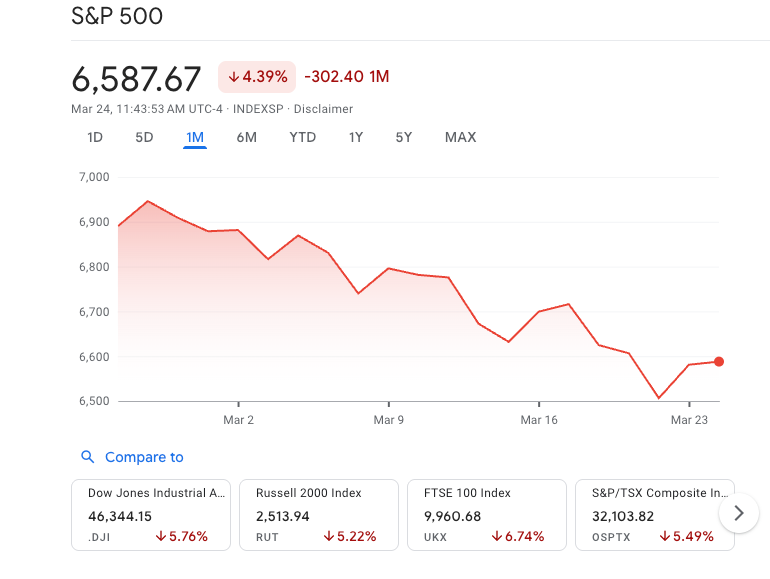
US business activity slowed to an 11-month low in March as the Iran war raised energy prices and input costs, reinforcing stagflation fears that have dragged the S&P 500 down 4.3% since fighting began. The index is riding a four-week losing streak and has fallen 4% in March alone. S&P Global's flash Composite PMI Output Index fell to 51.4 this month from 51.9 in February, the lowest reading since April 2025. The drop came entirely from services, where the PMI slipped to 51.1 from 51.7. Manufacturing improved to 52.4 from 51.6, partly reflecting "some softening of the tariff impact on order books." Private-sector employment dropped to 49.7, the first contraction in 13 months, as firms reduced "overheads in the uncertain economic climate." Services industries led the decline. Input prices surged. S&P Global's measure of prices paid by businesses jumped to 63.2 from 60.0, "widely linked to the war-related spike in energy costs and tightening supply conditions." Those costs were passed through. A gauge of output prices rose to 58.9 from 56.9 in February. The survey's price gauges pointed to consumer price inflation racing back to around 4%. "Companies are reporting a hit to demand from the additional uncertainty and cost-of-living impact generated by the conflict," said Chris Williamson, chief business economist at S&P Global. "The Fed will therefore need to juggle these intensifying upside risks to inflation against the growing risk of the economy losing growth momentum." Despite the deteriorating backdrop, Barclays raised its year-end S&P 500 target on Tuesday to 7,650 from 7,400, implying 16.2% upside from Monday's close. The bank lifted its earnings-per-share estimate to $321 from $305, betting that strong corporate earnings led by technology and resilient economic growth will outweigh macro risks. "We believe the US continues to offer stronger nominal growth than other major economies and a secular growth engine in technology that shows few signs of stopping," Barclays strategists said. But they warned the road "likely stays bumpy until we turn a corner." The bank outlined a bear-case scenario of 5,900 for the index, warning that sustained higher oil prices could force the Fed into an "unenviable corner." It also flagged rising redemption pressure in private credit funds as a risk that could trigger a sharper downturn. Barclays upgraded industrials to "positive" from "neutral" and raised materials and energy to "neutral" from "negative," citing improving industrial momentum, AI-linked capital expenditure, and benefits from higher energy prices. |
War Costs $1.3 Million Per Minute as Economic Damage Mounts
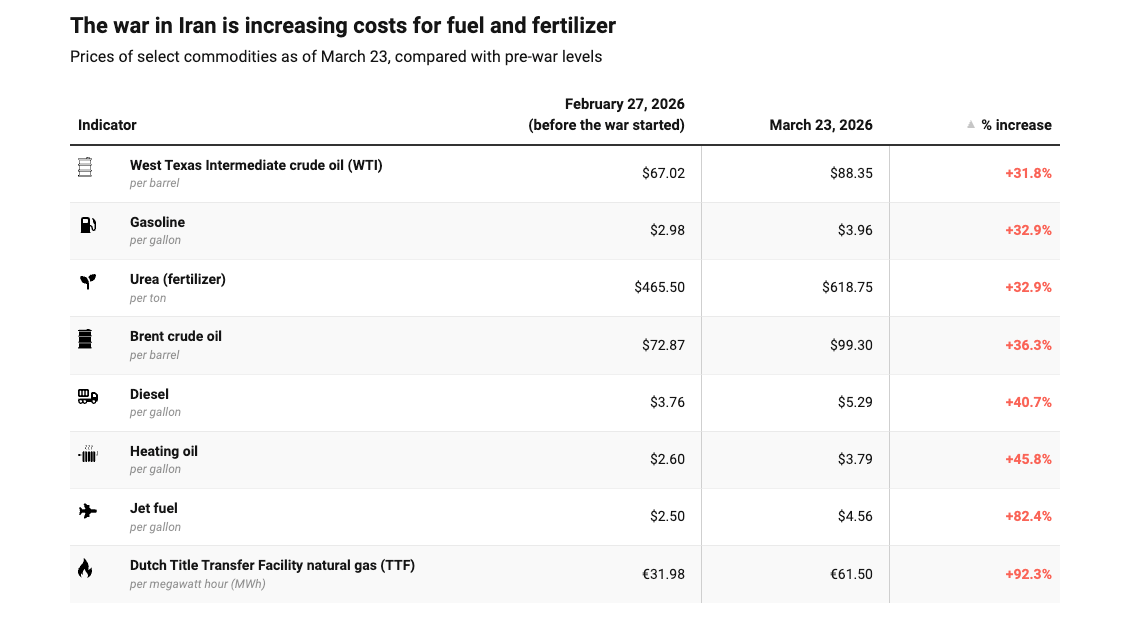
The Iran war cost $11.3 billion in just the first six days, burning through more than $1.3 million per minute. By week's end, the total will likely surpass $25 billion, with the Pentagon requesting an additional $200 billion from Congress to sustain operations. The true cost extends far beyond Pentagon spending. Harvard expert Linda Bilmes told the New York Times that most expenses arrive later, particularly lifelong medical benefits for service members. If troops claim benefits at the same rate as the 1991 Gulf War, that alone would cost at least $600 billion. Total cost could exceed $1 trillion. The asymmetry of warfare amplifies costs. The US launched about 800 interceptor missiles in the opening week, spending more than $3 billion on Patriot missiles alone. Each PAC-3 interceptor costs $4 million while Iranian Shahed drones cost just $20,000 to $50,000. Iran has launched thousands of these "poor man's cruise missiles" since the war began. "There is a disconnect," said Northeastern professor Denise Garcia. "The US and other major powers built massive aircraft carriers, fighter jets and costly missiles, yet it is the cheaper drones that are causing terror." The economic fallout compounds daily. Gas prices have jumped 92 cents nationally since February 28, with four of America's five biggest cities hit harder than the national average. Phoenix saw prices surge $1.33 per gallon. Fertilizer costs are 40% higher year-over-year, threatening future grocery price increases. Oil executives warned of lasting damage at the CERAWeek conference in Houston. "The consequence is not only high energy prices. It will damage other supply chains," said TotalEnergies CEO Patrick Pouyanne, pointing to disrupted helium shipments critical for semiconductors and medical supplies. ADNOC CEO Sultan Al Jaber warned the jump in oil prices is "slowing economic growth globally", with costs "mounting by the day" for "factories to farms to families around the world." The Strait of Hormuz closure creates unprecedented disruption. Unlike the 2022 Russia-Ukraine shock, which involved rerouting and sanctions, this represents a physical chokepoint. About 9 million barrels per day have been shut-in across Saudi Arabia, Iraq, Kuwait and the UAE. Alternative pipeline routes offer only 3.5-5.5 million barrels per day of spare capacity. Energy analyst Simon Flowers told the New Yorker that if attacks on energy infrastructure continue, "oil prices would likely go to $150 a barrel, and quite possibly to $200." Goldman Sachs warned prices could exceed their 2008 all-time high if disruption persists. Trump's shifting messaging creates additional volatility. Oil plunged Monday after he claimed "productive" talks with Iran, then climbed back above $100 Tuesday after Tehran denied any dialogue. Markets now face what Barclays called a "fog of war" fueling violent swings. Opinion polls show 67% of Americans disapprove of Trump's handling of cost of living, with 61% disapproving of his economic management. The war has cost more than the entire annual budgets of agencies Elon Musk targeted for cuts, including the IRS ($12.3 billion) and FDA ($7.2 billion). |
LaGuardia Crash Kills Two Pilots as Safety Warnings Surface
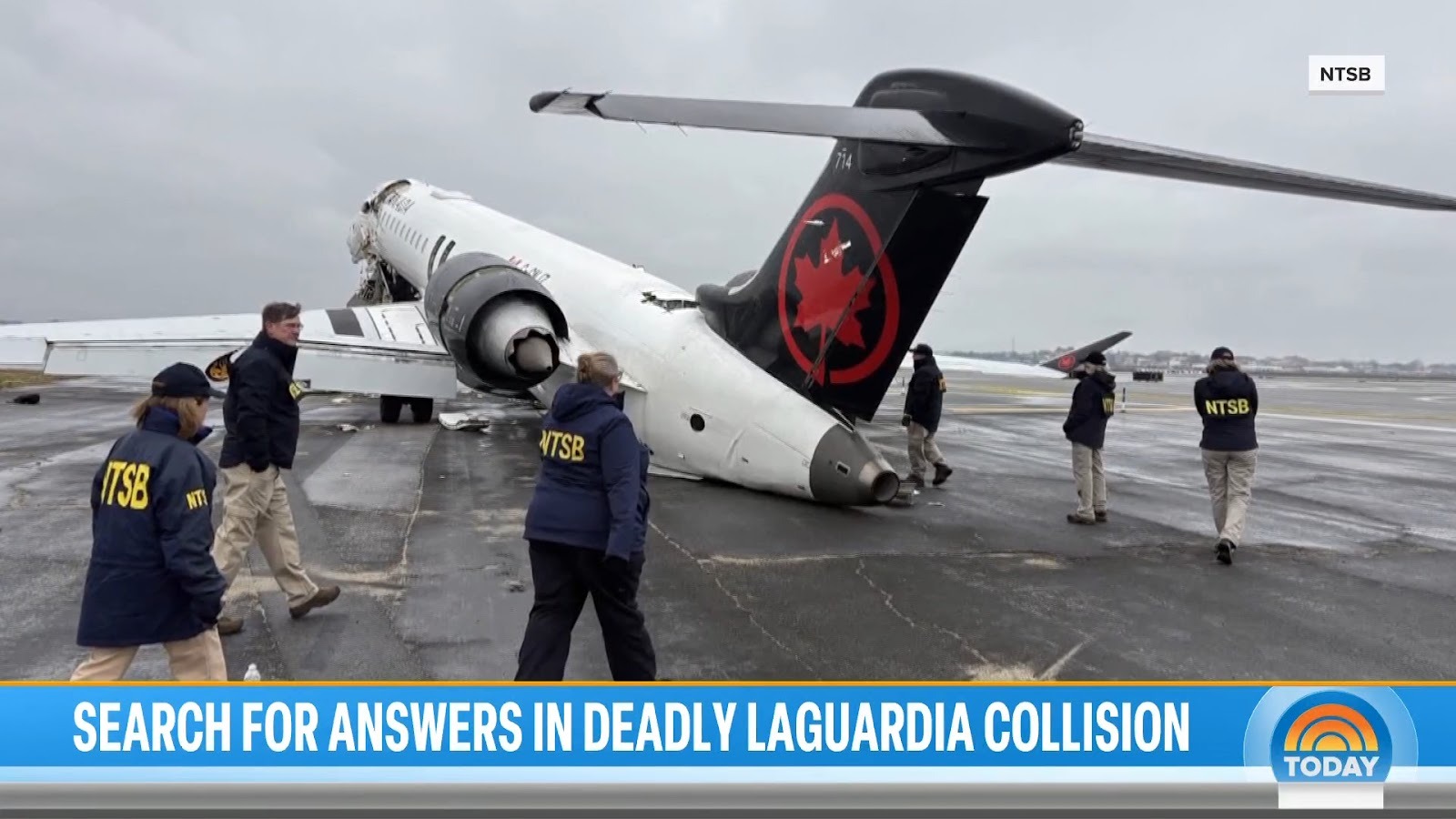
Two pilots died Sunday night when Air Canada Express Flight 8646 collided with a fire truck at New York's LaGuardia Airport, exposing systemic safety concerns at one of America's busiest airports. The crash killed pilots Antoine Forest and Mackenzie Gunther while injuring 41 of the 72 passengers aboard the Montreal-bound regional jet. The collision occurred around 11:45 p.m. as the plane landed on Runway 4. Air traffic control audio captured on LiveATC shows a controller clearing the Port Authority fire truck to cross the runway, then immediately ordering it to stop. After the crash, a controller is heard saying "I messed up." Passengers credited the pilots with saving lives by braking hard to slow the plane. "It was like a grinding sound. Then, a couple seconds after that, you just felt the collision," passenger Rebecca Liquori told NBC News. "It was like the loudest boom I've ever heard." The crash tore off the aircraft's nose, leaving mangled debris dangling toward the ground. Liquori, a registered nurse, opened the emergency exit door and helped passengers evacuate. "Everybody was scared. Everybody thought they were going to die," she said. The tragedy followed months of safety warnings from pilots. NASA's Aviation Safety Reporting System received dozens of complaints about LaGuardia operations. One pilot wrote last summer: "Please do something. The pace of operations is building in LGA. The controllers are pushing the line." That same pilot referenced the January 2025 Washington DC collision that killed over 60 people, warning that "on thunderstorm days, LGA is starting to feel like [Reagan National] did before the accident there." The crash comes as US airports face extreme operational stress. Air traffic controller shortages have been exacerbated by Trump administration's personnel cuts. A partial government shutdown since mid-February has forced hundreds of TSA agents to work without pay or quit entirely, creating massive security lines. An NTSB investigator sent to LaGuardia Monday was delayed three hours by security lines in Houston. NTSB Chair Jennifer Homendy said the investigator waited "until we called to beg, to see if we can get her through." Transportation Secretary Sean Duffy said LaGuardia has 33 certified controllers with seven more in training, below the staffing goal of 37. Training new controllers for LaGuardia airspace takes more than a year. The airport reopened Monday afternoon with a single runway, though the damaged aircraft remained at the crash site. Over 600 flights were cancelled. The collision occurred 34 years to the day after a 1992 USAir crash at LaGuardia killed 27 people. This was not LaGuardia's only recent incident — in October, two Delta jets collided on a taxiway, and in July a co-pilot reported a near-collision after controllers cleared a plane to cross a runway while another aircraft was landing. |
That’s all for today!/
