In partnership with

Hi there!
Welcome to FinSoar! In this knowledge economy, a blog post can trigger unprecedented selloffs, companies are suing over tariffs, and Novo Nordisk might become obsolete in the near future:
How a Blog Post Triggered Market Meltdowns
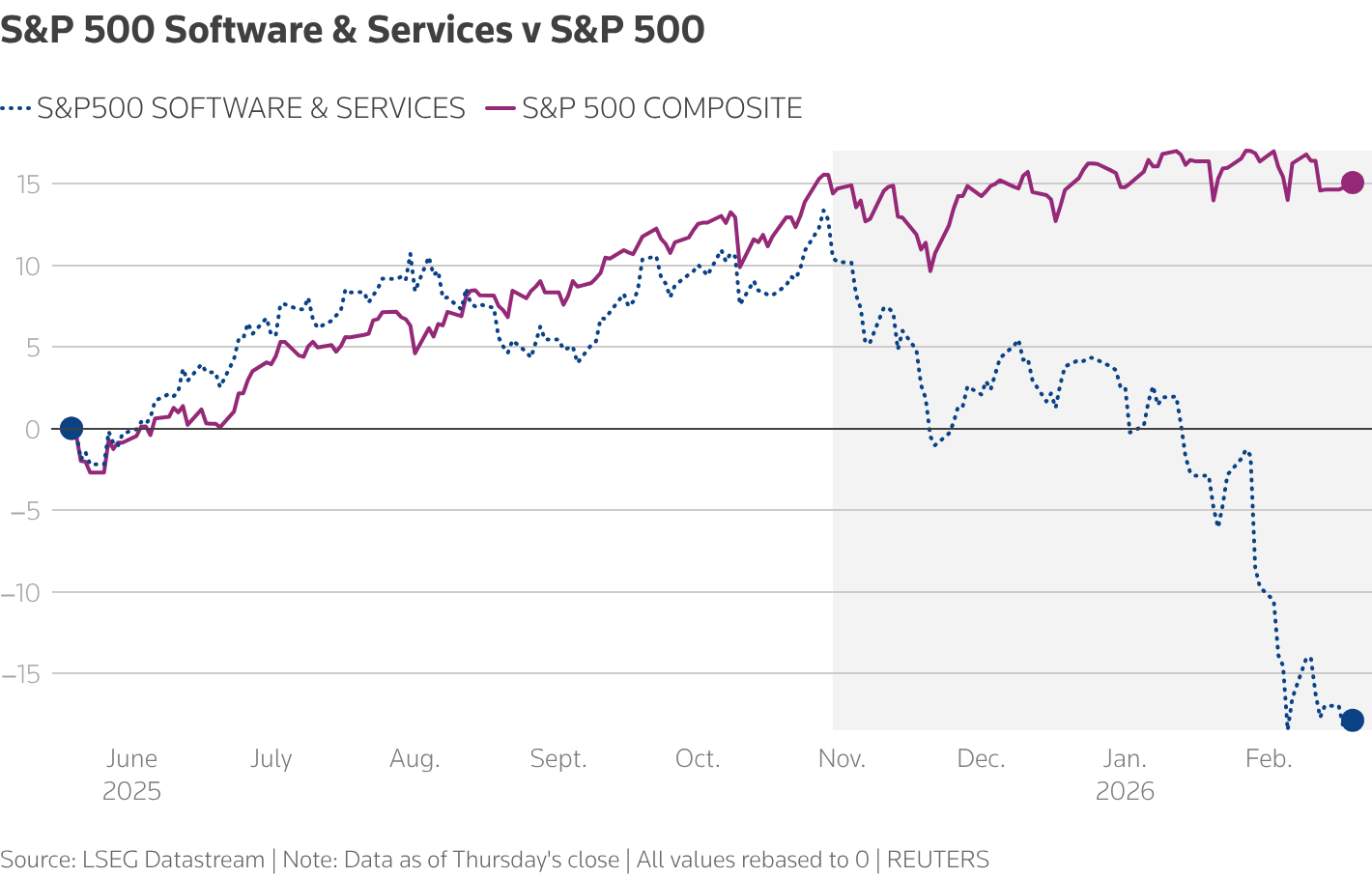
The Dow fell 822 points on Monday, driven partly by a 7,000-word hypothetical published over the weekend. A viral report by Citrini Research imagined a 2028 where AI triggers mass white-collar unemployment, pushing the jobless rate to 10.2% and the S&P 500 down 38%. The post was framed as "a scenario, not a prediction," but it was received like a prophecy by the markets anyway. Perhaps, a self-fulfilling one… I say this because the selling that ensued was brutal and targeted. IBM tumbled 13%, its worst one-day decline since 2000. Software stocks Datadog, CrowdStrike, and Zscaler each dropped more than 9%. DoorDash fell 6.6% after Citrini called it the "poster child" for how AI would dismantle companies built on friction. American Express dropped 7.9%, Mastercard 6.3%, and Visa 4.3%. Private credit firms took hits too, with KKR down 9%, Apollo 5.2%, and Blackstone 6.1%. Every stock Citrini mentioned by name was down. The report's core argument centers on what author James van Geelen calls "ghost GDP:" output generated by AI that never circulates through the real economy because machines spend nothing on discretionary goods. The scenario envisions a negative feedback loop where companies cut workers to boost margins, displaced workers spend less, forcing more AI adoption to protect margins. Citrini argues that "friction was going to zero," eliminating businesses built on habitual intermediation. Economists pushed back. Robert Armstrong at the FT said the scenario felt "incoherent," questioning how GDP could rise while consumption collapses without explaining where investment or exports go. Ed Yardeni noted the market was "discounting a scenario in which AI is our Frankenstein monster." If you think I'm inflating impact, the panic was global. For instance, Indian IT stocks that were already under pressure plunged 4.7% to their lowest since August 2023. The NSE Nifty IT Index is on track for its worst month since 2003, wiping out more than $54 billion. Citrini's report specifically called out Tata Consultancy Services, Infosys, and Wipro, arguing their model depended on Indian developers costing a fraction of American counterparts while "the marginal cost of an AI coding agent had collapsed to, essentially, the cost of electricity." The S&P 500 Software & Services Index has fallen 24% year to date. Citrini's scenario may or may not unfold, but it's alarming to note that a single blog post can cause market upheaval of this magnitude. Why do you think this is? |
Trump's Tariff Do-Over Sparks Refund Battle
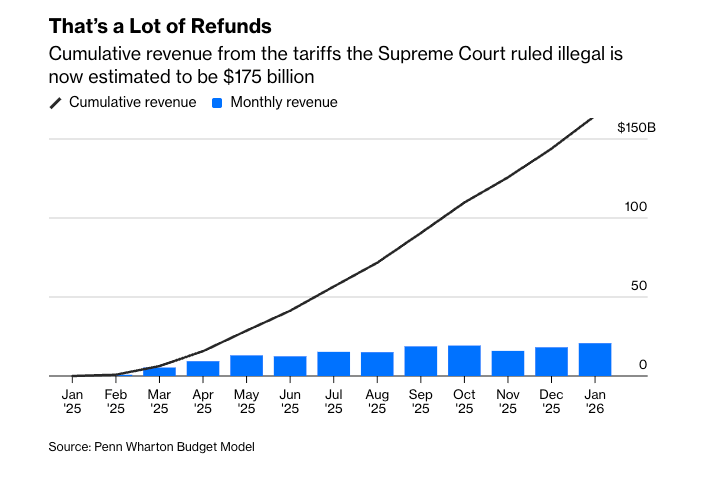
Trump announced a 10% global tariff on Friday after the Supreme Court struck down his emergency tariffs. On Saturday, he posted the rate would rise "effective immediately" to 15%. On Tuesday morning, hours before the levy took effect at 12:01 a.m., US Customs sent importers a memo: the rate would be 10% after all. The whiplash prompted the EU to freeze implementation of its trade deal with Trump from last summer. European Parliament trade committee chairman Bernd Lange called it "pure tariff chaos." The White House said it was working to raise the rate to 15% in a separate order requiring Trump's signature, but provided no timeline. The real fight is over refunds. The government collected an estimated $175 billion in now-illegal tariffs. FedEx filed suit Monday seeking a "full refund," marking the first major company to demand reimbursement after the Supreme Court ruling. Nearly 2,000 importers have filed lawsuits at the Court of International Trade, with thousands more expected. Consumers who paid higher prices will see almost certainly nothing. Refunds go to importers of record like Costco, Walmart, and Target, not end customers. The Harvard Business School Pricing Lab found businesses ate about three-quarters of tariff costs themselves, passing one-quarter to consumers through higher prices. The Tax Foundation estimates tariffs cost the average household $1,000 in 2025. California businesses paid $26.2 billion in illegal tariffs, Texas $11.4 billion. But getting money back will be difficult. Trump and Treasury Secretary Scott Bessent have indicated they won't refund without a fight. The process could take 12 to 18 months, even in the best case. Justice Brett Kavanaugh warned the refund process would be "a mess." There are roughly 600,000 US importers owed money. Many lack the resources to file suit. Larger corporations have advantages when fighting for refunds and are more likely to have passed costs to customers anyway. Senate Democrats are calling for refunds to go to small businesses and for large companies to pass savings to customers, but widespread price declines are unlikely. |
Novo Nordisk Loses $475 Billion as Weight Loss Drug Flops
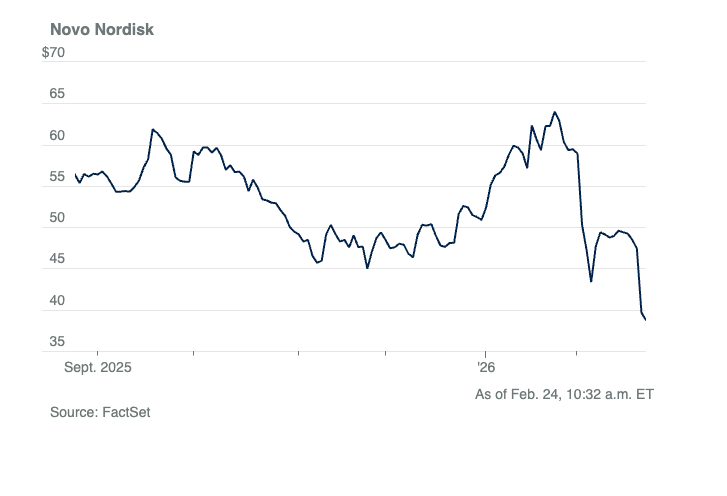
Novo Nordisk shares collapsed 16.5% Monday after its next-generation weight loss drug CagriSema failed to beat Eli Lilly's Zepbound in clinical trials. The stock hit its lowest level since June 2021, when Wegovy launched and triggered the boom that briefly made Novo Europe's most valuable company. CagriSema delivered 23% weight loss after 84 weeks compared to 25.5% for tirzepatide, Lilly's drug sold as Zepbound. The trial failed its primary goal of showing non-inferiority. Novo executives blamed the open-label design, meaning participants knew which drug they were taking, creating potential bias toward the well-known product.
Deutsche Bank analyst Emmanuel Papadakis called CagriSema "somewhat obsolete" as a competitive upgrade. CEO Mike Doustdar pushed back, calling it "a fantastic drug" that will have "the best weight-loss label" when it reaches market early next year. The failure caps a catastrophic stretch for Novo. Shares have fallen 56% over the past year, wiping out $475 billion in market value. The company this month predicted sales and profits would fall as much as 13% in 2026, citing US price cuts, patent expiries in Canada, Brazil, India, and China, and fierce competition from compounding pharmacies selling cheaper copycat versions. Novo announced plans to slash Ozempic and Wegovy prices 34% and 50% respectively, starting January 2027, but the stock fell another 2.5% Tuesday. Lilly shares rose about 4% Monday as the competitive gap widened. Morningstar lowered its fair value estimate from DKK 372 to DKK 343 per share after cutting CagriSema sales forecasts from DKK 85 billion to DKK 50 billion in 2035. Jefferies analysts said Novo faces "pressing need for M&A" and could spend up to $35 billion this year on acquisitions. Novo filed CagriSema with the FDA in December based on earlier trial data. A decision is expected by late 2026. The company is exploring higher-dose trials to salvage the drug's prospects. |
Meet America’s Newest $1B Unicorn

A US startup just hit a $1 billion private valuation, joining billion-dollar private companies like SpaceX, OpenAI, and ByteDance. Unlike those other unicorns, you can invest.
Over 40,000 people already have. So have industry giants like General Motors and POSCO.
Why all the interest? EnergyX’s patented tech can recover up to 3X more lithium than traditional methods. That's a big deal, as demand for lithium is expected to 5X current production levels by 2040. Today, they’re moving toward commercial production, tapping into 100,000+ acres of lithium deposits in Chile, a potential $1.1B annual revenue opportunity at projected market prices.
Right now, you can invest at this pivotal growth stage for $11/share. But only through February 26. Become an early-stage EnergyX shareholder before the deadline.
This is a paid advertisement for EnergyX Regulation A offering. Please read the offering circular at invest.energyx.com. Under Regulation A, a company may change its share price by up to 20% without requalifying the offering with the Securities and Exchange Commission.
That’s all for today!
