Welcome to FinSoar! Micron is pledging $250 million to Trump Accounts despite falling stocks, eggs are a federal issue, and June’s job report has economists concerned:
Disappointing June Payrolls
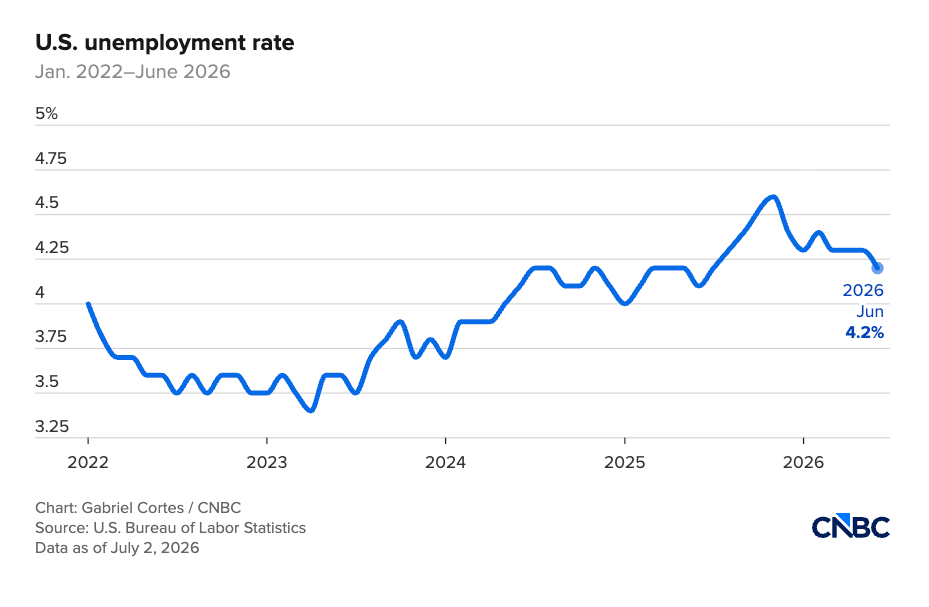
US job growth slowed to a near crawl in June, with employers adding just 57,000 jobs, about half what economists expected, in a report that revived questions about the labor market's momentum. The unemployment rate ticked down to 4.2% from 4.3%, but largely because more people left the workforce. The Dow Jones consensus had called for 115,000 jobs. The revisions made it worse — the Labor Department cut April and May by a combined 74,000 jobs, lowering May to 129,000. The drop in the jobless rate was not the good kind. Labor force participation fell to 61.5%, a five-year low, as the labor force shrank by 720,000. Economists tied the decline to baby-boomer retirements and tighter immigration policy, with prime-age participation also falling. Leisure and hospitality shed 61,000 jobs, its largest decline since the pandemic — despite the US hosting the World Cup. Healthcare, professional services, construction, and manufacturing all added jobs. That leisure number drew open skepticism on Wall Street. Harris Financial's Jamie Cox told Fortune the data was "misleading and should be disregarded," arguing there is "zero chance" the sector shrank during the World Cup. Bank of America card data showed spending up 5.4% over the group stage, driven by non-locals. The trend still beats last year — employers added an average of 92,000 jobs a month over the first half of 2026, against a loss of 8,000 a month in the back half of 2025. Wages are still losing to prices. Average hourly earnings rose 3.5% year over year, below the 4.2% inflation rate from May. The Fed reads the soft print as breathing room. Markets pulled back bets on a near-term hike, with odds of a July increase falling to roughly one in six from one in three. As FHN's Chris Low put it, there is not enough strength to justify a hike, nor enough weakness to justify a cut. The low-hire, low-fire freeze persists, wages lag inflation, and the workforce is shrinking. |
Egg Giants Settle Federal Price-Fixing Case for $3.3 Million
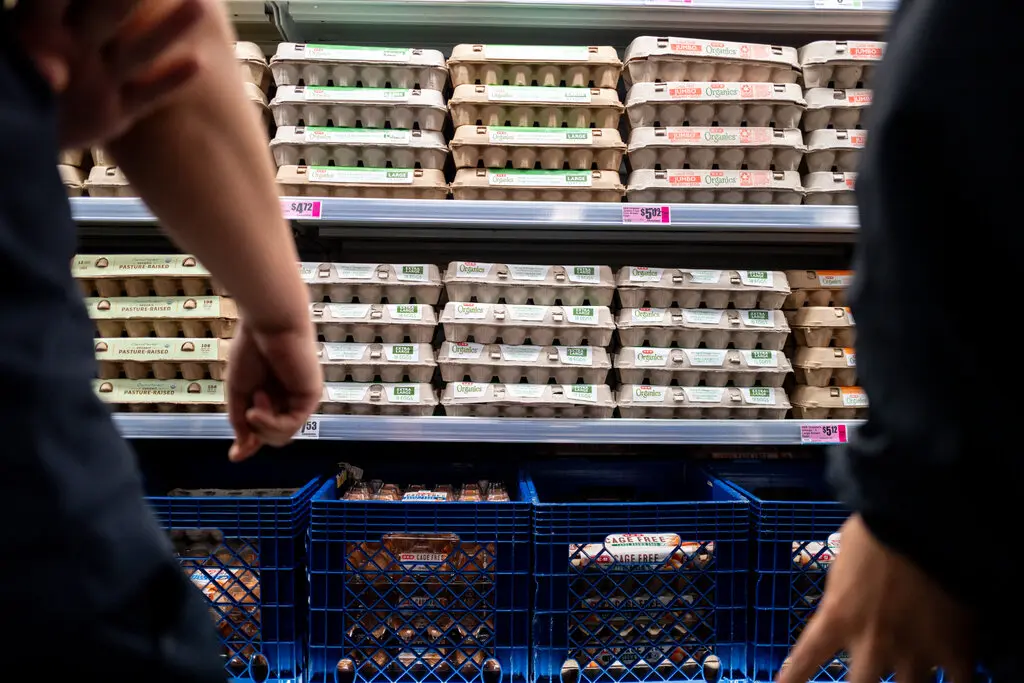
Three of the nation's largest egg producers agreed to settle a federal antitrust lawsuit accusing them of manipulating egg prices for nearly three years, paying $3.3 million and donating 53 million eggs. The Justice Department and 17 states reached the proposed settlement with Cal-Maine Foods, Versova, and Hickman's Egg Ranch, none of which admitted wrongdoing. The alleged scheme was specific. Prosecutors said the companies conspired from June 2022 to March 2025 to limit egg production so supply would not meet demand, then placed high-volume bids with the Egg Clearinghouse to drive up prices. Those coordinated bids created the appearance of stronger demand, inflating daily price quotes published by Urner Barry, whose index is widely used in egg supply contracts nationwide. Executives discussed the plan over emails and texts, the lawsuit said. The timing of the drop is telling. The DOJ said price quotes fell significantly after the companies learned of the investigation and were told to preserve documents in March 2025 — the same month wholesale prices peaked above $6 a dozen. The eggs are worth more than the cash. At the current retail price of about $2.19 a dozen, the 53 million donated eggs could be worth roughly $9.7 million, nearly triple the monetary payment. The producers pinned prices on bird flu. Cal-Maine called the claims "baseless," with CEO Sherman Miller citing avian flu, the pandemic, and weather as the drivers. Versova said it lost more than 25 million hens since 2022 and that most of its eggs sell on grain-based contracts tied to feed costs. The settlement carries teeth beyond the payout — the companies must cooperate with federal monitoring and adopt compliance programs. The deal still needs court approval following a 60-day public comment period. The politics are about affordability. Associate Attorney General Stanley Woodward said no product "more quintessentially represents affordability" than eggs. Egg prices became a symbol of post-pandemic inflation, spiking 150% year over year in February 2023, the largest annual jump on record. The sharp price retreat once investigators showed up is hard to ignore. For shoppers who paid $6 a dozen at the peak, a $3.3 million settlement and some donated eggs may feel light. |
Micron Pledges $250 Million to Trump Accounts as Its Stock Wobbles
Micron said it would invest $250 million in Trump Accounts, the largest corporate pledge yet to the new children's savings program, even as its high-flying stock stumbled this week. President Trump praised the memory-chip maker's move, calling it the biggest corporate investment of its kind. The accounts open for contributions July 4. The pledge has two parts. Micron will match employee contributions of up to $1,000 per child under 18, plus a one-time $250 deposit for children in states where it operates, including Idaho, New York, Virginia, and Texas. The company expects to reach up to one million children. Created under last year's tax bill, Trump Accounts give a $1,000 federal seed deposit to US citizen children born between 2025 and 2028, growing tax-free like an IRA. Assets must sit in low-fee US stock index funds until the child turns 18. Micron joins a crowded field. Nvidia, Goldman Sachs, JPMorgan, Intel, and Uber have all pledged to match the Treasury's $1,000 contribution for employees' children. The tech industry has broadly courted the administration, with 17 CEOs joining Trump on a recent China trip. CEO Sanjay Mehrotra framed the pledge around "US semiconductor leadership," tying it to more than $200 billion in domestic manufacturing already committed. Trump's praise could not lift the shares. Micron closed down 5.5% at $975.56 Thursday after a 10.6% drop the prior session, dragged by a broader tech selloff. Rivals SK Hynix and Samsung tumbled in South Korea, where the KOSPI fell 7.9%. The pullback follows a monster run — Micron is still up about 240% in 2026, with 37 record closing highs in the first half and a market value above $1 trillion. Not everyone is convinced. Michael Burry disclosed a short position, calling Micron a "destroyer of capital" with a 42-year median return on invested capital of just 4%. He argued the stock's extension above its 200-day average exceeds even the dot-com peak, framing high-bandwidth memory as a cyclical commodity, not a scarce prize. Micron is spending goodwill on a politically favored program while its valuation draws both presidential applause and a famous short-seller's scorn. Whether the AI boom that funded it holds is the harder question. |
That’s all for today!/
