In partnership with

Hi there!
Welcome to FinSoar. The Supreme Court just struck down tariffs, the President may be planning a war with Iran, and NVIDIA opted to invest a lower amount than promise in OpenAI:
Supreme Court Strikes Down Trump's Emergency Tariffs
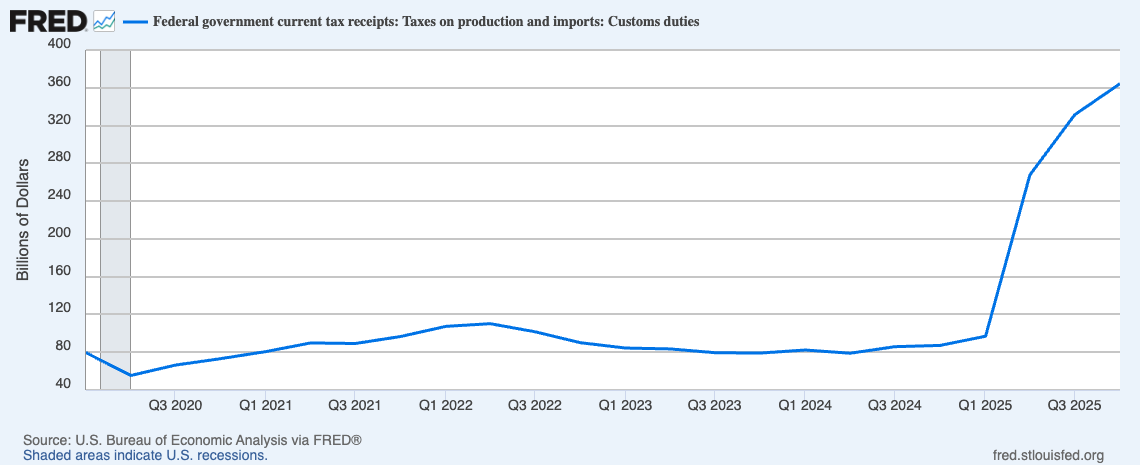
The Supreme Court ruled 6-3 on Friday that Trump exceeded his authority by imposing sweeping tariffs under emergency powers, striking down a core pillar of his economic agenda. Chief Justice John Roberts wrote the majority opinion, joined by the three liberal justices and two Trump appointees, Amy Coney Barrett and Neil Gorsuch. The ruling centers on tariffs imposed under the International Emergency Economic Powers Act, a 1977 law that allows the president to "regulate" imports during national emergencies. Trump used IEEPA to justify his "reciprocal" tariffs on nearly every country and separate duties on Canada, Mexico, and China tied to fentanyl trafficking. No president had ever used the law to impose tariffs before Trump. Roberts wrote that the Constitution "very clearly" gives Congress the power to impose taxes, including tariffs. The court applied the "major questions doctrine," the same principle used to strike down Biden's student loan forgiveness. Trump had claimed the words "regulate" and "importation" in IEEPA gave him authority to impose tariffs of any size, on any country, for any duration. Roberts responded bluntly: "Those words cannot bear such weight." The financial stakes are significant. The government collected about $130 billion through December under IEEPA tariffs, with Penn-Wharton Budget Model economists estimating more than $175 billion total at risk of refund. The court said nothing about how or whether refunds should happen. Justice Brett Kavanaugh warned in his dissent that the refund process "is likely to be a 'mess.'" The S&P 500 rose about 0.5% in mid-morning trading. Furniture stocks surged, with Wayfair up more than 5% and RH gaining 4%. Ten-year Treasury yields rose to 4.09%. The ruling doesn't eliminate all tariffs. Trump's steel and aluminum duties imposed under different statutes remain intact. The White House has previously said it will use other legal authorities to reimpose tariffs if IEEPA is struck down, though those pathways come with more constraints. Section 232 allows tariffs for national security but requires Commerce Department investigations. Section 122 of the Trade Act permits 150-day tariffs up to 15% to address balance-of-payment deficits. Trump called the decision "a disgrace" when informed during a meeting with governors. |
Trump Gives Iran Two Weeks as Military Buildup Accelerates
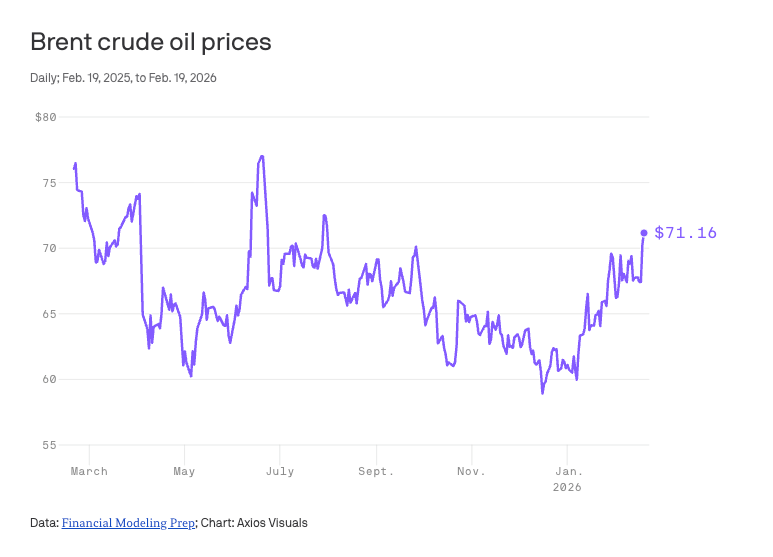
The US is assembling the largest military force in the Middle East since the 2003 Iraq war, positioning assets for potential strikes on Iran that could begin as soon as this weekend. President Trump told governors Thursday that Iran has "10 to 15 days, pretty much maximum" to reach a deal on its nuclear programme. Friday morning, he confirmed he was "considering" limited military strikes. The military buildup is staggering. Open-source tracking data shows the US has deployed more than 120 aircraft to the region within days, including E-3 Sentry AWACS, F-35 stealth fighters, F-22 air superiority jets, and supporting tankers. The USS Abraham Lincoln carrier strike group is already positioned in the Arabian Sea. The USS Gerald R Ford, the world's largest aircraft carrier, is en route from the Caribbean and expected to arrive within weeks. Military planning has reached an advanced stage. Reuters reported Friday that options include targeting individual Iranian leaders and pursuing regime change in Tehran. One US official pointed to Israel's success in killing at least 20 senior commanders during last June's 12-day war, saying the approach showed "the utility of that" targeting method. Trump has openly floated regime change, saying last week it "seems like that would be the best thing that could happen." The rationale remains murky. Trump insists he "obliterated" Iran's nuclear potential in strikes last June. CNN noted there is "little public debate" about what could be a weekslong assault, with the White House making "hardly any effort" to share the rationale. When asked why strikes might be needed, press secretary Karoline Leavitt said "there are many reasons" but offered no specifics. Talks this week in Geneva produced limited progress. Iran's foreign minister said the sides reached an understanding on "guiding principles," but one US official called the discussions "a nothing-burger." The Pentagon is moving personnel out of the region ahead of potential Iranian counterattacks. Oil markets reacted cautiously. Brent and WTI were both up about 5.3% for the week, trading near six-month highs. The Strait of Hormuz, which Iran has threatened to close, carries 20% of global oil supply. Traders have been buying call options and betting on higher prices. |
Nvidia Swaps $100 Billion OpenAI Pledge for Simpler $30 Billion Check
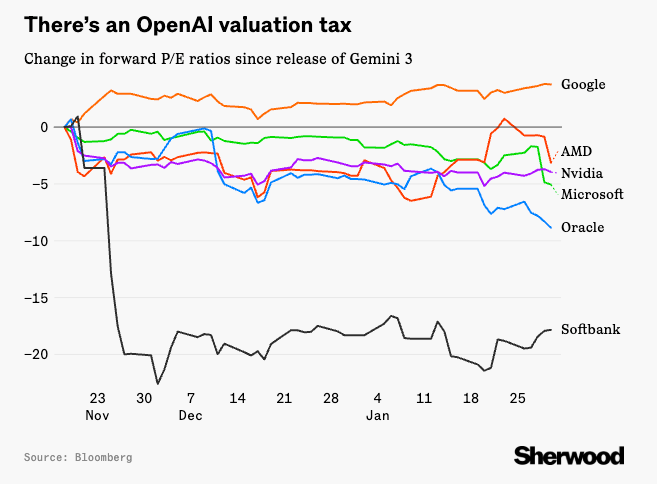
Nvidia is finalizing a straightforward $30 billion equity investment in OpenAI, abandoning the complex $100 billion infrastructure deal the companies announced with fanfare last September. The decision marks a retreat from one of the splashiest partnerships of the AI boom and underscores how companies are recalibrating their exposure to OpenAI amid growing investor jitters. The September announcement was a memorandum of understanding for Nvidia to build at least 10 gigawatts of computing power for OpenAI while investing $100 billion to help pay for it. OpenAI would lease chips from Nvidia over several years. The deal never progressed beyond early stages. Nvidia CEO Jensen Huang told reporters in January that the original agreement was nonbinding and "never a commitment." Behind the scenes, Huang has privately criticized what he described as a lack of discipline in OpenAI's business approach and expressed concern about competition from Google and Anthropic. The Wall Street Journal reported that if OpenAI falls behind rivals, it could dent Nvidia's sales. Both Anthropic and Google rely heavily on their own chips rather than Nvidia's GPUs. The $30 billion investment is part of a larger funding round raising more than $100 billion and valuing OpenAI at $730 billion pre-money, or potentially $850 billion post-money. Amazon is expected to invest up to $50 billion, SoftBank as much as $30 billion, and Microsoft billions more. The first phase is expected to close by month end. The simpler structure serves Nvidia's interests. Companies perceived as too dependent on OpenAI have been punished by markets. Microsoft suffered one of its biggest one-day drops on record after unveiling its OpenAI integration plans. Oracle's credit default swap spreads widened on similar concerns. Nvidia wants to be seen as the AI winner whose coattails others ride, not a company whose dominant position is threatened by overreliance on one customer. OpenAI will still spend much of the new capital on Nvidia hardware. Huang said in January that Nvidia would invest "probably the largest investment we've ever made" in the funding round. For reference, Nvidia has invested $5 billion in Intel and $10 billion in Anthropic. |
That’s all for today!
Become An AI Expert In Just 5 Minutes

If you’re a decision maker at your company, you need to be on the bleeding edge of, well, everything. But before you go signing up for seminars, conferences, lunch ‘n learns, and all that jazz, just know there’s a far better (and simpler) way: Subscribing to The Deep View.
This daily newsletter condenses everything you need to know about the latest and greatest AI developments into a 5-minute read. Squeeze it into your morning coffee break and before you know it, you’ll be an expert too.
Subscribe right here. It’s totally free, wildly informative, and trusted by 600,000+ readers at Google, Meta, Microsoft, and beyond.
