Hi there!
Welcome to FinSoar. The Fed takes one last stand of the year, Oracle has a problem, and Claude Code just came to Slack. Stocks, money, AI, all tied up:
The Fed's Last Stand: Powell Cuts Rates as Trump Names a Successor
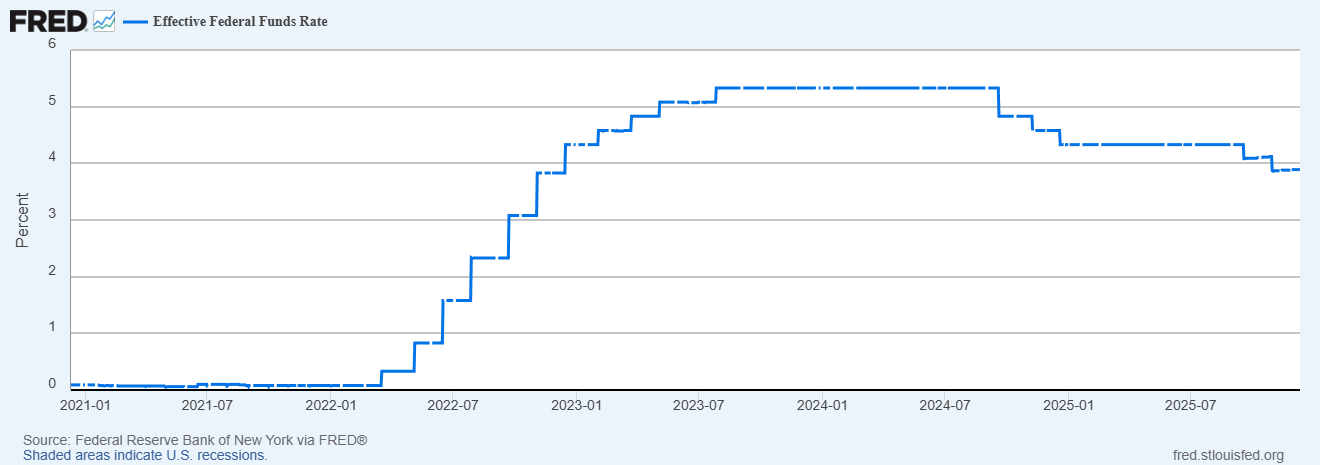
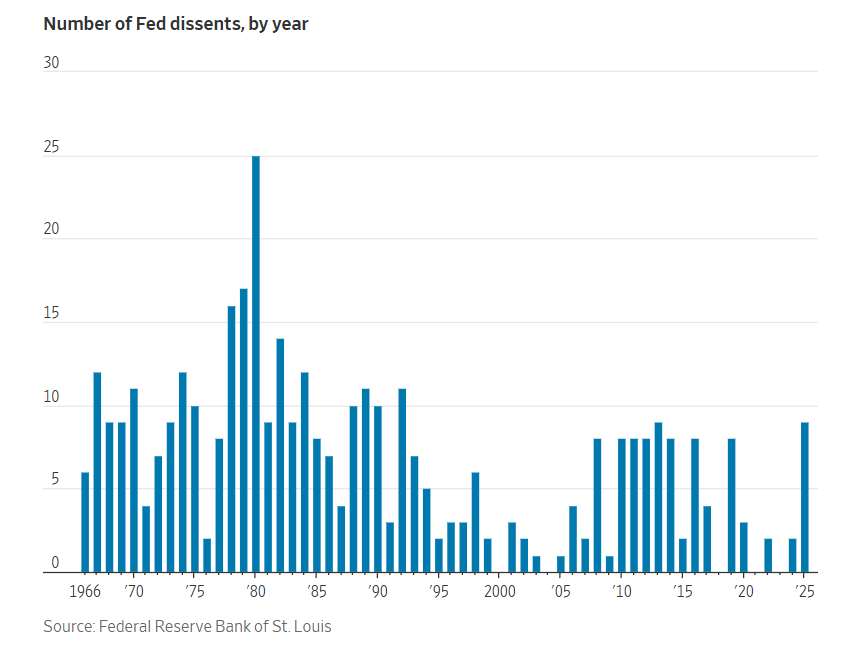
The Federal Reserve cut rates Wednesday by a quarter point to 3.5% to 3.75%, marking the third consecutive cut. But the 9-3 vote was the most divided since September 2019, and Powell signaled the cuts may be over: "We are well positioned to wait and see how the economy evolves." The dissents came from both sides. Governor Stephen Miran wanted a half-point cut (his third consecutive dissent), while Chicago Fed President Austan Goolsbee and Kansas City Fed President Jeffrey Schmid voted to hold rates unchanged. Four other non-voting participants registered "soft dissents" indicating they disagreed with the decision. The dot plot revealed just one cut projected for 2026, unchanged from September. But seven officials penciled in zero cuts next year. The division stems from conflicting data: inflation remains at 2.8% to 3% while unemployment climbed to 4.4%. Powell repeatedly said job growth may actually be negative due to overcounting in official figures. "I think a world where job creation is negative, I think we need to watch that situation very carefully," he said. Challenger reported announced layoffs topped 1.1 million through November. The Fed also announced it will resume buying Treasuries, starting with $40 billion in T-bills Friday, amid concerns about overnight funding market pressures.
The cuts haven't delivered much relief to consumers. The 10-year Treasury yield closed at 4.163% Wednesday, barely changed from 4.01% when cuts began in September. Average 30-year mortgage rates remain at 6.19%, virtually identical to the 6.20% from mid-September 2024. Credit card rates only fell 1 percentage point to 19.83%. Auto loan rates dropped just half a point. The only bright spot is that home equity lines fell from 9-11% to 7.81%. Powell has just three meetings left before his term expires in May. Trump said Tuesday he's close to naming a successor, with Kevin Hassett the front-runner at 72% on prediction markets. The New York Times noted Powell could follow the Marriner Eccles precedent from 1951: step down as chair but remain as governor until January 2028 to defend Fed independence. When asked about his legacy, Powell said: "I really want to turn this job over to whoever replaces me with the economy in really good shape." Thursday's Biggest Movers
|
||||||||||||||||||||||||||||||||||||||||||
Oracle's $10 Billion Problem Just Killed the AI Party
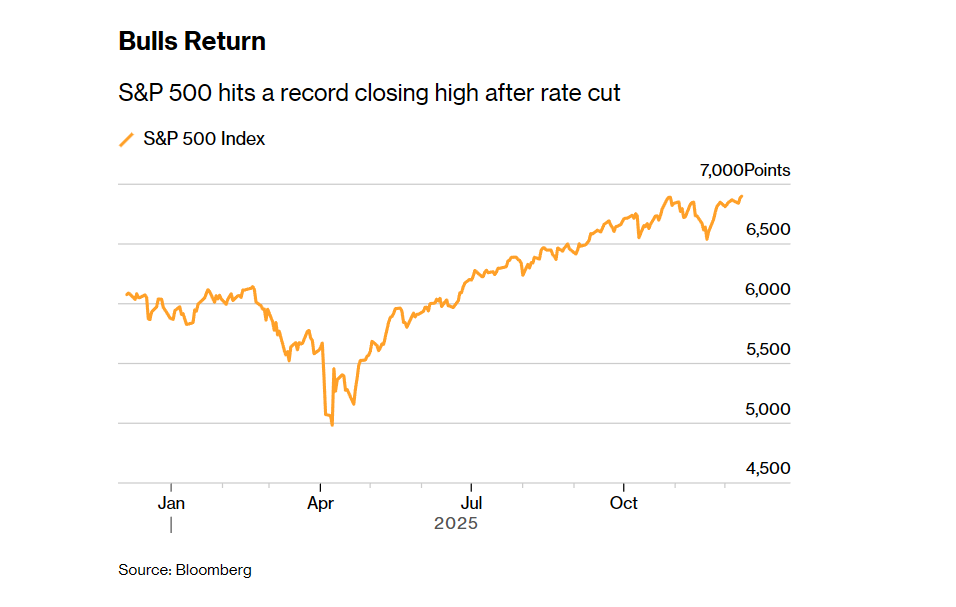
The S&P 500 and Dow hit record highs on Thursday, but look beneath the surface and the AI trade appears to be cracking. Oracle plunged 11% after reporting revenue of $16.06 billion versus $16.21 billion expected and raising its 2026 capital expenditure forecast by $15 billion to $50 billion. The damage spread. Nvidia fell 1.6%, Micron dropped 2%, and CoreWeave slid 0.9%. The Nasdaq Composite fell 0.26% while the Dow surged 1.34%, a clear rotation out of tech. Oracle's free cash flow came in at negative $10 billion, far worse than the expected negative $5.2 billion. The company has secured billions in construction loans for data centers in New Mexico and Wisconsin and expects to raise $20 billion to $30 billion in debt annually for three years. Broadcom initially jumped 3% after beating earnings, but reversed to fall 4.5% in after-hours trading after CEO Hock Tan failed to definitively rule out Google bringing chip development in-house. When asked about "customer tooling," Tan called it "an overblown hypothesis, which frankly, I don't think will happen." Sellers wanted a harder no. The Russell 2000 hit record highs as small caps benefit more from rate cuts. Visa surged 6% after a Bank of America upgrade, lifting the Dow. Retail investors are driving the rally to extremes. JPMorgan data shows retail poured $7.8 billion into stocks in the week to December 10, above the $6.3 billion weekly average. 2025 is set to be a record year for retail flows, tracking at 1.9x the five-year average. Bank of America's Bull & Bear Indicator stands at 7.8, just below the "extreme bullishness" level that historically signals a sell. Ed Yardeni recommended investors underweight the Magnificent Seven, warning: "The AI trade is turning into a Game of Thrones." Interactive Brokers' Steve Sosnick said: "If the steam is coming out of the AI trade, there's a lot of heavy lifting that has to be done by everything else." |
Claude Code Invades Slack: The $1 Billion Coding Agent Nobody Saw Coming
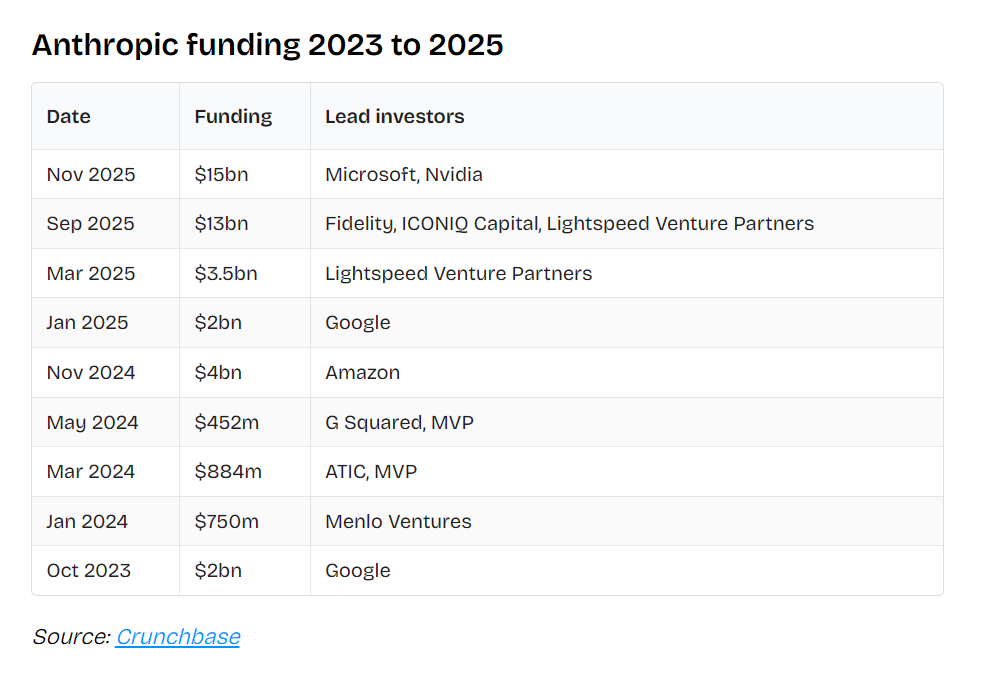
Anthropic launched a beta integration on Monday connecting Claude Code directly to Slack, letting developers tag @Claude in chat threads to automatically spin up coding sessions. The timing is strategic: Claude Code just hit $1 billion in annualized revenue six months after its public debut. The mechanics are simple but effective. Tag Claude in a Slack thread discussing a bug, and it analyzes the conversation context, identifies the right repository, investigates the issue, proposes a fix, and posts a pull request. All while updating the original thread with progress. Rakuten reduced software development timelines from 24 to 5 days using Claude Code, a 79% reduction. Customers now include Netflix, Spotify, KPMG, L'Oreal, Salesforce, Novo Nordisk, Uber, Snowflake and Ramp. The financial backing is massive. Microsoft and Nvidia pledged up to $15 billion in fresh investment last month, alongside a $30 billion commitment to run Claude Code on Microsoft's cloud. This adds to $8 billion from Amazon and $3 billion from Google. Anthropic made its first-ever acquisition earlier this month, buying Bun, a JavaScript runtime that's become essential infrastructure for AI-led software engineering. Broadcom also revealed a $10 billion custom chip order from Anthropic signed in September, increasing investor intrigue. The company views Claude Code as a core business line worth substantial investment. Internal data reveals dramatic shifts. Anthropic employees use Claude in 60% of their work and report a 50% productivity boost. The maximum number of consecutive tool calls increased 116%, while human intervention decreased 33%. But 27% of Claude-assisted work consists of tasks that wouldn't have been done otherwise. The competition is fierce. Cursor offers Slack integration, GitHub Copilot recently added pull request generation from chat, and OpenAI's Codex is accessible via custom Slack bots. The race is for workflow integration depth, not just model capability. Ironically, Slack CEO Denise Dresser just left to become OpenAI's first chief revenue officer, tasked with helping OpenAI escape its multibillion-dollar losses. OpenAI is valued at $500 billion but doesn't make a profit and has committed more than $1 trillion to cloud providers and chipmakers. |
That’s all for today!
