Welcome to this edition of FinSoar!
The IMF warned on Tuesday that the global economy is teetering on the edge of recession, with oil prices threatening to push growth below 2% for only the fifth time in four decades.
American farmers are already feeling the squeeze as the Strait of Hormuz blockade chokes off fertilizer supplies, forcing a shift away from corn and raising the specter of a global food crisis.
And amid the turmoil, United's CEO pitched the biggest airline merger in a generation to President Trump.
Fertilizer Shock Squeezes American Farmers as Strait of Hormuz Blockade Chokes Global Supply
The Iran war has opened a second front against American agriculture. With the Strait of Hormuz effectively closed for more than a month, roughly 30% of globally traded fertilizers have stopped moving. US farmers are finalizing purchases for spring planting, and benchmark nitrogen costs at US ports have risen nearly 30% since the conflict began. The disruption is forcing a shift in what gets planted. The USDA reported that farmers intend to plant 95.3 million acres of corn this year, down from 98.8 million in 2025, while soybean acreage will rise to 84.7 million from 81.2 million. The math is straightforward: corn requires nitrogen fertilizer, soybeans do not. With urea prices up 46% month-on-month between February and March, growers are planting what they can afford. The US produces most of its fertilizer domestically but still relies on imports for 25% of its supply, including 18% of nitrogen use. Qatar and Saudi Arabia were key suppliers. That supply now sits stranded in the Persian Gulf. Unlike oil, which trickles out through Saudi pipelines, fertilizer has no alternative route out of the region. The stakes extend well beyond farm margins. The US food and agriculture sector generates $10.4 trillion in economic value, roughly 20% of total output, and supports more than 48 million jobs. Fertilizer alone delivers $140 billion in annual economic impact and half a million jobs. Farmers were already stretched thin. Soybean prices have been depressed by a global supply glut driven largely by Brazilian production. Operating costs have stayed elevated since 2020. A trade war with China last year cut off a major export market, and while Beijing eventually resumed purchases, US soybean exports still run 15% to 20% below normal levels. Farm bankruptcies are also climbing. In a late March survey, nearly half of farmers said their operations were financially worse off than a year ago. The FAO warned last week that if inputs do not start flowing through the strait soon, 45 million additional people could face acute hunger by mid-2026. The agency's chief economist put it plainly: the clock is ticking. |

United CEO Pitched American Airlines Merger to Trump as Fuel Shock Rattles Industry
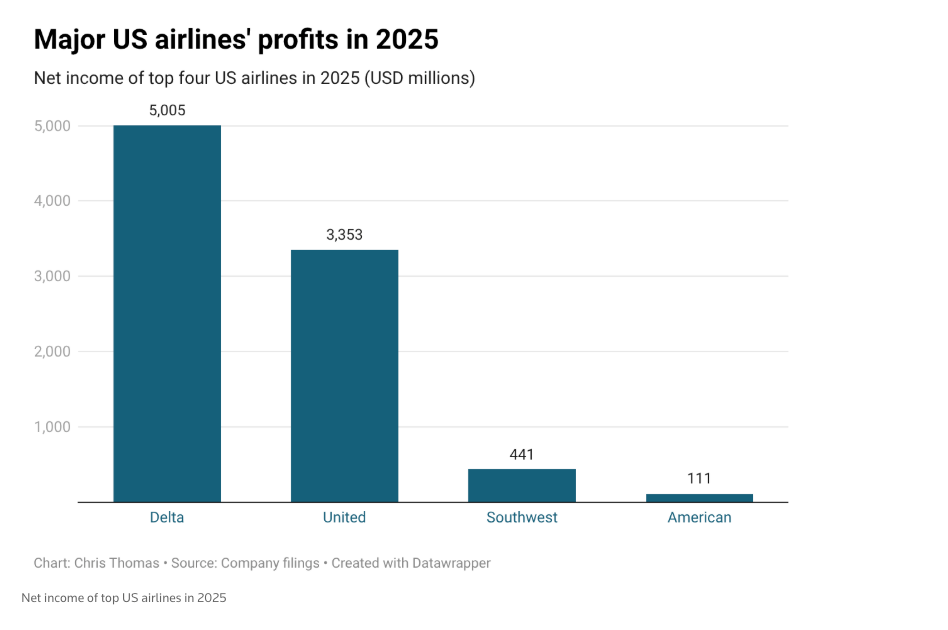
United Airlines CEO Scott Kirby floated the idea of merging with American Airlines during a White House meeting with President Trump in late February, according to Reuters. The meeting took place on February 25, three days before the Iran war began. It would be the largest airline consolidation in more than a decade and would create the biggest carrier on the planet. The two airlines already rank as the world's largest by available capacity. Together, they control more than a third of the US market. The domestic industry is already highly concentrated, with American, Delta, United, and Southwest each holding roughly 17% of traffic. The pitch comes as American struggles financially. The carrier earned just $111 million on $54.6 billion in revenue last year. United earned $3.35 billion on $59.1 billion. American carries about $25 billion in long-term debt, more than its larger rivals, and its net debt-to-EBITDA ratio sits at 6.23 compared to 1.61 for United. Analysts expect American to lose $147 million this year. Kirby has been candid about the gap. In a memo last month, he noted that United and Delta represented 100% of total US industry profitability in 2025. He said high oil prices put more stress on weaker rivals and that United could use any shakeout to buy assets or absorb network changes. There is also a personal dimension. Kirby served as American's president from 2013 to 2016 but left after it became clear he would not become CEO. He joined United as president and rose to the top job. Regulatory approval remains a long shot. Transportation Secretary Sean Duffy said last week there may be room for aviation mergers but warned that any large deal would face close scrutiny and might require asset divestitures. The JetBlue-Spirit merger was blocked on antitrust grounds in 2024. Industry officials cited concerns over route overlap, job losses, and higher fares in an already concentrated market. American shares rose about 5% on the news. United climbed roughly 2%. Both stocks have slid since the Iran war began, with American down 14% and United off 10% as jet fuel costs surged. |
Global Economy Teetering on the Brink of Recession According to the IMF
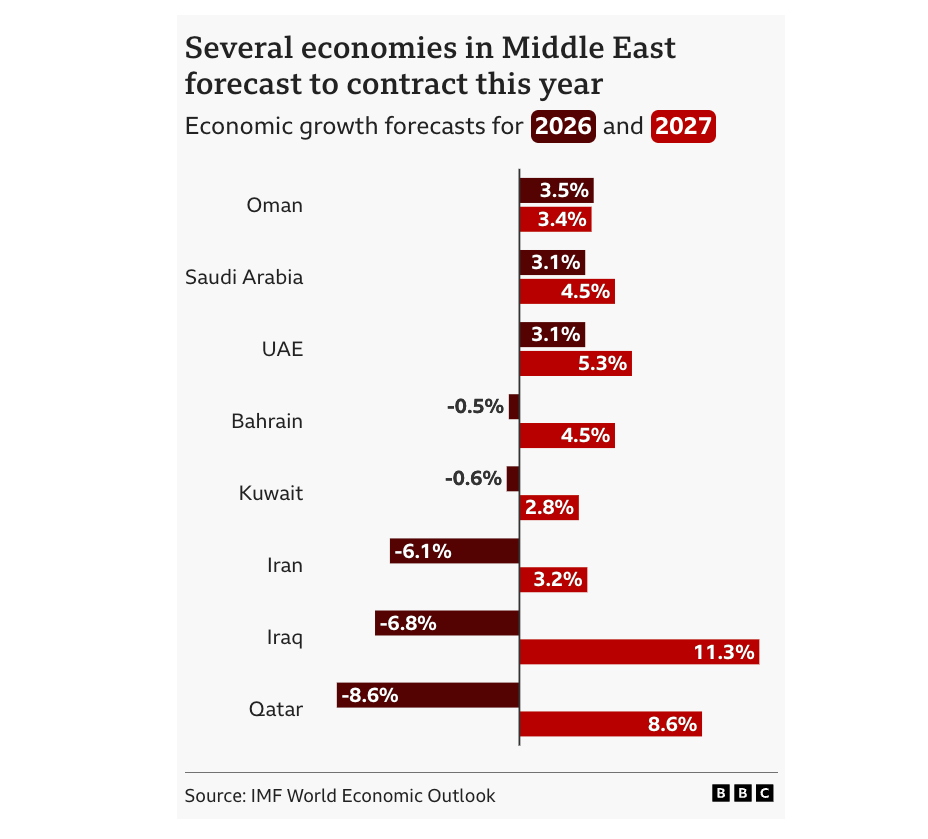
The International Monetary Fund cut its global growth forecast on Tuesday and warned that the world economy could slip into recession if the Iran war persists and oil prices remain elevated. In its World Economic Outlook, the fund presented three scenarios. Even the most optimistic one shows damage already done. Under the IMF's baseline assumption, which requires a short-lived conflict and energy markets normalizing by mid-year, global growth falls to 3.1% in 2026, down from 3.3% forecast in January. Absent the war, the IMF said it would have upgraded its forecast to 3.4%. The numbers get worse from there. An "adverse scenario" with oil prices averaging $100 per barrel this year would drag growth down to 2.5%. A "severe scenario" with prices hitting $110 this year and $125 in 2027 would cut growth to just 2.0%, a threshold the world has only crossed four times since 1980. The last two were the global financial crisis and the pandemic. The inflation picture is equally grim. Under the severe scenario, global inflation would top 6%, forcing central banks to raise interest rates even as growth weakens. IMF chief economist Pierre-Olivier Gourinchas warned that prolonged high oil prices could shift inflation expectations, requiring "more pain than in 2022" to bring prices back under control. The damage is not evenly distributed. The UK faces the sharpest downgrade in the G7, with growth slashed to 0.8% from a January forecast of 1.3%. The US forecast fell to 2.3%. China's outlook dropped to 4.4%. The Middle East takes the heaviest blow: Iran's economy is expected to contract 6.1%, Qatar 8.6%, and Iraq 6.8%. One country benefits. Russia's growth forecast was revised up to 1.1%, helped by higher oil prices and the temporary lifting of US sanctions on some Russian oil sales. Gourinchas put the stakes plainly: "The downside risks are tremendous." Even if the war ends quickly, the economic damage is locked in. And if it does not, the fund warned, the world faces an energy crisis "on an unprecedented scale." |
That’s all for today!/
