Welcome to a weekend with FinSoar. This week remembers SpaceX as the biggest IPO in history, with Elon Musk to become a trillionaire, Oracle’s unchecked AI spending underwhelms investors, and we’re met with the usual Schrödinger’s Iran deal, which is, and isn’t:
SpaceX Prices the Biggest IPO in History at $1.77 Trillion
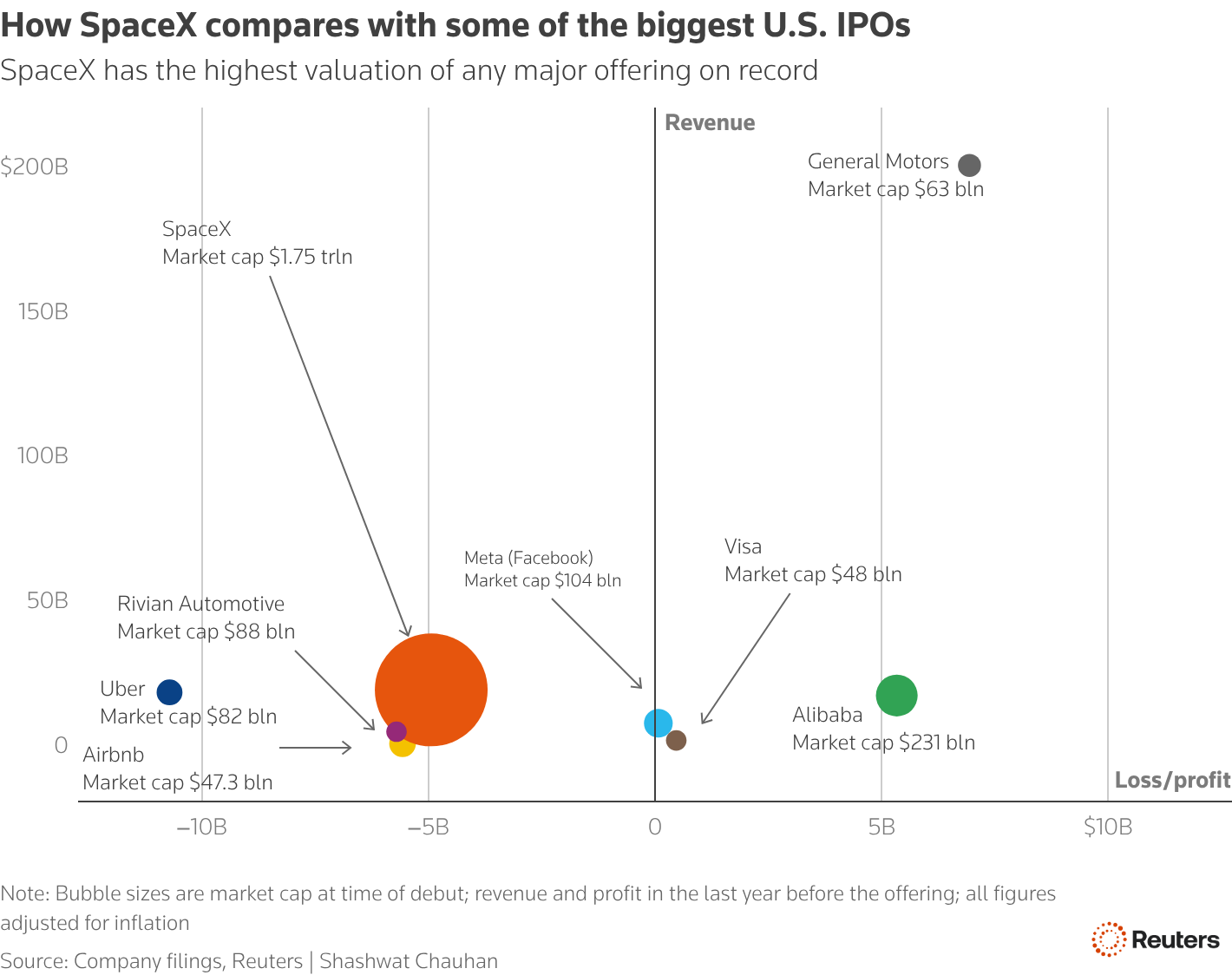
SpaceX priced the largest IPO ever on Thursday at $135 per share, raising a record $75 billion and valuing Elon Musk's rocket and satellite company at $1.77 trillion. The sale of 555.56 million shares makes SpaceX the seventh most valuable US-listed firm, ahead of JPMorgan, Berkshire Hathaway, Meta, and Musk's own Tesla. Shares begin trading on the Nasdaq on Friday under the ticker SPCX. The deal shatters the previous record. Saudi Aramco's 2019 listing raised $29.4 billion. SpaceX's offering was oversubscribed three to four times, drawing more than $250 billion in bids, with 30% of shares set aside for retail buyers. The IPO also made Musk the world's first trillionaire. His SpaceX stake is worth roughly $866 billion, and combined with Tesla and his other ventures, his net worth will exceed $1.1 trillion when trading begins. Musk ran the process on his own terms. He announced the price before the roadshow, bypassing the traditional price-discovery process, and communicated it while markets were still open. He will hold 82% of voting power despite owning 42% of equity. The governance structure alarmed pension fund managers. New York and California fund officials warned in a May letter that removing Musk would "require his own vote, essentially making him unfireable." The valuation has drawn sharp skepticism. Morningstar values SpaceX at just $63 a share, a 53% discount to the IPO price, warning of "a major disconnect between market expectations and underlying fundamentals." SpaceX posted a $4.9 billion net loss in 2025 on $18 billion in revenue. At $1.77 trillion, it trades at roughly 92 times trailing sales. Most of that revenue rests on Starlink, its satellite internet unit with more than 10 million subscribers. The index dynamics create forced demand. Nasdaq's rule change could admit SpaceX in 15 trading days, meaning passive funds tracking the index must buy regardless of price. The debut is also a referendum on Musk himself. Renaissance Capital's Angelo Bochanis told NPR that buying the deal "is in part a bet on Elon Musk," whose attention is "very much divided." For everyday investors, the warning from Renaissance is simple: anything less than a 10% first-day pop disappoints; more than 50% means it is trading on pure hype. |
Oracle's Worst Run in 25 Years on AI Spending Fears
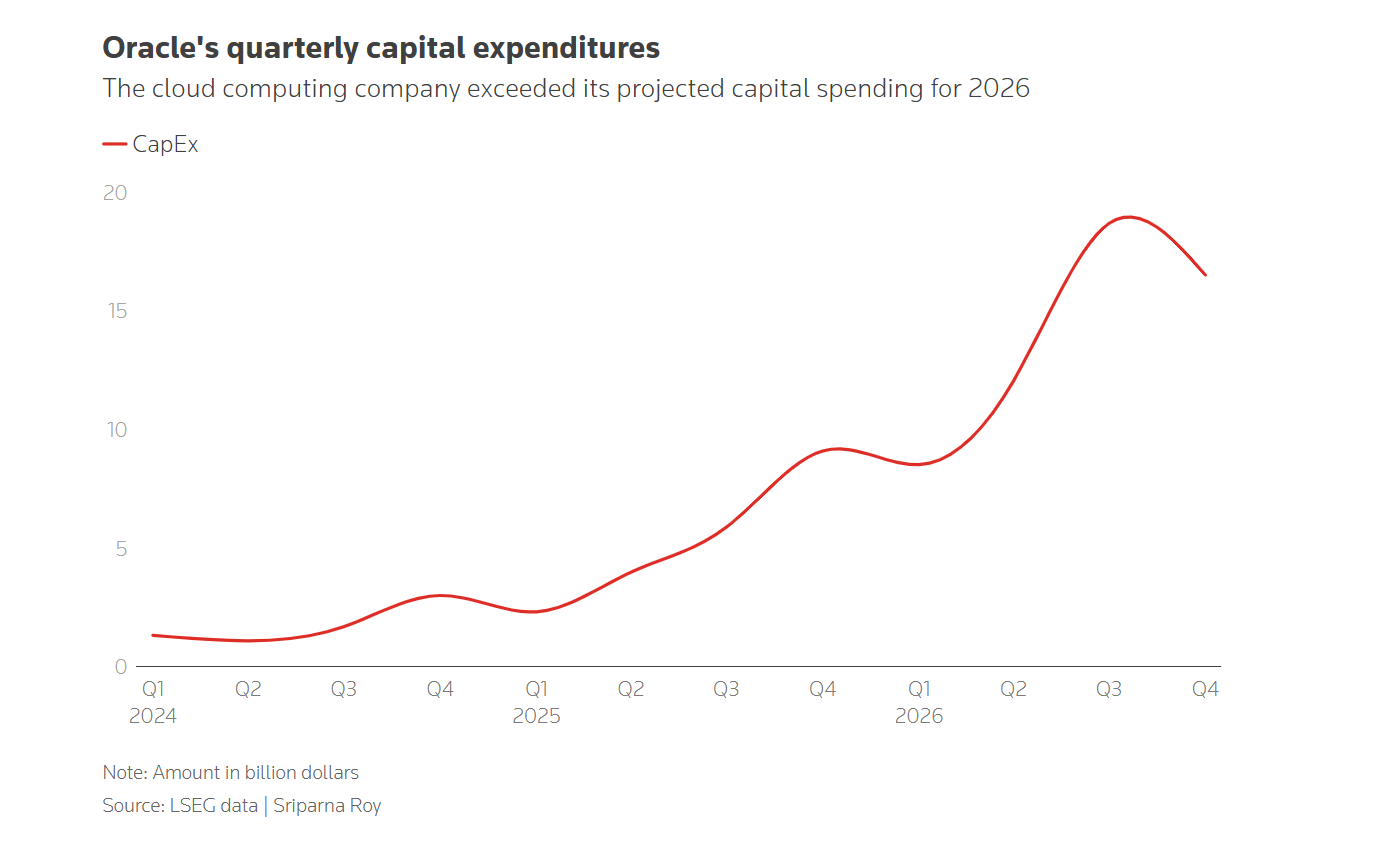
Oracle shares plunged in their sharpest decline since 2001, as a $95 billion spending plan and questions about converting its AI backlog into revenue rattled investors. The stock fell roughly 8.5% on Thursday, putting it on track to fall 25% over five sessions. Oracle reported $19.2 billion in revenue, up 21% year over year, beating estimates, with adjusted EPS of $2.11 against $1.96 expected. Cloud infrastructure revenue jumped 93% to $5.8 billion. The remaining performance obligations, a key measure of contracted future revenue, skyrocketed to $638 billion, with $85 billion in net new additions. The spending is what spooked the market. Oracle reported $55.7 billion in capital expenditures for fiscal 2026, about $5 billion above estimates, and guided to up to $95 billion in fiscal 2027 capex. CFO Hilary Maxson said $70 billion of that would be Oracle's own net outlay, with $20 billion to $25 billion expected to be repaid by customers. The company plans to raise nearly $40 billion in debt and equity financing in 2027, deepening negative free cash flow. Oracle reaffirmed its $90 billion revenue target for fiscal 2027 rather than raising it, which disappointed some investors. Morgan Stanley flagged a mismatch between how fast Oracle is spending on physical infrastructure and how slowly that turns into recognized sales. For the quarter ending in February, Oracle logged $261 billion in leases not yet commenced, the largest backlog of any hyperscaler, indicating a massive construction queue before revenue can be booked. The pain hit Larry Ellison directly: the Oracle chairman saw his net worth fall nearly $50 billion in roughly a week. Not everyone is bearish. Guggenheim's John DiFucci, who has a $400 target, wrote the stock fell "for no apparently good reason" and called Oracle his "Best Idea," with free cash flow expected to rise substantially from fiscal 2029. Oracle delivered 1.2 gigawatts of data-center capacity in fiscal 2026 and is approaching 1 gigawatt in Q1 2027 alone. Its Stargate data center in Texas, built with OpenAI, will be more than three-quarters complete within 90 days. The question Wall Street is now pricing is whether Oracle can clear the construction queue and convert that $638 billion backlog into cash before the debt load and margin pressure catch up. |
Trump Says a Deal is Near, Iran Disagrees
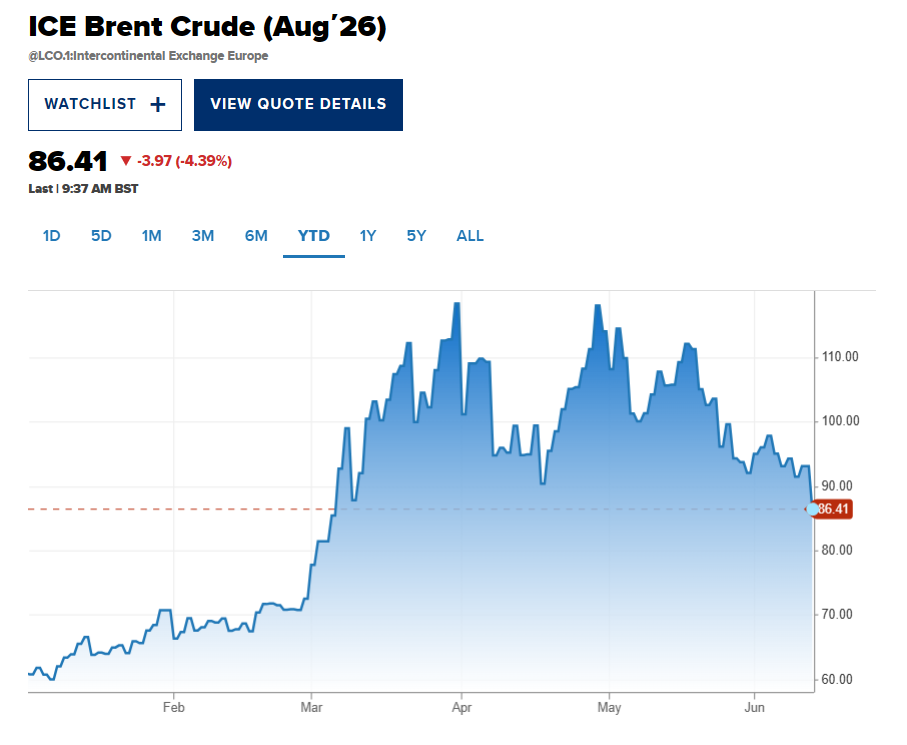
President Trump claimed on Thursday that the US had reached a framework agreement to end the three-month Iran war, sending oil to two-month lows and stocks higher, even as Tehran said no final decision had been made. Trump said an agreement could be signed "maybe over the weekend" and that the Strait of Hormuz would reopen as soon as it was signed. This is a pattern. Trump has said more than 30 times since the war began February 28 that a deal is close. The markets moved fast on the news. US crude futures fell 1.61% to $86.30 per barrel, with Brent down 1.75% to $88.80. Asian and global stocks rallied. Tehran was quick to temper expectations. Foreign Ministry spokesman Esmaeil Baghaei said large parts of the text were finalized but that "Iran has not yet reached a final conclusion." State outlet Fars characterized Trump's move as a tactical retreat, saying it was the US that had returned to Iran's previously submitted text. The deal terms remain contested. Trump insists any agreement must bar Iran from developing nuclear weapons, which Tehran denies pursuing. Iran's demands include lifting sanctions, releasing frozen assets, and recognition of its control over the Strait of Hormuz. A diplomat briefed on the talks told the Guardian the deal was largely agreed weeks ago but still had a "50% chance" of collapsing. The announcement reversed a dramatic escalation. Hours earlier, Trump had vowed to hit Iran "VERY HARD TONIGHT" and threatened to seize Kharg Island, which handles about 90% of Iran's oil exports. The week was the most intense combat since April's ceasefire, with the US striking air defense sites across Iran while Iran targeted five US bases in Kuwait, Bahrain, and Jordan. US forces disabled three commercial tankers near the strait, with India confirming three of its nationals were killed on one vessel. The political stakes are driving the urgency. The war has become a White House headache, with Trump's approval sinking amid voter anger over high gasoline prices, and some Republicans fearing the war's unpopularity could cost them Congress in November. The oil market's restraint is notable — BMO Capital Markets and Citi both noted prices have stayed surprisingly contained through the strikes, helped by alternative shipping routes and sharply lower Chinese crude imports. The naval blockade stays in place until any deal is finalized. With Iran disputing the terms, drones still flying over Hormuz, and a 50% collapse risk on the table, the gap between Trump's announcement and an actual signed agreement remains the whole story. |
That’s all for today!/
