In partnership with

Hi there!
Welcome to FinSoar! This week I’m looking at escalating tension between the U.S., Israel, and Iran amid escalating gas, and oil prices, the use of AI in warzones, and sliding aviation stocks in the aftermath of the middle-eastern conflict:
Iran War Chokes Oil Supply as Strait of Hormuz Shuts
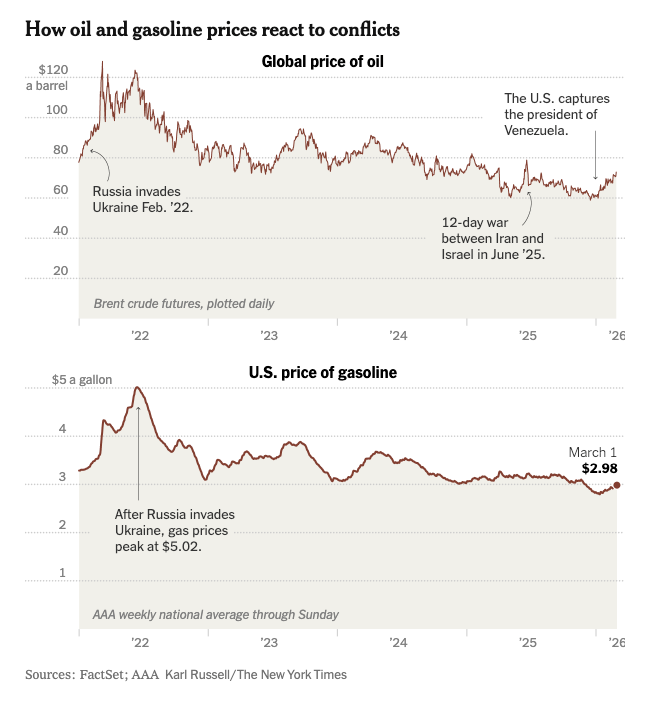
The Strait of Hormuz, which carries 20% of global oil and a fifth of seaborne LNG, has effectively shut down following US-Israel strikes on Iran. Brent crude briefly surged above $82 per barrel on Monday before settling around $77, up about 6%. Oil had already climbed 17% this year amid escalating tensions. Iran has not formally closed the strait, but threats to shipping effectively did so. Insurance companies have stopped covering vessels in the Persian Gulf. The cost of hiring a supertanker to move oil from the Middle East to China hit a record $423,736 per day on Monday, nearly double last week's price. QatarEnergy, which supplies 20% of global LNG, halted production Monday after drone attacks on facilities at Ras Laffan and Mesaieed. European gas prices jumped 41% to €45 per megawatt hour. UK gas surged 40% to 110p per therm, doubling since Friday and hitting three-year highs. Saudi Arabia shut units at Ras Tanura, the kingdom's largest refinery processing 550,000 barrels daily, after intercepting two drones. ICE gasoil futures surged more than 20%, the biggest jump since March 2022. Trump said the conflict could last four weeks, adding "whatever the time is, it's OK." Analysts warn oil could hit $100 per barrel if disruptions persist. Every $10 increase in oil adds roughly 25 cents per gallon at US pumps. Stock markets tumbled globally. The FTSE 100 fell 2.6%, Germany's DAX dropped 3.6% and France's CAC-40 slid 2.9%. Japan's Nikkei closed down 3.1% while South Korea's Kospi, shut Monday for a holiday, plunged 7.2% Tuesday. US markets initially dropped but ended Monday higher as investors bet on a brief disruption. The conflict poses stagflation risks. Every $10 rise in oil can add 0.4 percentage points to inflation and reduce global GDP growth by 0.3 percentage points. Bank of England rate cut odds fell to 29% from 80% last week. India faces particular vulnerability, importing 85% of its oil with half transiting through Hormuz. Asia accounts for nearly 70% of crude shipments through the strait. China, which buys 90% of Iran's 1.7 million barrels daily, faces scrambling for replacement supplies. |
Pentagon Forces AI Into War as Anthropic Refuses, OpenAI Complies
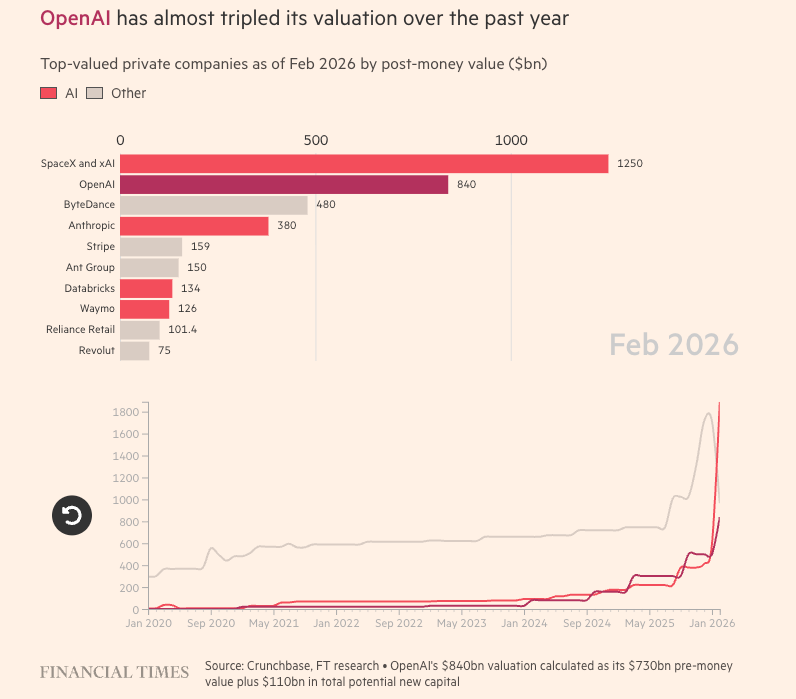
The Pentagon cornered AI companies into military use ahead of Iran strikes. Anthropic refused to remove safety guardrails preventing its Claude model from being used for domestic mass surveillance and autonomous weapons. Trump called the company "left-wing nut jobs" and ordered federal agencies to stop using Anthropic. Defense Secretary Pete Hegseth designated Anthropic a "supply chain risk," blocking military contractors from any commercial activity with the company. OpenAI quickly filled the gap. CEO Sam Altman announced on Friday that his company struck a deal with the Pentagon, claiming it included the same safeguards Anthropic wanted. But OpenAI's agreement permits "all lawful uses" of its tech, simply citing existing laws rather than establishing independent red lines. A legal expert wrote that the contract "does not give OpenAI an Anthropic-style, free-standing right to prohibit otherwise-lawful government use." Altman admitted on Monday the deal was "opportunistic and sloppy," announcing OpenAI would explicitly bar its technology from being used by intelligence agencies like the NSA. ChatGPT uninstalls surged 295% Saturday as users boycotted. Anthropic's Claude climbed to No. 1 on Apple's App Store, with free active users up over 60% since the year's start. Nearly 900 employees at OpenAI and Google signed an open letter opposing the Pentagon's demands. "They're trying to divide each company with fear that the other will give in," the letter reads. The US military had already deployed AI systems during operations. Anthropic's Claude was reportedly used in Iran strikes as the technology "shortens the kill chain." The Guardian reported that the US and Israel launched almost 900 strikes on Iranian targets in the first 12 hours. Craig Jones at Newcastle University said that "the AI machine is making recommendations for what to target, which is actually much quicker in some ways than the speed of thought." Israeli forces have used AI systems, including "Lavender," "The Gospel," and "Where's Daddy?" to generate kill lists of Palestinians in Gaza. Claude was also used during the January raid that abducted Venezuelan President Nicolas Maduro. Intriguingly enough, AI favors nuclear escalation in simulations. A King's College London study found ChatGPT, Claude, and Gemini deployed nuclear weapons in 95% of 21 scenarios. Claude had the highest win rate at 67%. When enemies used nukes, opponents de-escalated only 25% of the time. Study author Kenneth Payne said AI already shapes discussions among human strategists. Elon Musk's xAI signed an agreement allowing military use of its Grok model in classified systems. |
Airlines Grounded as Iran War Sends Travel Stocks Plunging
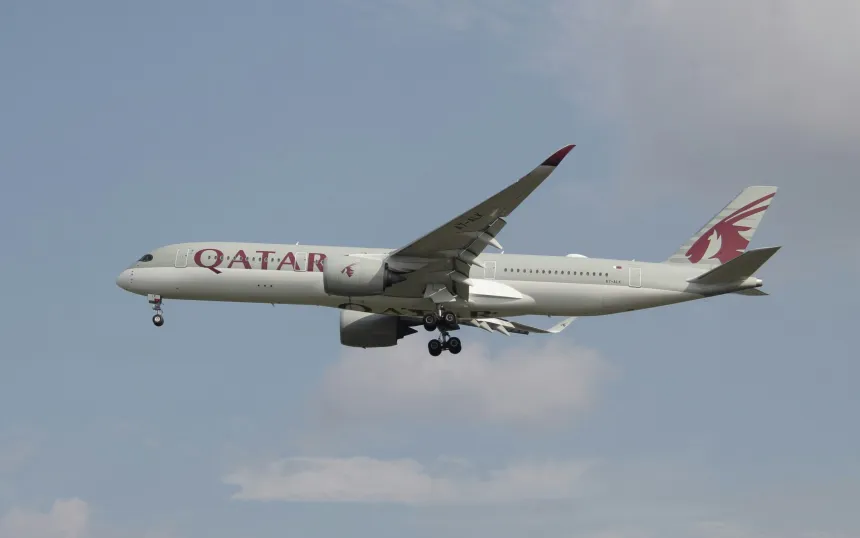
More than 11,000 Middle East flights were cancelled since the US-Israeli strikes, sending airline stocks tumbling globally. United Airlines fell nearly 5%, American dropped 5% and Delta slid 4%. European carriers saw steeper losses with Air France-KLM plunging 9%, IAG down 5% and Lufthansa off 6%. Iran, Iraq, Kuwait, Bahrain, Qatar, Israel, and the UAE all closed their airspace following retaliatory strikes. Three major hub airports in Dubai, Abu Dhabi, and Doha halted operations after sustaining damage from attacks. The closures created ripple effects worldwide since Qatar Airways, Etihad, and Emirates operate hubs connecting passengers to destinations globally. Asian carriers saw similar declines on Monday. Singapore Airlines fell 4.5%, Qantas dropped 5.4%, Japan Airlines lost 5.6% and Cathay Pacific slid 2.8%. Singapore Airlines cancelled 16 flights between Singapore and Dubai through March 7. Budget subsidiary Scoot suspended flights to Saudi Arabia's Jeddah. Rising fuel costs pose the bigger threat. Oil jumping 6.7% Monday means jet fuel prices will surge, hitting airlines' biggest cost after labor. United, which has the most international exposure among US carriers, halted service to Tel Aviv, one of its most profitable routes. The airline warned flights to Abu Dhabi, Beirut, Dubai, Erbil, and Tel Aviv may face disruption through March 31. Delta cancelled New York to Tel Aviv flights through March 9. The disruption comes as international travel had been a bright spot. January international air demand jumped 5.9% year-over-year, while domestic flight demand stayed nearly flat. Cruise operators sank even harder. Norwegian Cruise Line plunged 10.5%, Carnival fell 7.6% and Royal Caribbean dropped 3.3%. Higher marine fuel costs will squeeze profits despite just 4% of Norwegian's 2024 cruises visiting the Middle East when the Israel-Hamas war erupted in October 2023. Hotel stocks also declined. Hilton fell 2.5% amid broader travel sector weakness. The duration of airspace closures and fuel price spikes will determine the ultimate damage to travel company earnings. Qantas CEO said the airline has "pretty good fuel hedging" while monitoring price spikes. But prolonged disruption could overwhelm protective measures. Flights began departing some Middle East airports on Tuesday, though travel chaos is expected to persist for days, if not longer. |
What If You Didn't Have to Push Yourself Anymore?

Imagine waking up Monday being pulled out of bed — not needing to pushing yourself out of it.
That pull isn't motivation. It isn't willpower. It's what happens when Tony Robbins conditions a different identity into your nervous system. An identity doesn't wait, doesn't hesitate, doesn't negotiate with itself.
That's what Unleash the Power Within does. It’s not inspiration. It’s Conditioning. The patterns that keep you hesitating, shrinking, and circling the same problems — Tony interrupts them at the root and installs new ones. You don't leave motivated. You leave re-wired differently.
4 days. Virtual. March 12–15. 5 million people across 195 countries have done this. It’s your time.
Save $100 by getting a ticket before March 6th. After that the price goes up. But the real cost is another year pushing instead of being pulled.
That’s all for today!
