Welcome to FinSoar! It’s an interesting day, with Alphabet fanning away sweat from investor heat on overspending even as flagship models suffer delays, new Tariffs slapped on Canadian imports, and a courtroom quarrel between Novo Nordisk and Eli Lilly:
Google Is Spending $190 Billion, and Its Best Model Is Late
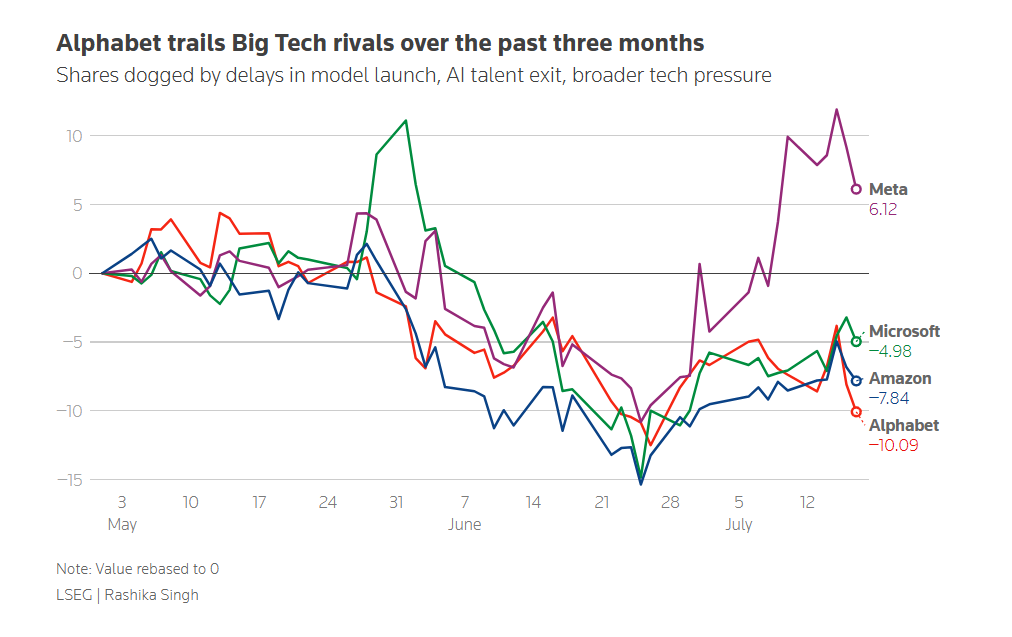
Alphabet reports second-quarter earnings this Wednesday while its flagship model is delayed, the capex is enormous, and rivals are pulling ahead on the one job that pays. Gemini 3.5 Pro was promised for June. It is still in testing. Bloomberg reported its coding fell short of internal targets, and Alphabet shares dropped 4% on the news. That stings, because coding is now one of the biggest paying uses of AI, and both OpenAI and Meta have shipped models that beat Google's current lineup at it. So Google shipped what it had. On Tuesday, it released three cheaper, faster Gemini models for running agents, including a security version priced to undercut Anthropic and OpenAI. The strategy is efficiency over raw power, a reasonable bet as companies cap their token budgets. Still, Google has no model in the top 10 of the Artificial Analysis leaderboard. The spending is a different problem. Alphabet lifted 2026 capex guidance to $180 billion to $190 billion and raised about $85 billion in equity, Berkshire Hathaway included. Analysts expect $117 billion in quarterly revenue, up 21%, with cloud growth near 63%. Infrastructure this expensive only pays off if enterprises standardise on Gemini, not just experiment with it. Talent has been walking out too. Gemini co-lead Noam Shazeer left for OpenAI. Nobel laureate John Jumper left DeepMind for Anthropic. The bull case is the rest of the stack. Google owns the distribution, the cloud, and the custom chips, with multi-billion-dollar TPU deals signed with Meta and Anthropic. One reported project, a Gemini-specific chip called Frozen v2, could serve six to ten times more tokens per watt than current TPUs by 2028. That news alone lifted the stock 3.7%. Alphabet is still up around 13% this year, second-best of the Magnificent Seven. The model is late. The bet is that owning everything underneath it buys enough time. |
Novo Takes the Weight-Loss War to Court
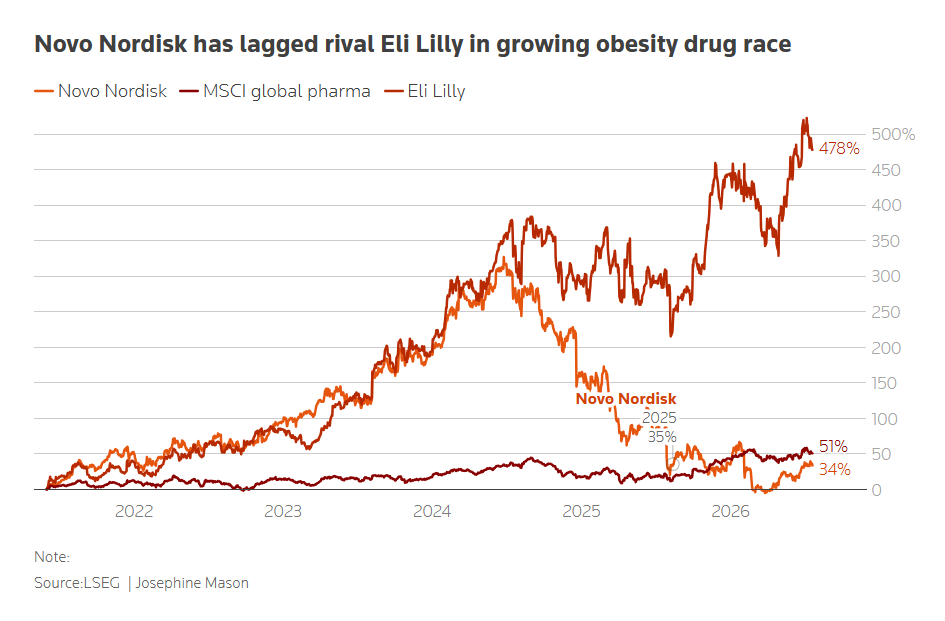
Novo Nordisk has sued Eli Lilly, accusing its rival of running deliberately false ads about which company's weight-loss drugs work better. The complaint landed in a New Jersey federal court. The dispute is about doses. Lilly's ads lean on its Surmount-5 trial, which pitted the highest doses of Zepbound against 1.7mg and 2.4mg of Wegovy and produced a tidy 50-pounds-versus-33-pounds comparison. That trial finished in 2024. In March, the FDA approved a 7.2mg dose of Wegovy, and a later study showed that dose losing about 47 pounds on average. Novo's argument is that no head-to-head trial has ever compared the two drugs at their highest doses, so the ad's superiority claim is stale. Novo sent a cease-and-desist letter in April. Lilly did not respond, general counsel John Kuckelman said, and instead added a disclaimer he called virtually illegible. The scale matters here. The Zepbound campaign has racked up more than 700 million impressions since late April. Lilly is unmoved. It calls its head-to-head trial the gold standard for comparing medicines and frames the suit as Novo asking a court to silence real results rather than compete on the products. Novo wants the ads pulled, a corrective campaign, and any profits Lilly made from them. If Lilly does not comply within days, Novo says it will seek an injunction. Lilly shares rose 1.4% on the news; Novo slipped 0.4%. Over the past year Lilly is up 52% and Novo is down 24%. Novo led first on injectables, lost that lead, and has since clawed back ground in pills. The courtroom is where you fight when the ad break is not going your way. |
Trump Reaches for a 1930 Law to Hit Canada
Trump signed three proclamations imposing a 50% tariff on a wide range of Canadian goods. Wine, hockey sticks, cement, dairy, plywood, and furniture are all in scope. The duties take effect in 30 days, which leaves a negotiating window before anything bites. The legal route is interesting. After the Supreme Court struck down his emergency-powers tariffs in February, the administration went looking for other authorities. This time it used Section 338 of the Tariff Act of 1930, a Smoot-Hawley-era provision that lets the president tax imports from countries found to discriminate against US commerce. One law firm found no public record of its use since 1949. A trade lawyer told the NYT it is broad but completely untested, and will be challenged in court. The stated grievances are cars, dairy, and alcohol. Canada taxes some US vehicles, caps others, limits American cheese, and most provinces pulled US liquor from shelves last year. The duties cover roughly $20 billion in annual imports. For energy markets, what matters is what does not get hit. The tariffs exclude energy products, potash, certain fish, and critical minerals. Those exemptions spare Canada's most strategically important exports and limit the fallout for US industry. The break with precedent is elsewhere: unlike earlier rounds, these duties apply even to goods covered by USMCA, the pact Trump signed in 2018. Mark Carney called it a direct violation of that agreement and said Canada stands ready to intensify talks. Ontario's Doug Ford was blunter, calling for tariff for tariff, dollar for dollar. |

That’s all for today!/
