Hi there!
Welcome to FinSoar. The promised November jobs report is almost with us, Ford has lost billions in the EV market, and things might be looking up for the cannabis industry. Take a whiff of this:
The Jobs Report Nobody Trusts: America's 43-Day Data Blackout
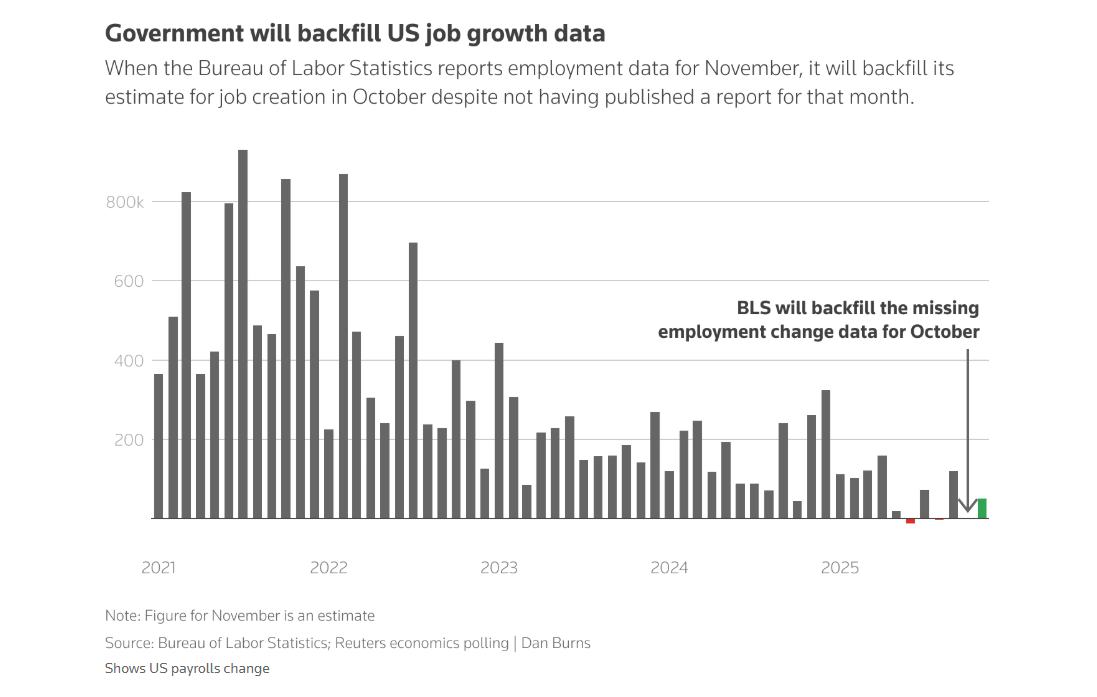
The Labor Department releases the November jobs report on Tuesday, 11 days late and riddled with gaps after the 43-day government shutdown prevented data collection. Economists expect 40,000 to 50,000 jobs added in November, down sharply from 119,000 in September. October's picture is worse. There will be no unemployment rate for October, marking the first time since 1948 that the government failed to publish the jobless rate. The household survey that calculates unemployment couldn't be conducted during the shutdown. October payrolls likely declined, with some economists predicting losses as steep as 100,000 jobs. What's the culprit? More than 150,000 federal workers who took DOGE buyouts dropped off payrolls at the end of September. Wells Fargo expects federal employment to decline by roughly 125,000 in October. Powell warned last week that the job market is weaker than it appears. He suspects government data overstates hiring by 60,000 jobs per month, meaning employers haven't been adding jobs at all. "It's a labor market that seems to have significant downside risks," Powell said. The November unemployment rate is expected to hold at 4.4%, but some economists estimate October's rate would have jumped to 4.6% to 4.7% had it been measured. Data quality remains questionable. The BLS extended collection periods and allocated extra processing time, but Powell said the data "may be distorted" and officials must view it "with a somewhat skeptical eye." Markets braced for impact. Asian shares tumbled on Tuesday, with Tokyo's Nikkei falling 1.6%. US futures slipped, with the Dow down 0.13% and S&P 500 down 0.19%. Thursday brings another incomplete puzzle: the November CPI report will exclude October headline numbers because price data couldn't be collected during the shutdown. |
Ford's $19.5 Billion Surrender
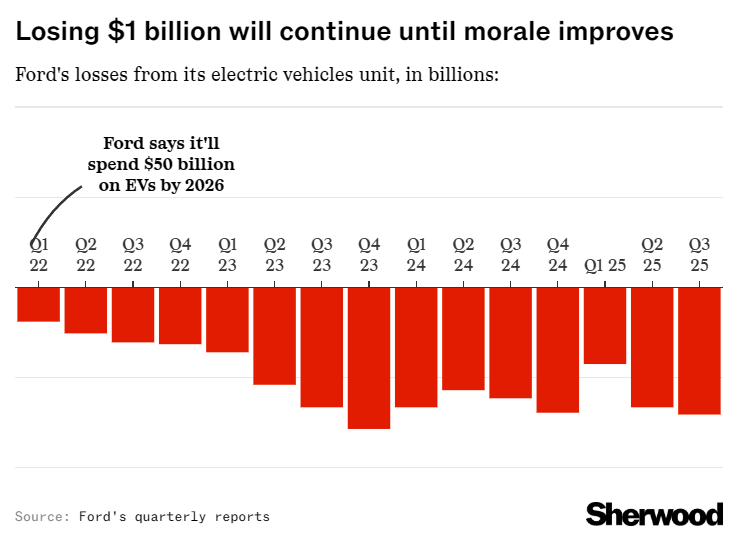
Ford announced on Monday that it will take a $19.5 billion writedown as it abandons large electric vehicles, marking the most dramatic retreat from EVs in auto industry history. The F-150 Lightning is dead, replaced with an extended-range electric model using a gas generator for a 700-mile range. The writedown breaks down to $8.5 billion for cancelled EV models, $6 billion for dissolving its SK On battery partnership, and $5 billion in program expenses. Ford's Model e division lost $3.6 billion in the first three quarters of 2025 alone, on top of $13 billion in losses over the past two years. November EV sales plunged 61% to just 4,247 units. F-150 Lightning sales collapsed 72% between November 2024 and November 2025. CEO Jim Farley told Bloomberg: "It was really the customer changing their decision." Trump's policies devastated the market. The $7,500 EV tax credit expired September 30, causing US EV sales to plunge 40% in November. Trump loosened fuel economy rules earlier this month, which Farley celebrated as "a victory of common sense." The US EV market share dropped from 12% to 5%, Farley said. North American EV sales fell 1% this year while global sales rose 21%. China sold 11.6 million EVs, Europe sold 3.8 million, and North America sold just 1.7 million. Price remains a barrier. Average US EV transaction price hit $57,000, 16% above the overall car average. The cheapest US battery car, a Nissan Leaf, costs $30,000. UK buyers can find EVs under £20,000. Ford is pivoting hard to hybrids. The company expects 50% of global volume to be hybrids, EREVs, and EVs by 2030, versus 17% today. Farley said November hybrid sales jumped 30%. Ford is repurposing Kentucky and Michigan battery plants to build energy storage systems for AI data centers, with initial capacity online within 18 months. At least 1,600 battery plant jobs will be cut, though 2,100 could be added over time. Ford raised 2025 EBIT guidance to $7 billion from $6-6.5 billion on strong gas truck sales. The company expects Model e to be profitable by 2029. GM took a $1.6 billion charge in October for similar EV cutbacks. |
Trump's Weed Pivot: The $28 Billion Industry That Can't Bank
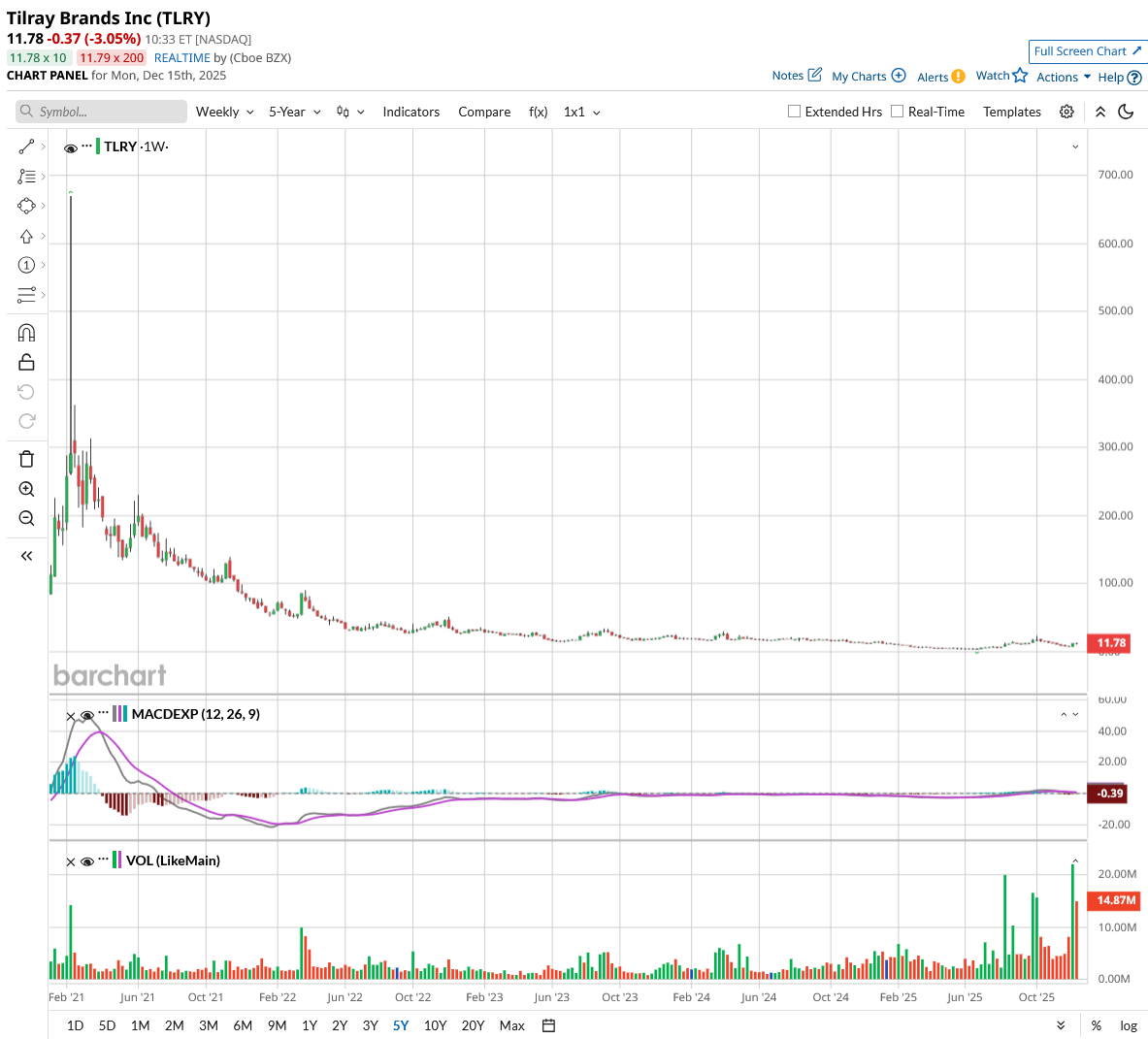
Trump confirmed Monday he's considering an executive order to reclassify marijuana from Schedule I (same as heroin) to Schedule III (same as steroids and Tylenol with codeine). "A lot of people want to see it," he said, "because it leads to tremendous amounts of research that can't be done unless you reclassify." Cannabis stocks exploded 50%+ on Friday on the news, then crashed back to earth on Monday. Tilray surged 31% on Friday, Canopy Growth jumped 23%, only to fall 10% and 4.6% respectively Monday as investors took profits. The Amplify Seymour Cannabis ETF hit its best day on record Friday, then dropped 7% Monday. The shift wouldn't legalize marijuana federally. More than 40 states allow medical marijuana, while about half allow recreational use. But federal Schedule I status means companies can't deduct operating expenses under IRC Section 280E. They must pay federal income taxes without standard deductions. Federal restrictions keep most banks and institutional investors out of the sector, forcing producers to turn to costly loans or alternative lenders. Customers can't use credit cards. Trump discussed the plan with RFK Jr., Mehmet Oz, and Mike Johnson in a Wednesday call. Johnson was skeptical, citing studies and data against reclassification. Trump turned the phone over to industry executives who rebutted Johnson's arguments. Meanwhile, Congress just killed the industry's other revenue stream. The spending bill that ended the shutdown criminalized hemp-derived THC products, reversing the 2018 Farm Bill loophole. The national intoxicating hemp market is worth $28 billion, with 300,000 jobs created since 2018. The ban includes a one-year implementation delay, giving Congress time to walk it back. Several states use hemp taxes to fund addiction services and public health programs. Missouri estimated that over 40,000 businesses sell products that would be banned. Biden's Justice Department recommended Schedule III reclassification in 2024, but the DEA review stalled. A White House official said on Monday that no final decisions have been made. |
That’s all for today!
